Short answer: your hands get you about 80% of the way there, for free. Wool feels dry, springy and slightly warm; polyester feels slick and cool for a second, then hot and clammy. Wool crushed in a fist relaxes back out; polyester either holds a hard crease or refuses to crease at all. Wool scatters light in a broken sheen; cheap polyester glints flat. What your hands cannot resolve is the last 20% -- the gap between "mostly wool" and "a wool blend with a lot of polyester in it". For that you need the fibre-content label, which is not optional in the US or EU, and a straight answer before anyone cuts.
I am Jay. I spent about ten years in the US -- Pennsylvania, New York, Houston -- buying suits badly, came to Hoi An as a customer of Nathan Tailors about a year ago, and liked it enough to become a partner. I now stand next to Linda, born here, 25 years at the cutting table, while she rubs a corner of cloth between finger and thumb and names it before anyone reads the ticket. The loudest complaint about tailoring here is not fit and not price. It is fibre content.
How do you tell if a suit is real wool or polyester?
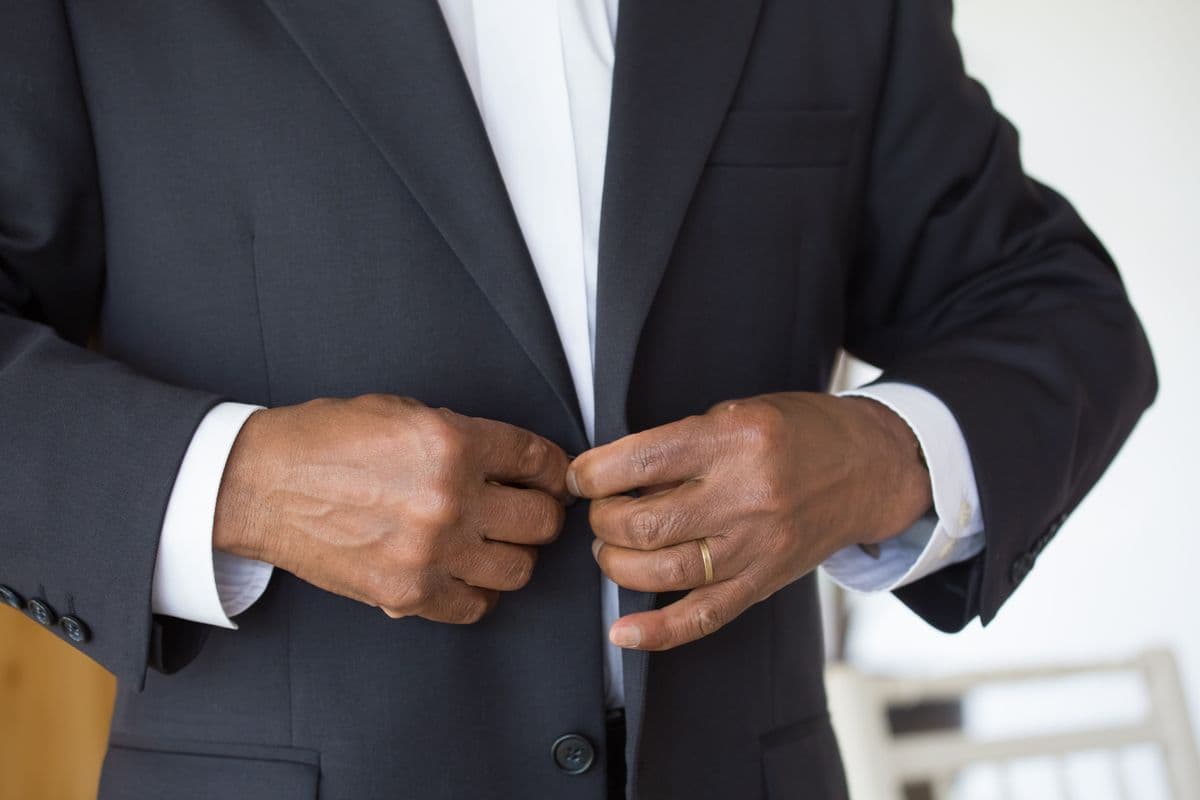
Hand and warmth. Hold a fold flat in a closed hand for fifteen seconds. Wool warms gently and lets go dry. Polyester feels cool at first touch, then warm and sticky -- which is why cheap suits are unwearable in summer. One buyer described a budget suit in three words: "it feels like plastic".14 Compare against a cloth you already trust.
Scrunch and release. Ball a fistful, hold ten seconds, let go. Wool's fibre is a natural coil, so most of the wrinkle falls out within a minute or two. High-polyester suiting either springs back instantly and completely or takes a sharp crease and keeps it. Too perfect is a real signal.
Tilt it to the light. Wool scatters light and the sheen breaks up across the weave; cheap polyester reflects like a sheet. That is the property behind the words that recur in budget-suit reviews -- "literally a translucent suit" fit for "costume purposes",18 or "feels like wearing a cheap Halloween costume".12 But shine is a finish as much as a fibre: a hard-finished worsted throws plenty of light, a matte polyester can look dull. Same with scratchiness -- "the material feels cheap and scratchy" is a common review line,11 and it identifies fibre diameter, not fibre type.
The burn test: what it proves and what it does not
A commenter under a video about four Vietnamese tailors gives the classic version: "a synthetic will melt and a natural will go to ash."7 That is right. Wool is protein -- it curls from the flame, smells of burning hair, self-extinguishes, leaves crushable ash. Polyester is plastic -- it shrinks, melts, drips, and leaves a hard bead you cannot crush. Three things almost nobody adds:
- It is one-directional. A bead proves synthetic is present, not whether that is 10% or 70%. A wool-polyester blend -- exactly what you are hunting -- burns like hair and beads. It catches a lie about "all wool"; it never confirms a claim of pure anything.
- It tests one component. Warp and weft can differ; shell, lining and interfacing almost always do. A top comment on a first-suit buying guide: "make sure your first suit doesn't have a polyester lining. They don't breathe, heat up and you end up stinking and sweaty."17
- Safety. Molten polyester is sticky, drips, and keeps burning on skin. Fingernail-sized snippet, metal tweezers, ceramic dish, outdoors, never on a garment you have paid for. Many shops will say no, and that is their right.
Tests that do not work: the water drop (defeated by any modern finish), static cling, and price. Nor is the word on the tag -- of a lining described only as "satin", one commenter noted that "satin is a weave and not a material... probably means it's polyester."9 Satin, twill and sharkskin describe structure, not fibre.
What is the label legally required to tell you?
In the United States, under the Textile and Wool Acts a label must carry generic fibre names and percentage by weight in descending order. Fibres under 5% of weight generally may not be named and appear as "other fiber" -- with one loud exception in your favour: wool must always be disclosed by name and percentage, however little is present. "100%" is reserved for a single-fibre product, and every part of the statement must be in lettering of equal size and conspicuousness, so nobody can print WOOL in capitals and the polyester in mouse type.1 In the EU, Regulation (EU) No 1007/2011 requires composition in decreasing percentage order in clear, uniform lettering, and allows "100%", "pure" or "all" only for cloth of one fibre and nothing else.2
Two consequences. A garment sold in the US or EU with no fibre-content label is a red flag by itself. And -- the one that matters 9,000 miles from home -- a bolt of cloth on a shelf in Hoi An or Bangkok is not a labelled retail garment, so none of those rules run in the room. A viewer asked it directly under a Thailand tailoring video: "some tailors... sell suits that pretend to be made from high-quality fabrics, but are actually a budget polyester blend. How can I protect myself?"10 Get the composition in writing before anyone cuts. A shop that will type "55% polyester, 45% wool" into a message is telling the truth. A shop that will only say "wool, very good quality" is answering a different question on purpose.
What does "cashmere wool blend" mean at a tailor?
Usually less than you think. The US rule is specific: cashmere must be fine dehaired undercoat of the cashmere goat, averaging no more than 19 microns, with no more than 3% by weight above 30 microns -- and a named specialty fibre must carry its percentage.1 The decoder:
| What you are told | What it means | What to ask next |
|---|---|---|
| "Wool blend" | Some wool plus something else -- very often polyester. The ratio is the whole story. | "What are the exact percentages, in order?" |
| "Wool-cashmere" | Some share is cashmere. Could be 90/10. Could be 98/2. | "What percentage is cashmere?" |
| "Cashmere wool silk" | Three nouns, no numbers. A commenter's blunt read of it in Bangkok: "if they say cashmere wool silk = polyester."4 | "Show me the roll ticket." |
| "80% wool, 20% silk" | Honest, specific, and not cashmere: "then it's a wool-blend fabric. It's definitely not cashmere!"5 | Nothing. This is a good answer. |
| "130 gram cashmere" | Grams are cloth weight, cashmere is a fibre: "'130 gram cashmere suit' doesn't make any sense."10 | "Is 130 the weight or the Super number?" |
There is a hard economic floor under the word, too. A commenter watching a very cheap tailored suit get made did the arithmetic: "The cashmere fabric cost more than $100 a metre and you need 3 m of fabrics."8 If the finished suit costs less than its claimed cloth would, the cloth is not the cloth you were told.
Is bamboo fabric from Vietnam really bamboo?
Usually not in the way the word implies. Genuine bamboo apparel fabric is nearly always viscose (rayon) made from bamboo pulp -- a legitimate fibre, just not "bamboo" the way linen is flax. The second problem is what shoppers hit: the top-voted fabric warning under a Hoi An tailor comparison reads, "most of the time it's just cotton mixed with polyester and marketed as bamboo because it sounds eco-friendly... Always ask for the exact fabric composition before buying."3 That commenter is not running a lab, but the advice is right: the word is not the fibre; the composition is the fibre. If a shop cannot say whether its "bamboo" is viscose or a cotton-poly mix, you have learned what you needed to learn.
Does "Super 120s" tell you what the cloth is made of?
No, and this trips up careful shoppers. A Super number grades how fine the wool yarn is. It is not a fibre-content statement, and it is not among the things US or EU labelling rules require anyone to declare,12 so nothing stops a "Super 130s" ticket sitting on a blended cloth. You want both sentences; the scale is in Super 120s vs 150s. Construction is independent too: a fused chest can be cut from beautiful wool and a half-canvassed chest from polyester -- see half-canvas vs full canvas vs fused, or how Suitsupply builds its chests.
Is a polyester suit always bad?
No. It is cheap, holds a press, does not moth, and with a good fit can look fine -- one buyer wrote that his budget three-piece "looks and feels like a heavy weight gabardine even if it is only polyester".15 For one indoor event in a cold month, a polyester suit that fits beats a wool suit that does not. You are buying against three costs. Heat and smell: polyester holds no moisture, and the lining matters as much as the shell.17 The iron: in a Bangkok tailoring video the shop's pure-polyester cloth is its cheapest line, and the customer says on camera, "My last suit was polyester and I melted it when I was ironing it."6 And the gap between what you paid for and what you got: "A $99 polyester 'wool blend' suit in Thailand or Vietnam is not the same as true wool or linen."3 A five-star review titled "Gorgeous suit; no polyester junk!" opens with "I didn't want the standard polyester."16 People shop on fibre. They just cannot verify it.
What should you ask the tailor?
- "What is the exact composition, in percentages?" A real answer has numbers and adds up to 100.
- "Can you put that on the quote before you cut?" The willingness to write it down is the test.
- "What is the lining made of?" Ask separately, and ask for the fibre -- "satin" is not an answer.9
- "May I see the roll ticket?" It is the closest thing to a label a cloth room has.
Four straight answers and the rest is taste and money. Four deflections and you walk. The other trust questions travellers ask are on Hoi An questions.
What we do about this at Nathan Tailors
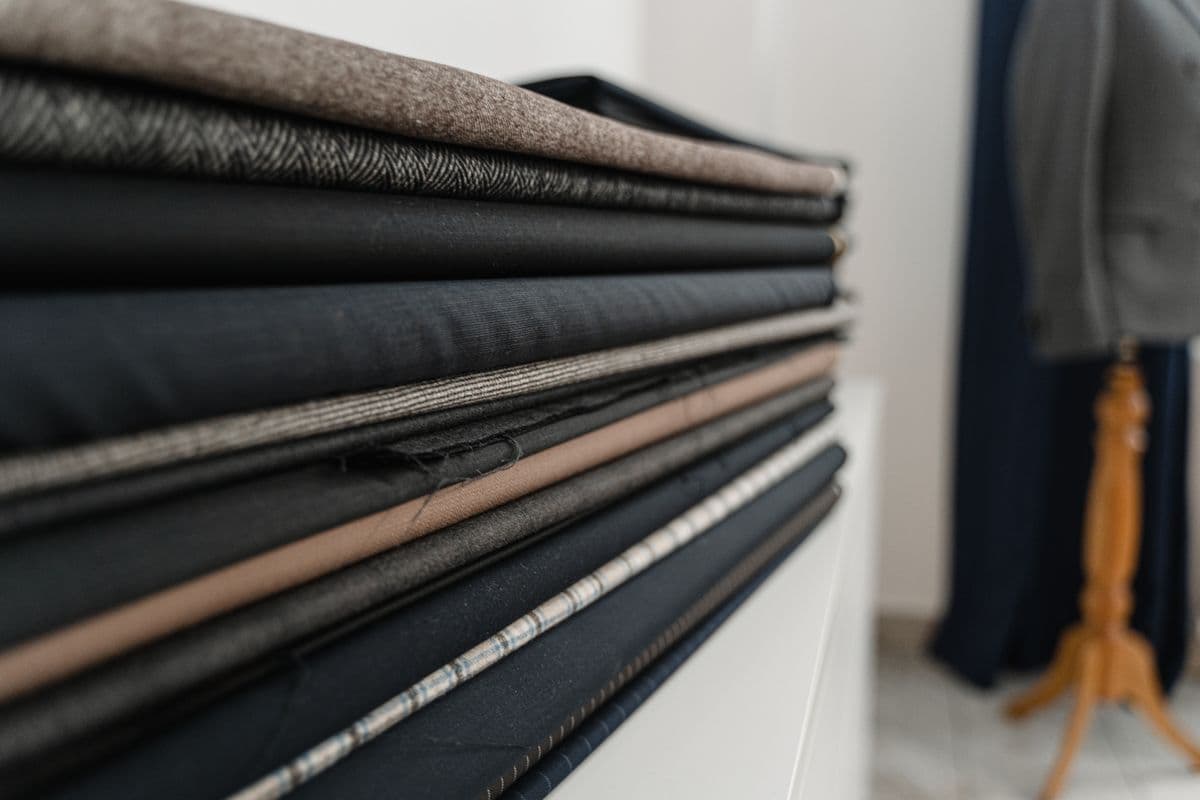
Only what I can stand behind, because unverifiable fabric claims are the whole problem. We state compositions as blends, honestly -- if a cloth is a blend we call it a blend and give the numbers, and we make no "100% fibre" claims, because that word means one fibre and nothing else.2 We do not name mills we cannot verify roll by roll; a claim we cannot prove for every bolt is worth less than no claim. The cloth library is inspectable -- everything we cut from is listed live in our fabric catalog, and we cut only from our own library. Suits are $169 to $459, garment-only, shipping quoted separately -- and the arithmetic above applies to us too.8
Frequently asked questions
Should a suit be 100% wool?
Not necessarily -- a little of another fibre can add stretch or crease resistance. What matters is the ratio: mostly wool behaves like wool, mostly polyester behaves like polyester, and both are legally a "wool blend". Under US rules wool is always named with its percentage.1
What does 100% polyester look like?
Flat, even sheen that does not break up as you tilt it; a cool-then-clammy hand; either a razor crease that will not come out or no crease at all. In reviews it reads as "translucent", "costume", "plastic".1814
Are suits made in Vietnam polyester?
Some are, some are not -- the country is not the variable, the shop is. US buyers who got "Halloween costume fabric" were describing a price point, not a nationality.13 Ask the four questions and the country stops mattering.
The bottom line
Your hands are a good instrument and a bad witness. Use them to shortlist -- warmth, scrunch, tilt -- then move the argument onto paper, where a fibre percentage either exists or does not. In the US and EU that paper is legally required.12 In a cloth room it is a sentence somebody is either willing to write down or not, and that willingness sorts the industry faster than any test above.
From our side: the cloth is listed in the fabric catalog, you can start from your own measurements with the guided measurement app, and remote orders are explained on our online tailor page. Or come by 127 Tran Hung Dao and put your hands on the cloth. Linda will name it before you finish asking -- and then, almost certainly, ask why you are so handsome.