There are nine questions. Ask them out loud before you pay a deposit and you will avoid almost every bad tailoring story on the internet. Here they are, and here is what a straight answer to each one sounds like.
I am Jay. I spent about ten years in the US and came to Hoi An as a customer a year ago; I liked the shop enough that I became a partner in it. Linda was born here and has been at the cutting table twenty-five years. Below: why each question matters, and how we answer it -- including where our answer is not the one you wanted.
The list you can literally read out
- What is the fibre content, in percentages, and where was it woven?
- Is the jacket fused, half-canvas or full canvas?
- How many fittings, on which days, and what happens at each?
- If it does not fit at the final fitting, what do you do -- recut, alter, or refund?
- After I fly home, who pays for alterations, and do you send seam allowance and spare cloth?
- What is included in the price -- lining, buttons, extra trousers, shipping?
- What is the real turnaround this week, not in low season?
- Do you sew here? Can I see the room?
- Can you show me a finished garment in this cloth and this cut?
A good shop enjoys those questions. That reaction is part of the answer.
What is this cloth actually made of?
Question one, because it hides the most money and is hardest to verify by touch. A traveller who documented four Hoi An tailors put it precisely: "you can't be sure about the fiber content... there aren't like care labels." She was told one piece was cotton with stretch and concluded, on her body, that it was primarily synthetic.1 The top comment under a Hoi An price-comparison video: a "$99 polyester 'wool blend' suit... is not the same as true wool or linen."7
So ask for percentages. A shop that answers "80% wool, 20% silk" is being more open than one that answers "premium Italian": the number is checkable, the adjective is not.
What does "cashmere wool blend" mean at a tailor?
At tourist-tailoring prices it usually means a blend containing no cashmere at all. In a Bangkok fitting video the tailor recommends "cashmere wool" for the heat and, in the same breath, gives the composition as "80% wool, 20% silk."2 Commenters under another video of that shop asked the obvious question: "80% wool 20% silk... so where is cashmere?"5
"Cashmere wool" is a fabric-book category name, not a fibre declaration. Real cashmere costs enough that a shop selling it names the percentage unprompted. Ask "what percent cashmere?" If the answer is a feeling rather than a number, you have your answer.
A number you can check beats an adjective you cannot. "80/20 wool-silk" is more honest than "premium Italian", even when it sounds less impressive.
Is the jacket canvassed or fused -- and can I check?
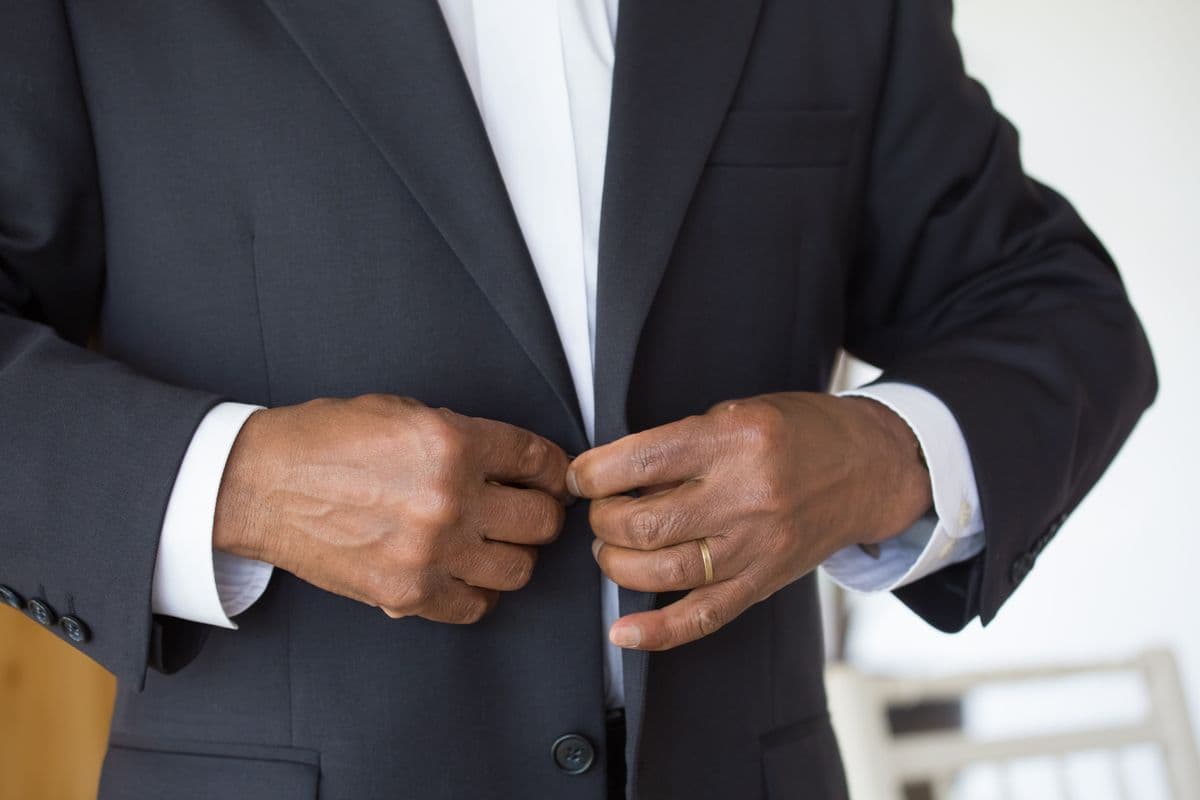
Inside a jacket front there is either a floating canvas that moulds to you, or interlining glued to the cloth. Full canvas runs the whole front; half-canvas runs chest and lapels and fuses below; fused is glued throughout. The check: pinch the sleeve as a baseline, then pinch below the lowest buttonhole and try to separate the layers -- three layers means a floating canvas.1011
Here is the part against my own interest: the pinch test cannot separate fused from half-canvas. On a half-canvassed jacket the front below the second button is fused anyway, and every jacket has a floating chest piece, so a layer at the chest proves nothing.9 Modern fusing "is not always as stiff",11 and working sleeve buttonholes appear from Savile Row down to budget brands.12
So the only reliable route is a shop that says it in words -- and the answer can move while you stand there. A commenter under a Bangkok process video: "They showed him a half and full canvas option, and the moment he haggled they downgraded him to fused construction lol."6 The big Western brands are no more forthcoming, which is why we published the construction answers for Indochino, Suitsupply, Jos. A. Bank and J.Crew on their own pages.
How many fittings does a custom suit need?
Two is the realistic floor for anything cut to your body; three is what properly bespoke looks like. A Vietnamese commenter who has clothes made at home: "up to 4 weeks for a suit. My tailor in particular will not deliver a piece before at least 2 fittings." Another, on the 24-hour promise: "The first red flag was the short turnaround... fast fashion with extra steps."1 Under a Bangkok fitting video: "Minimum is 3 fittings, up to 5."5
The compressed Asian process, from the shops' own footage: day one fabric and measuring, the cutter cutting the jacket in 30 to 45 minutes; day two the fitting; day three pickup.2 A second shop names the rhythm out loud -- "this is the we call first fitting for measuring... then we see you tomorrow for second fitting."3 Two real fittings inside 72 hours: legitimate, but not three across four weeks. The shop that pretends otherwise is the problem, not the timeline.
Can a tailor copy a suit from a photo?
Yes, and it is completely normal -- it is also where most miscommunication happens. In the four-tailors video the buyer sends a WhatsApp photo as a reference, and notes most tailors keep "a sort of printout folder that you can look through designs."1
The failure mode is not skill; a photo carries silhouette and almost nothing else. In that video she pointed at where a neckline should sit and the finished top came back cut far lower; on another order the strap style was changed outright -- "the tailor decided to do something else and thought it'd be better."1
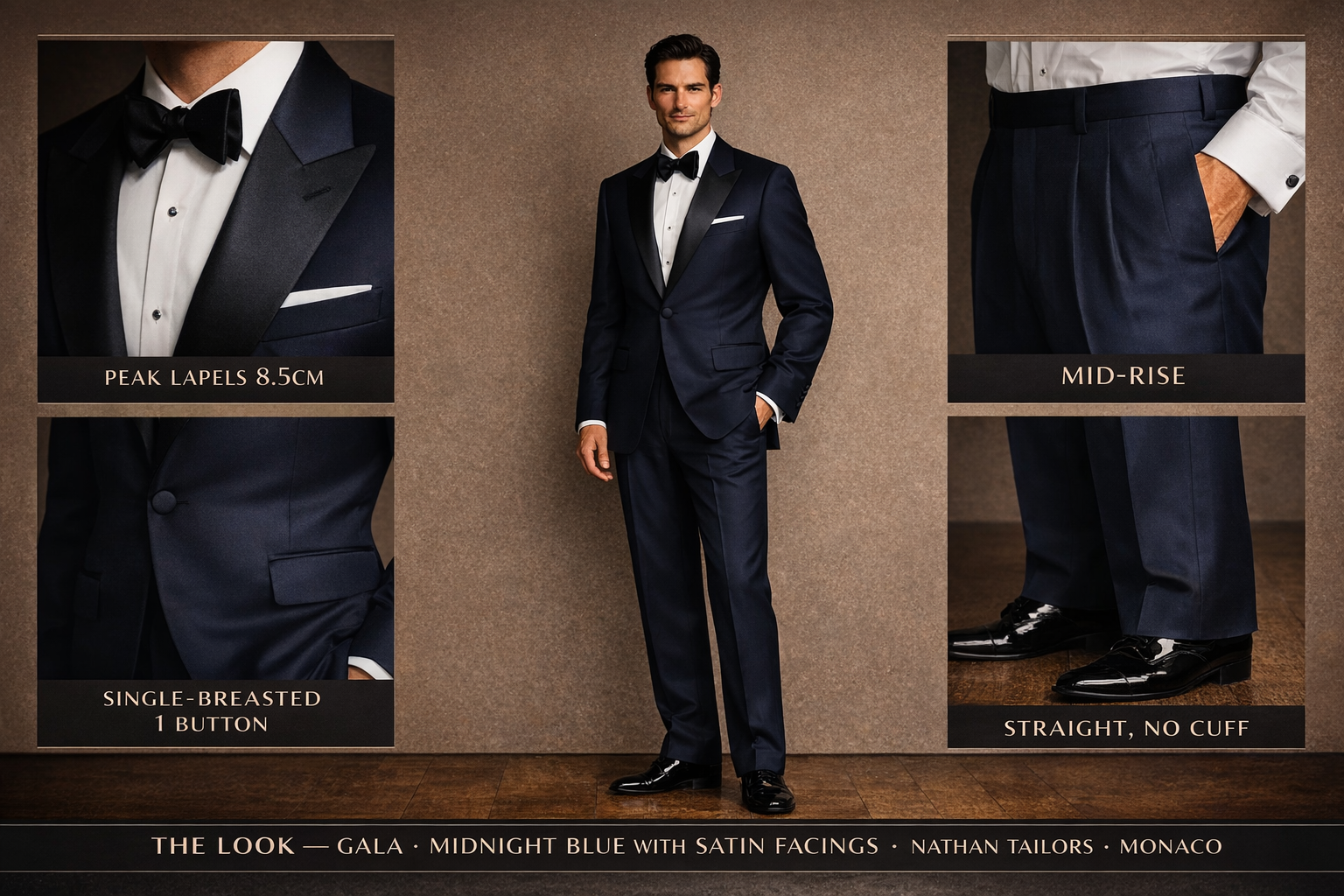
So bring the photo, then convert it into numbers. Not "like this one" -- say notch lapel, 3.25 inches, two-button, flap pockets, single vent, no cuff, half break. Better still, bring a garment you own: a physical reference cannot be misread.
What happens if it does not fit, and who pays?
Ask this while you are happy, because you will not get a straight answer while you are upset. The four-tailors video ends with garments that came back wrong, a cancellation met with "it's bad luck to give refunds", and hours of WhatsApp with staff who "couldn't actually like follow through on the promises."1 They were intermediaries, not the tailor who made the mistake nor the owner who could authorise a refund.
So it is two questions: what is the remedy, and who here can authorise it? Some Western brands beat us outright on this; a store that hems your trousers free the same afternoon offers something no overseas workshop can match. The policies for Jos. A. Bank, Nordstrom, Indochino and Suitsupply sit on their own pages.
What is in the price, and how long will it really take?
Get the price in lines, and the turnaround for this week. The Bangkok video models a clean answer: suit $350, shirt $50, total $400 -- quoted in dollars because the baht price "is always a bit flexible."2 Ask the same way: is lining included, are extra trousers extra, when is shipping quoted. And the internet's "24-hour Hoi An suit" is a low-season number: the four-tailors buyer arrived at the end of March expecting 24 to 48 hours and was quoted "up to sort of 5 to 9 days".1 Time pressure is the biggest driver of bad outcomes, because it removes the fitting you needed.
Our numbers, so you can hold me to them: suits are $169 to $459, garment only, as of October 2026, shipping quoted separately before you pay. Three to four working days to make; two to three weeks shipped worldwide; two days in person in Hoi An.
Does the shop actually sew the suit in-house?
The best filter, and the hardest to verify. The circulating advice -- buy where you can see people sewing -- is right in spirit and incomplete in practice. The four-tailors buyer chose a shop that "did have sewing machines in it", then watched her alteration arrive "delivered by a motorbike. So, they must have taken it offsite." Her conclusion: "the more layers of staff between you and the person making your clothes or holding your money" the harder it is "to advocate for yourself."1 Our own take on ordering at a distance is in ordering from a tailor remotely.
Volume itself is not a red flag -- often the opposite. In the Bangkok footage, much of that shop's business is online orders, "not just from individual customers, but also suit suppliers and other tailors will send their measurements... and the same team will produce all the suits."2 Some shops you walk into are themselves customers of a workshop like that. The workshop is what you want: a cutter who cuts every day beats one who cuts twice a week. So refine the question -- not "do you have a sewing machine", but who cuts my pattern, and will the same person handle the alteration? More in our Hoi An tailoring questions.
Is there a lingo? Bespoke, canvas, supers, drop, rise, break
Someone asked exactly this under a custom-suit buying guide: "is there any lingo or way to talk to the tailor about measurements, specifications for the suit?"8 There is, and it is small.
Bespoke vs made-to-measure vs custom. Three different things -- as a commenter wrote under a Hong Kong video titled "Custom Tailored Bespoke Suit": "seriously? These all mean different things in tailoring."4 Made-to-measure adjusts an existing block pattern to your measurements; bespoke draws a fresh pattern and fits it in stages; custom covers both. Ask: "Are you drafting a new pattern for me, or adjusting a block?"
Super numbers (100s, 120s, 150s). A yarn-fineness rating for wool: higher is finer and softer but more delicate. A fineness scale, not a quality ranking -- a Super 110s in good cloth outlasts a Super 150s worn twice a week. Neither Bangkok process video I studied mentions a super number at all;23 if a shop cannot give you one, the cloth is sold by feel, not by spec.
Drop is the inches between chest and waist -- a 42 chest with a 36 waist is a drop 6; it decides whether an off-the-rack jacket can ever fit you. Rise is crotch seam to waistband: high sits at the natural waist, low on the hips. Break is how much the hem folds over the shoe -- none, half or full; say "half break" and a tailor anywhere knows what you mean. Also worth naming: gorge (lapel notch height) and vent (single, double or none). Our measurement studio walks through each measurement on screen; the measurement guide explains what each number does.
The honest case for going direct
None of the nine questions favour us automatically. A shop in your city that alters free next Tuesday offers something real, and if you need a suit in seventy-two hours you should buy one there today. What a workshop like ours removes is the layers between cloth and customer -- no importer, no brand licence, no mall lease -- which is why body-pattern half-canvas lands at $169 to $459. Hold us to the list above, or compare at the comparison hub and custom tailored suits.
The bottom line
Almost every tailoring horror story comes down to a question nobody asked while everyone was still smiling. Ask them anywhere -- and ask them here, where Linda will answer every one and then, somewhere in the middle of the tape measure, ask you why you are so handsome. Pick a cloth, try the measurement studio, or message us with the list.