A customer messaged us last week and told us how he found us: he was searching online for whether Men's Wearhouse or Jos. A. Bank was the better place to buy a suit. That is one of the most common questions in American menswear — and almost nobody answers it with the one fact that reframes the entire decision. So let me, as a tailor, walk you through where these suits actually come from, who actually makes them, and what you are actually paying for between the sewing floor and the sales tag.
I am Jay. I spent about a decade in the US — Pennsylvania, New York, Houston — buying suits from exactly these stores. I moved to Hoi An, Vietnam, and now partner with Nathan Tailors, where I watch suits get cut and sewn every day and I know what the fabric and the labor actually cost. I am not here to tell you the big brands are villains. They are not. I am here to follow the supply chain honestly, with sources, so you can make the call with the same information the industry has.
First, the plot twist: they are the same company
If you are weighing Men's Wearhouse "versus" Jos. A. Bank, you are comparing two brands owned by one parent. Men's Wearhouse announced it would acquire Jos. A. Bank on March 11, 2014, for $65.00 per share — roughly $1.8 billion — and completed the deal that June.12 The combined parent later took the name Tailored Brands, which also owns Moores and K&G.
That single fact quietly answers most of the "which is better" debate. They share corporate ownership, overlapping management, and similar supply chains. When you see a $399 suit at one and a $349 sale suit at the other, you are usually not choosing between two philosophies of tailoring — you are choosing between two storefronts of the same business. I go deeper on the construction and fit differences in our Men's Wearhouse vs Jos. A. Bank comparison and in an honest Jos. A. Bank quality review.
One more bit of context worth knowing: Tailored Brands filed for Chapter 11 bankruptcy in August 2020 as office-wear demand collapsed during the pandemic, and emerged that December having eliminated about $686 million in debt.34 It is now privately held by its former lenders.5 The stores are stable and still open — this is not a "going out of business" story. It is a "know who you are buying from" story.
So where are the suits actually made?
Here the brands are more transparent than most shoppers realize — you just have to read the filings instead of the hang-tags. In its 2015 annual report (Form 10-K) — the last detailed sourcing disclosure it filed before going private — Tailored Brands reported sourcing the majority of its merchandise from outside the United States, with roughly a third coming from China and the rest spread across other parts of Asia, Mexico, and elsewhere. The company also noted that substantially all of its foreign purchases are paid for in US dollars.6
In plain terms: the large majority of what hangs on those racks is made overseas, predominantly in Asia. That is not a scandal — it is simply how virtually all mid-priced American suiting works. Department-store labels (Calvin Klein, Tommy Hilfiger, and the rest) follow the same map, often out of the very same factories.6 The country on the label changes; the basic geography does not.
The part nobody mentions: Vietnam is now the source
Here is the detail that flips the usual "is a cheap Vietnamese suit any good?" anxiety on its head. Vietnam is now the #1 supplier of apparel to the United States, having overtaken China.89 The country exported roughly $44 billion in textiles and garments in 2024, making it the world's second-largest apparel exporter, with the US as its single biggest market.78
So when an American shopper imagines "ordering a suit from Vietnam" as some exotic downgrade from the mall, the reality is the opposite: a great deal of what is already in that mall came from Vietnam in the first place. Coming to a Hoi An tailor is not going downmarket. It is going to the source.
Ordering a suit from Vietnam is not a downgrade from the mall. A lot of what is in that mall came from Vietnam to begin with.
You are not behind the trend — you are ahead of the factories
Here is the part that should genuinely reframe your purchase. The shift toward Vietnam is not finished — it is happening right now. The big brands' factories are still partly in China, and the entire industry is mid-migration toward Vietnam. We know this because the migration shows up in the numbers: Vietnam only recently overtook China as the top supplier of US apparel.89 That "overtaking" is the corporate move, in progress, in real time.
But a national retailer cannot flip its supply chain overnight. Relocating sourcing — qualifying factories, re-tooling, re-negotiating, re-routing logistics — is an operation that takes years, slowed further by corporate inertia. So the brands are trying to get where Vietnam already is, and they are doing it slowly, at the speed a large organization can move.
You do not have that constraint. With this information, you can do today what their procurement departments are spending years trying to do: buy directly from the Vietnamese source. You are not catching up to the trend — you are positioning your purchase ahead of a decision the factories want to make but cannot make quickly. The order button does in one click what corporate logistics does in one fiscal cycle.
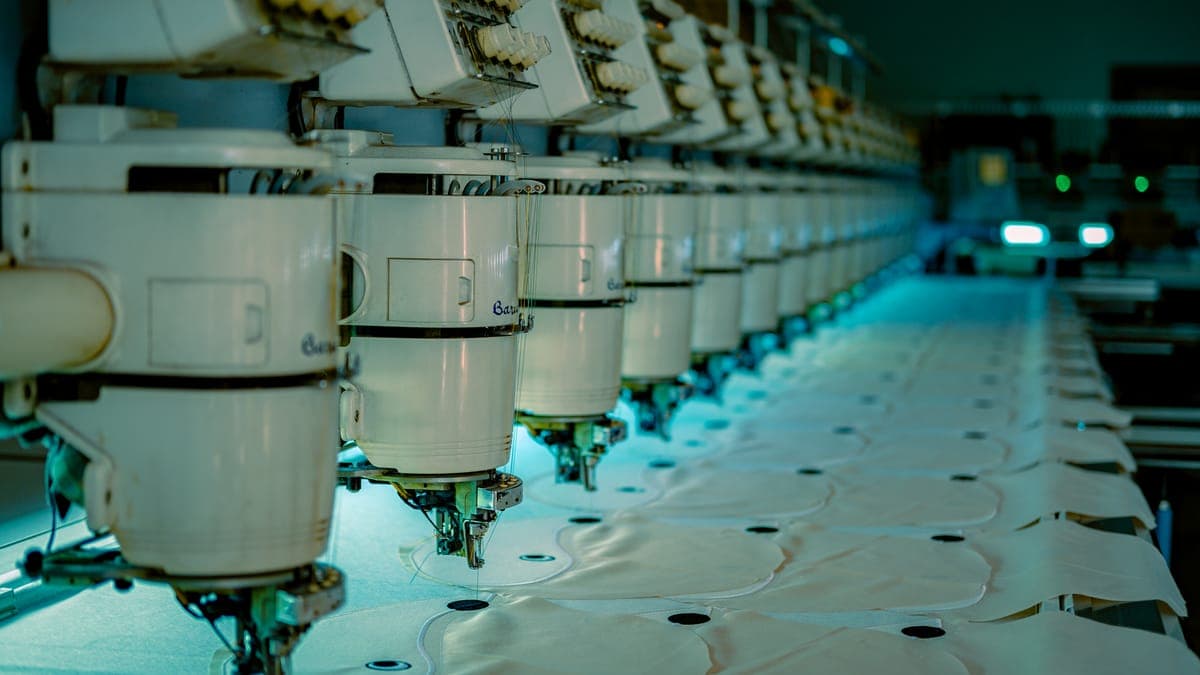
Inside a large Vietnamese suit factory (an illustration)
I want to be precise here, because precision is the whole point of this article: I cannot name a specific factory that makes Men's Wearhouse or Jos. A. Bank suits, and I will not pretend to. That information is not public. What I can do is describe, accurately, what a large export garment operation in Vietnam looks like — the kind of place that supplies Western brands generally — so you can picture the economics.
Vietnam has roughly 3,800 garment factories employing about 2.7 million workers.10 A large facility can produce on the order of several million units a year.10 At that scale, the per-suit numbers look very different from a retail price tag:
- Fabric: a suit takes roughly 4 yards of cloth. Wool suiting runs anywhere from about $24 to $70 a yard at retail, and far less at mill-wholesale volumes.13
- Ocean freight: trivial per unit — a single shipping container holds thousands of garments, so freight adds only a few dollars (or less) to each suit.
- US import duty: men's wool suits carry a duty of roughly 16%–17.5% depending on the exact wool classification (Vietnam has no US free-trade agreement, so the standard rate applies).11
Follow your suit's passport
Now stack the layers. A suit produced overseas does not go from the sewing floor to your closet. It travels:
- Factory (FOB cost) — fabric + labor + the factory's own margin.
- + Freight and import duty — the ~16–17.5% wool-suit duty and shipping get layered in as it lands.11
- + Importer / brand margin — the company that owns the label takes its cut.
- + Retail markup — the storefront marks it up again to cover rent, staff, marketing, and profit.
Apparel pricing conventionally runs on "keystone" markup — doubling the cost — and modern retail often runs keystone-plus, around 2.1x to 2.6x at each major step.12 Compound two of those steps and the retail tag commonly lands at three to four times the production cost. A useful rule of thumb the industry itself uses: fabric and labor are only about a quarter to a third of what the customer finally pays. The rest is the journey.
None of this is cheating. It is just what a multi-layer supply chain costs to operate. But it does explain why two suits of genuinely similar make can wear wildly different price tags — and why a tailor who skips the importer, the brand, and the retail floor can put more fabric and better construction into the same dollar. I lay the per-bucket numbers out in detail in our custom suit cost breakdown and the cheaper-alternative-to-Men's-Wearhouse guide.
"Direct" is not a downgrade — it is the same world, minus the middle
This is the honest punchline, and I want to keep it honest rather than triumphant. The big brands are not selling you a lie. They are selling you a garment that was made well overseas, then routed through the layers that a national retail business requires. Those layers are real costs, and they buy you real things: a store you can walk into today, a salesperson who pins your hem, a suit in your hands in under an hour.
What a direct tailor offers is the same starting point — skilled overseas hands, the same global fabric world — without the importer, the brand licensing, the distributor, and the mall lease stacked on top. At Nathan Tailors a two-piece wool suit starts at $149 with half-canvas construction standard (full canvas available on request at a higher price), and DHL gets it to the US in about a week once it is finished. You measure yourself at home with our guided measurement app, and every suit ships with generous seam allowances and spare matching cloth so a local tailor can fine-tune the fit. We do not name-drop Italian mills we do not buy from — for any Vietnam workshop those claims are usually marketing fiction — but the cloth is real, and you can see it before we cut. Browse the fabric catalog to see what that means.
So what should you actually do?
It comes down to time, not loyalty:
- Under 72 hours: Buy in-store. The brands earn their markup on speed alone.
- 3+ weeks of runway: Go direct. You get a suit cut to your body, in fabric you chose, for less than the all-in cost of an off-the-rack suit plus alterations. See how the math compares head-to-head in our Men's Wearhouse vs Jos. A. Bank vs custom piece.
- A wedding or a group: Coordinating groom, groomsmen, and fathers from one fabric batch is exactly where direct shines — the Nathan Tailors weddings path is built for it.
Frequently asked questions
Are Men's Wearhouse and Jos. A. Bank the same company?
Yes. Men's Wearhouse acquired Jos. A. Bank in 2014 for about $1.8 billion, and both operate under the parent company Tailored Brands, alongside Moores and K&G.12
Where are Men's Wearhouse and Jos. A. Bank suits made?
Overseas, predominantly in Asia. In its 2015 annual report, Tailored Brands disclosed sourcing the majority of merchandise outside the US, with roughly a third from China and the remainder spread across other Asian countries, Mexico, and elsewhere.6 No public document ties either brand to a specific named factory.
Are suits made in Vietnam lower quality?
Not inherently — quality depends on the maker and the cloth, not the country. Vietnam is now the largest single source of apparel imported into the United States, ahead of China,8 which means much of the clothing already sold in American stores is Vietnamese-made. The country is the source, not a shortcut.
Why is a custom suit from Vietnam cheaper than a mall suit?
Because it skips layers, not quality. A retail suit's price climbs through import duty, brand margin, distribution, and store overhead — commonly to three or four times its production cost.12 Ordering directly from a workshop removes the middle layers, so more of your money goes into fabric and construction. Full breakdown in our cost guide.
Will I pay import duty ordering a suit from Vietnam?
For a personal-use garment shipped to you, the economics are very different from a retailer importing in bulk, and small personal shipments are often handled simply by the courier. Commercial wool-suit imports carry a duty of roughly 16–17.5%.11 For an individual ordering one suit, shipping — quoted at cost by weight and destination before you pay — is the cost that matters in practice.
Is Men's Wearhouse going out of business?
No. Tailored Brands emerged from Chapter 11 bankruptcy in late 2020 and continues to operate hundreds of stores.34 The question is value, not survival.
The bottom line
If you came here comparing Men's Wearhouse against Jos. A. Bank, the most useful thing I can tell you is that you are comparing two doors into the same house — a house whose suits, like most American suits, are made overseas and marked up through several layers on the way to the rack. There is nothing wrong with paying for those layers when you need the speed and the storefront. But if you have three weeks and you would rather your money buy fabric and fit than freight and rent, the source is closer than you think — and it has probably already made half the clothes in your closet. Pick a fabric, try the measurement app, or just message us. No pressure, no upsell — only an honest quote.