"You're going to like the way you look. I guarantee it." George Zimmer said that in every Men's Wearhouse commercial for twenty years. He was not wrong -- a new suit does make you feel good. But here is the question nobody in those commercials answered: where does your money actually go when you buy a suit at Men's Wearhouse vs Jos A. Bank vs getting one custom made?
I am Jay. I spent ten years living in the US -- Pennsylvania, New York City, Houston -- buying suits from exactly these stores. I have stood in the Men's Wearhouse on 50th Street in Midtown. I have walked through the Jos A. Bank on Broadway. I have felt the fabric, tried the fits, and done the math. Now I live in Hoi An, Vietnam, where I partner with a tailoring shop that makes custom suits every single day. That gives me a perspective most comparison articles do not have: I know what the fabric costs, what the labor costs, and where the markup lives.
This is not a hit piece on either brand. Both Men's Wearhouse and Jos A. Bank serve a real purpose. But I owe you honest numbers so you can decide for yourself.
The Quick Comparison: Men's Wearhouse vs Jos A. Bank vs Online MTM vs Vietnam Custom
If you only have sixty seconds, this table tells you almost everything you need to know.
| Feature | Men's Wearhouse | Jos A. Bank | Online MTM (Indochino / SuitSupply) | Vietnam Custom (Nathan Tailors) |
|---|---|---|---|---|
| Price Range (Suit) | $199 - $799 | $199 - $399 (on sale) | $399 - $1,299 | $149 - $309 |
| Fit Type | Off-the-Rack (OTR) | Off-the-Rack (OTR) | Made-to-Measure (MTM) | True Custom / Bespoke |
| Fabric Quality | Mid-range (poly-blend to wool blend) | Entry to mid-range (varies by line) | Italian mills (marketed) | Wool blends to premium worsted wool from established mill suppliers |
| Construction | Mostly fused | Fused to half-canvassed (by line) | Half-canvassed to full-canvassed | Half-canvas |
| Turnaround | Same day (walk out wearing it) | Same day (walk out wearing it) | 2 - 6 weeks | 2 - 4 weeks (shipped to your door) |
| Customization | None (pick from what is on the rack) | None to minimal | Moderate (fabric, buttons, lapel, lining) | Unlimited (any design, any detail) |
| Alterations Included? | Basic hemming; others $20 - $150 | Basic hemming; others $20 - $150 | $75 alteration credit (Indochino); varies | Built to your measurements; seam allowances + extra cloth for local alterations |
| Best For | Need a suit today | Budget-conscious, conservative style | Convenience + some personalization | Best value, perfect fit, lasting quality |
Now let me walk you through what is actually happening at each option -- because the sticker price never tells the full story.
Men's Wearhouse: The Convenience Play
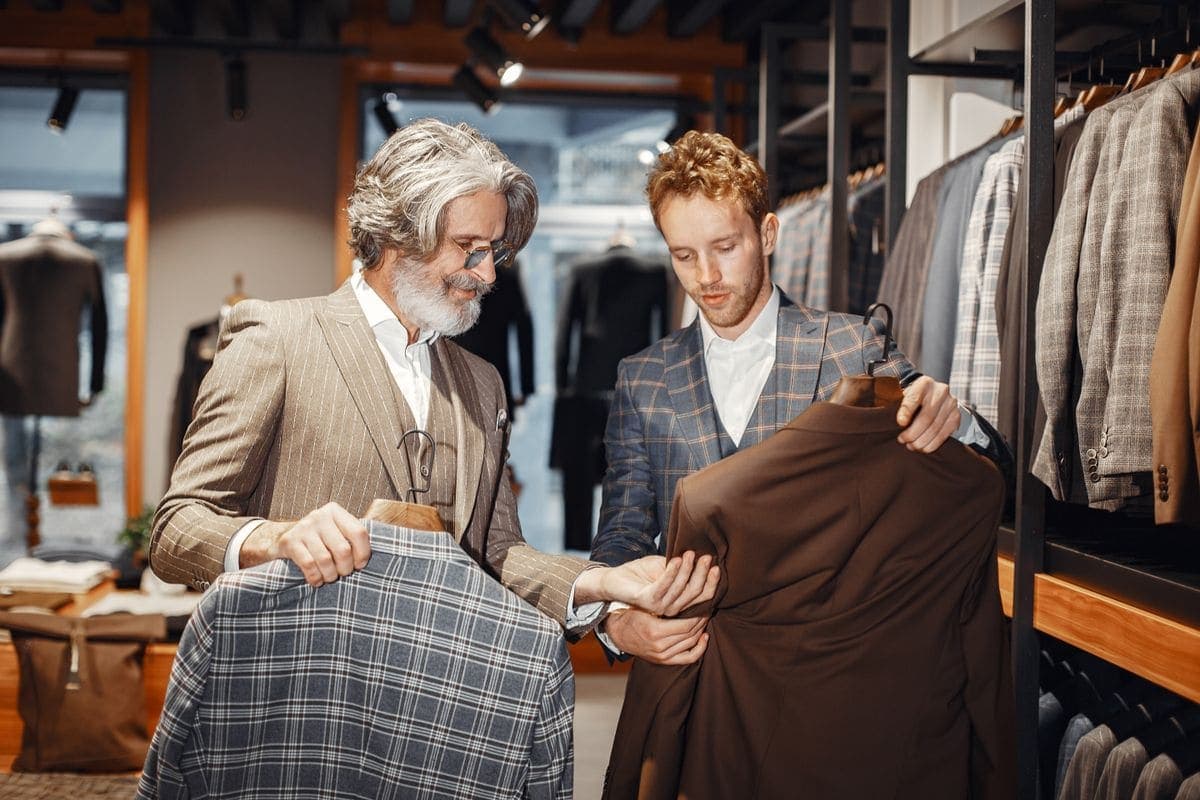
This article now has a live data companion. Our comparison engine tracks both brands' current prices, construction and ownership — verified monthly:
Men's Wearhouse vs Jos. A. Bank — live comparison · Men's Wearhouse review · Jos. A. Bank review
What You Are Actually Buying
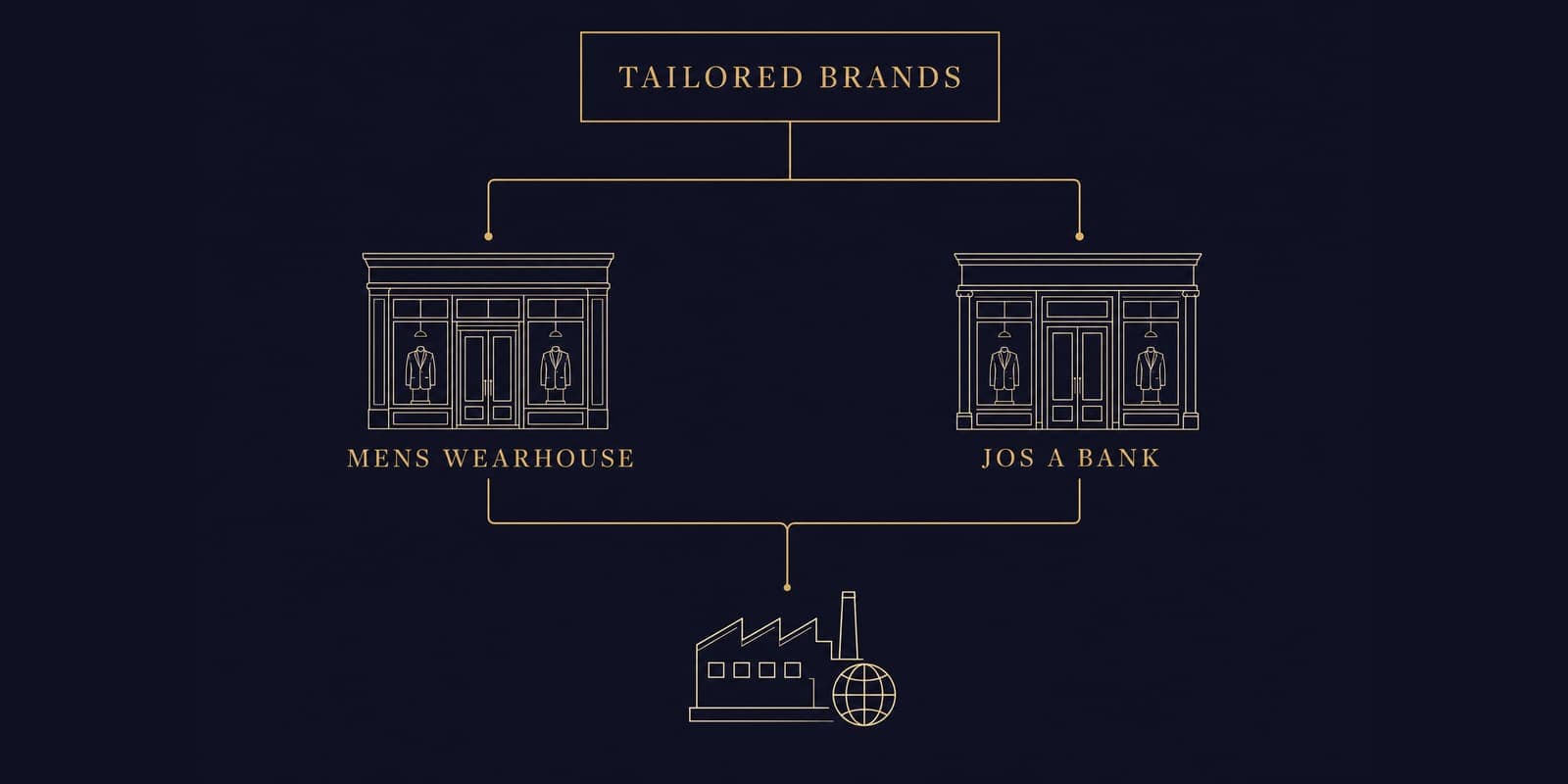
Men's Wearhouse operates hundreds of stores across the US under Tailored Brands (the same parent company that owns Jos A. Bank -- more on that in a moment). When you walk into a Men's Wearhouse, you are buying off-the-rack suits sized to standard body templates -- typically a 40R with a 34-inch waist, or a 42L, or whatever standardized size fits you closest. The suit was not made for your body. It was made for a statistical average.
Their suit lineup includes brands like Joseph Abboud, Calvin Klein, Lauren by Ralph Lauren, AWEARNESS by Kenneth Cole, and BLACK by Vera Wang. Prices range from $199 for sale inventory to $799 for premium designer labels, though the typical purchase lands between $299 and $499.
The Honest Strengths
Immediate availability. This is the biggest and most legitimate advantage. If you have a funeral on Thursday and it is Tuesday afternoon, Men's Wearhouse solves your problem. You walk in, pick a suit, get basic hemming done in an hour or two, and walk out. No online brand and no custom tailor can match that turnaround.
In-store experience. They have people who will help you. Not all of them are master tailors, but someone will measure your neck, suggest a shirt, and make you feel like you are making a good decision. For a guy who has never bought a suit before, that hand-holding has real value.
Rental option for one-time events. Their tux and suit rental program starts around $150 - $230 for a complete package. If you truly only need a suit for one event and never again, rental math can work -- though I will explain below why it usually does not.
Free lifetime pressing. Buy a suit at Men's Wearhouse and they will press it for free forever. That is a genuinely nice perk if you live near a store.
The Honest Weaknesses
Fit is generic by definition. An off-the-rack suit assumes your body matches a template. If you have a longer torso, wider shoulders, a drop that does not match standard proportions, or one arm slightly longer than the other (most people do) -- the suit will not fit right out of the box. And many fit issues with OTR suits cannot be fixed by alterations. You can hem pants and take in a waist, but you cannot meaningfully restructure the shoulders or rebalance the chest of a jacket that was cut for a different body shape.
Alterations add up fast. Basic hemming might be included, but most adjustments cost extra. Expect $20 - $65 for simple changes and $75 - $150 for more involved work. A $349 suit with $100 in alterations is actually a $449 suit -- and it still will not fit like something made for you.
Perpetual "sales" inflate perceived value. Men's Wearhouse runs promotions constantly. A suit "regularly" $599 that is "on sale" for $349 was never really a $599 suit. The anchor price exists to make $349 feel like a deal. Federal pricing guidance is explicit about this: where an "artificial, inflated price was established for the purpose of enabling the subsequent offer of a large reduction," the advertised bargain is "a false one."5 This is not a Men's Wearhouse-specific trick -- it is retail psychology 101 -- but it means you should evaluate the suit at the price you pay, not the price on the tag.
Fabric is mid-range at best. At the $299 - $499 price point, you are typically getting polyester-wool blends or lower-grade wool. These fabrics do not drape or breathe the way pure Italian wool does. They tend to look shiny under harsh light, wrinkle unpredictably, and wear out faster. For a deeper dive into how fabric quality affects longevity, see our complete suit fabric guide.
Construction is mostly fused. Fusing means the jacket's interlining is glued to the outer fabric rather than stitched with floating canvas. Fused jackets are cheaper to produce, but the adhesive degrades over time -- from body heat, moisture, and dry-cleaning -- and the result is irreversible bubbling and delamination that, in the words of one menswear guide, leaves "no way to fix this problem once it's occurred."7 Most Men's Wearhouse suits under $500 are fully fused.
The Rental Trap
Men's Wearhouse pushes rentals hard for weddings and prom. A suit rental runs $150 - $230 per event. Sounds reasonable until you do the math:
- Two events per year (a wedding and a holiday party) = $300 - $460 in rentals
- Three years of that = $900 - $1,380 spent with nothing to show for it
- A custom suit from Nathan Tailors starts at $149 and you keep it forever
Renting makes sense exactly once: when you need a very specific look (like matching groomsmen tuxedos) for a single event and have zero lead time. In every other scenario, buying or going custom is better math.
Jos A. Bank: The Perpetual Sale
What You Are Actually Buying
Jos A. Bank was founded in 1905 in Baltimore by Charles Bank and Joseph Alfred Bank.1 It was acquired by Men's Wearhouse in 2014. So yes -- Men's Wearhouse and Jos A. Bank are owned by the same parent company, Tailored Brands.1 They share supply chains, back-office operations, and in some cases, even store locations. I trace exactly where Men's Wearhouse and Jos A. Bank suits are actually made in a companion piece -- it is the same overseas factory world for both labels.
What does that mean for you? It means the differences between these two brands are more about marketing positioning than fundamental product differences. Jos A. Bank positions itself as slightly more traditional and promotion-heavy. Men's Wearhouse positions itself as slightly more modern and brand-driven. Under the hood, you are buying from the same machine.
The BOGO Problem
Jos A. Bank became famous for "Buy One Get Three Free" promotions. That sounds incredible until you think about it for five seconds. If a company can afford to give you three free suits with every purchase, the suits are not worth what the tag says.
Their suits carry "regular" prices of $600 - $1,200, but the actual transaction price -- the money you hand over -- is typically $199 - $399 per suit. The "regular" sticker exists purely to make the "deal" feel generous. This is precisely the practice federal pricing guidance warns about: a former price inflated to enable a dramatic markdown turns the advertised bargain into "a false one."5 The FTC's deceptive-pricing guides cover both former-price comparisons and "buy one, get one" offers conditioned on additional purchases -- the exact mechanics of BOGO.6
The model was not just psychologically aggressive -- it proved commercially unsustainable. Men's Wearhouse founder George Zimmer later called the merger "ill-fated," saying Jos A. Bank had "damaged their brand over a number of years by running incessant promotions so that nobody wanted to go there and pay regular price."3 When the company tried to wean customers off the giveaways, the numbers fell off a cliff: in one post-acquisition stretch, Jos A. Bank same-store sales dropped 14.6% for the quarter and 35.1% quarter-to-date.3
If a company can afford to give you three free suits with every purchase, the suits were never worth what the tag says.
In recent years, Jos A. Bank moved away from the most aggressive BOGO tactics, shifting to "everyday low prices" and percentage-off sales. But the psychology is the same: the "regular" price is fiction, and the sale price is the real price.
Construction by Product Line
Not all Jos A. Bank suits are created equal. They run multiple lines with different construction:
| JAB Line | Construction | "Regular" Price | Typical Sale Price | Honest Assessment |
|---|---|---|---|---|
| Traveler / 1905 | Fully fused | $600 - $700 | $199 - $249 | Entry-level; fine for occasional wear |
| Signature | Half-canvassed | $800 - $900 | $299 - $399 | Best value in the JAB lineup |
| Signature Gold | Half-canvassed, better wool | $900 - $1,100 | $249 - $399 | Decent when caught at $250 |
| Reserve / Platinum | Full canvas | $1,000 - $1,200 | $399+ | Approaching online MTM pricing with OTR fit |
The Signature Gold at $250 on sale is probably the best deal in the store. It is half-canvassed, uses reasonable wool, and comes in traditional fits that work for business settings. But remember -- it is still off-the-rack. You are still buying a suit made for a template body.
The Honest Strengths
The lowest possible entry price for an in-person suit. At $199 on sale, Jos A. Bank gets you into a suit for less than almost anyone except fast-fashion brands. If your budget is genuinely under $200 and you need something this week, JAB serves that purpose.
Wide selection of conservative styles. If you want a classic navy or charcoal business suit -- nothing trendy, nothing slim, just traditional -- Jos A. Bank has a deep inventory of exactly that.
Physical stores with staff. Like Men's Wearhouse, you can walk in and get help. For someone uncomfortable buying clothes online, that matters.
The Honest Weaknesses
Deceptive pricing conditions your brain wrong. When you see "$900 suit, now $299" -- your brain evaluates a $299 suit as if it is a $900 suit on discount. It is not. It is a $299 suit that was never worth $900. This is not me being cynical; the regulation itself spells it out: an inflated former price set up "for the purpose of enabling the subsequent offer of a large reduction" makes the bargain "a false one."5 Evaluate the suit at the price you pay.
Fabric quality concerns at the actual price points. The fusing on entry-level suits is the recurring complaint: at lower price points the glued interlining is most prone to bubbling and delamination after a few dry-cleanings -- and once that happens it cannot be effectively repaired.7 The "Traveler / 1905" tier is where this risk is highest.
Styling skews dated. Jos A. Bank has historically leaned into boxy, full-cut American silhouettes. If you want a modern, slightly tapered fit with natural shoulders -- the kind of silhouette that is dominating in 2026 -- JAB's selection will feel like stepping back a decade. For more on how suit silhouettes are shifting, see our 2026 silhouette guide.
Quality perception softened after the merger. As of writing, Jos A. Bank's scores on consumer review aggregators skew low, and the recurring themes are fit and fabric durability rather than service. Aggregator numbers drift, so treat any single score as a snapshot, not a verdict -- but the pattern of complaints has been consistent for years.
The Same Parent Company Secret
Here is something most comparison articles gloss over: Men's Wearhouse and Jos A. Bank are not competitors. They are siblings. Men's Wearhouse acquired Jos A. Bank in 2014 for $65.00 per share in cash -- roughly $1.8 billion in total -- and the transaction completed on June 18, 2014.2 Both brands operate under Tailored Brands, Inc., which also owns Moores (Canada) and K&G Fashion Superstore.1
The marriage was not a happy one. George Zimmer, the Men's Wearhouse founder, publicly called it "ill-fated," and the post-merger sales data backed him up: Jos A. Bank same-store sales fell 14.6% in one quarter and 35.1% quarter-to-date as the company tried to dial back its perpetual giveaways.3 A few years later, the strain caught up with the whole group.
What does the shared ownership mean practically?
- They share supply chains and sourcing relationships
- Management, logistics, and back-office operations overlap
- The suits at similar price points come from similar (sometimes identical) factories
- The brands are differentiated by marketing, not manufacturing
So if you are agonizing over Men's Wearhouse vs Jos A. Bank -- in many ways, you are comparing Coca-Cola to Sprite. Different branding, same company, similar ingredients. The meaningful comparison is not between these two brands. It is between off-the-rack retail and the alternatives. (If you want the full factory-to-rack trace, read where Men's Wearhouse and Jos A. Bank suits are actually made.)
The Custom Alternative: What Most People Do Not Know
Online Made-to-Measure ($399 - $1,299)
Brands like Indochino and SuitSupply offer made-to-measure suits where a standard pattern is adjusted to your measurements. This is better than OTR because the suit is at least tweaked for your body, but it is not truly custom -- the base pattern, construction, and design are predetermined.
Indochino runs $399 - $699 per suit with around 93 showrooms across North America. SuitSupply is $499 - $1,299 with about 150 stores worldwide. Both use decent Italian fabrics and offer moderate customization (fabric, lining, buttons, lapel style).
The tradeoff: you are paying Western retail overhead -- store leases, sales staff, marketing budgets -- baked into the suit price. A $499 SuitSupply suit includes roughly $200+ in operational overhead that has nothing to do with the actual garment on your body.
Vietnam-Based Custom ($149 - $349)
This is where I have to be transparent about my bias: I partner with Nathan Tailors in Hoi An, Vietnam. So take what follows with that context. But the economics are the economics, and I will show you the numbers.
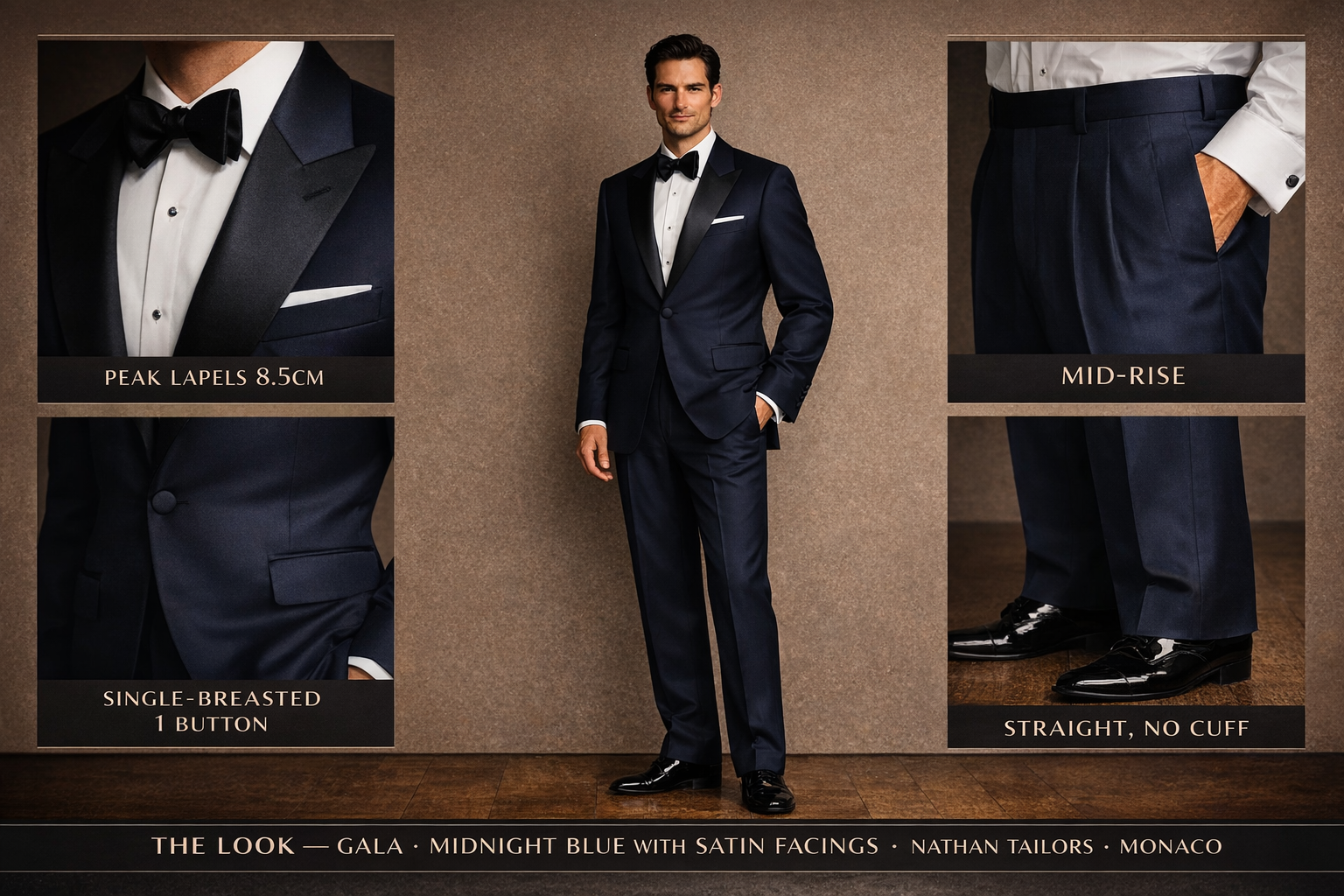
A custom suit from Nathan Tailors costs $149 - $309 depending on fabric choice. For that price, you get:
- A suit cut to your exact measurements -- not a template adjusted, but a pattern drafted from scratch
- Real wool from established mill suppliers across our cloth tiers
- Half-canvas construction
- Unlimited customization -- any lapel style, any pocket detail, any lining, any button
- WhatsApp consultation + guided measurement for remote orders
- Seam allowances + extra cloth -- every garment is cut with generous seam allowances and ships with a piece of the same fabric, so a local tailor can adjust the fit if anything needs tweaking
How is this possible at that price? It comes down to three things:
1. No retail overhead. We do not pay $15,000/month for a storefront on Madison Avenue or in a suburban mall. Our workshop is in Hoi An, where operating costs are a fraction of the US.
2. Direct from workshop. When you order from Men's Wearhouse, your money passes through the brand, the parent company, the distributor, the factory, and the fabric supplier -- each layer taking a margin. When you order from us, you are going straight to the people who cut and sew your suit. There is no middleman. For more on how supply chain layers affect pricing, see our custom suit cost breakdown.
3. Volume-trained tailors. Our tailors make suits every day, all day. A local tailor in a US city might make a few suits per week. Our workshop handles 30 - 50 clients daily. That volume means our tailors have seen every body type, solved every fit problem, and built the pattern-making intuition that only comes from repetition. It is the same reason a surgeon who does 500 procedures a year is generally more skilled than one who does 50.
The Real Cost Per Wear: Where the Math Gets Interesting
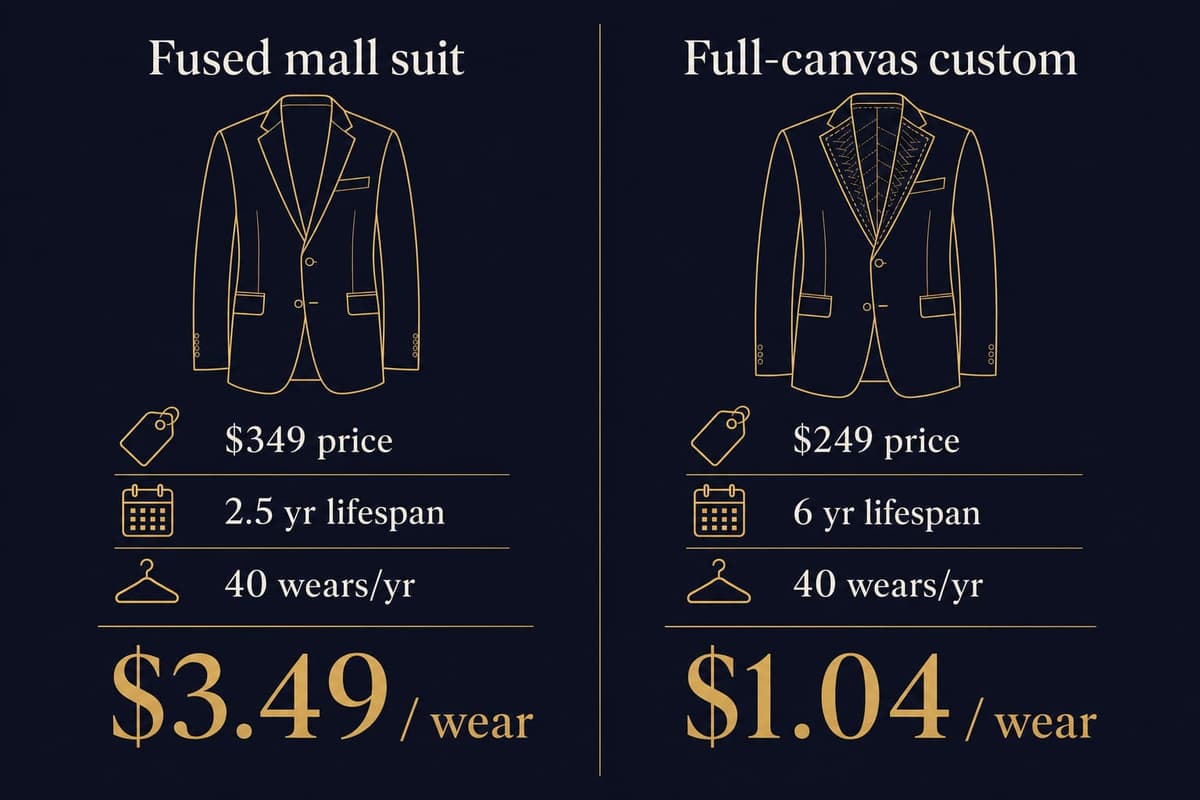
Sticker price is not real cost. Cost per wear is. Here is how these options compare when you factor in longevity, alterations, and actual wearable life:
| Factor | Men's Wearhouse ($349 suit) | Jos A. Bank ($249 suit) | Custom (Nathan $249 suit) |
|---|---|---|---|
| Purchase Price | $349 | $249 | $249 |
| Alterations Needed | $75 - $150 | $75 - $150 | $0 (built to measure) |
| Shipping | $0 (in store) | $0 (in store) | Quoted at cost by weight & destination (DHL) |
| True All-In Cost | $424 - $499 | $324 - $399 | $249 + shipping at cost |
| Construction | Fused | Fused to half-canvassed | Half-canvas |
| Expected Lifespan | 2 - 3 years (with regular wear) | 1.5 - 3 years | 5 - 8 years |
| Wears Per Year (estimate) | 40 | 40 | 40 |
| Total Wears (lifetime) | 80 - 120 | 60 - 120 | 200 - 320 |
| Cost Per Wear | $3.53 - $6.24 | $2.70 - $6.65 | $0.86 - $1.45 |
Read that bottom row one more time. The "cheapest" option upfront -- Jos A. Bank at $249 -- can actually cost four to five times more per wear than a custom suit that uses better fabric and better construction. This is not marketing spin. It is basic division.
Why does the custom suit last so much longer? Two reasons. First, canvassed construction drapes with the fabric instead of fighting it: the canvas is pad-stitched so it moves with your body, reducing strain on the cloth and seams, while a glued fused interlining stretches and strains until the bond breaks down.8 Fused suits fail at the glue layer, and once they bubble there is no fixing it.7 Second, a suit that fits your body correctly does not stretch, pull, or strain in the spots where ill-fitting suits deteriorate fastest -- the shoulder seams, the back vent, the seat of the trousers.
The Fit Problem Nobody Talks About
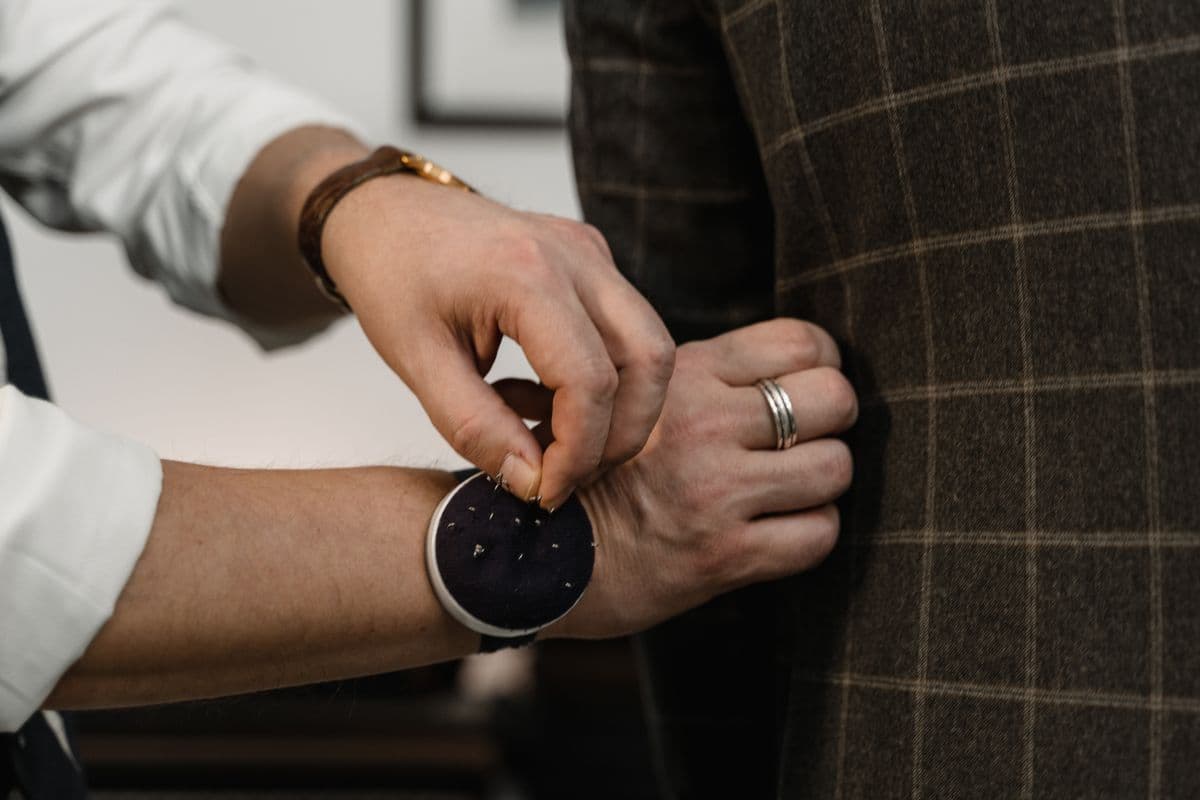
Here is the thing that fundamentally changes this comparison: most off-the-rack suits need alterations, and most alterations have limits.
When you buy a suit at Men's Wearhouse or Jos A. Bank, a salesperson will pin the jacket, mark the pants, and tell you it will fit great after tailoring. And basic adjustments -- hemming trousers, taking in the waist an inch, shortening sleeves -- do work. Those cost $20 - $65 per adjustment at Men's Wearhouse.
But here is what they will not tell you: there are structural fit issues that alterations cannot fix. Or more accurately, fixing them costs so much that it defeats the purpose of buying off-the-rack:
- Shoulder width: If the shoulders are too wide or too narrow, reshaping them requires essentially disassembling and rebuilding the upper jacket. Cost: $100 - $200. Most tailors will not even attempt it.
- Chest suppression: If the jacket pulls across the chest or gaps at the lapels, the issue is in the pattern, not the fabric. Alterations can help slightly but cannot redesign the chest piece.
- Jacket length: Shortening a jacket by more than an inch changes the proportion of every detail -- the button stance, the pocket placement, the vent length. It is rarely worth doing.
- Sleeve pitch: If the sleeves twist forward or backward, the issue is how the sleeve was set into the armhole. Correcting it is a $75 - $125 job that many alteration shops will not touch.
So what happens in practice? You buy a $349 suit, spend $100 on alterations, and still have a jacket that does not sit right in the shoulders or gaps at the collar. You tell yourself it looks "fine" because you have spent $449 and want to feel good about it. But every time you see a photo of yourself, something looks off.
A custom suit eliminates this entire problem because the pattern is drafted for your body from the start. There is no "close enough" -- and every garment is cut with generous seam allowances and ships with a piece of the same fabric, so a local tailor can fine-tune the fit if anything needs tweaking. For more on how suit fit should actually look and feel, see our guide on what to do when a custom suit does not fit.
Care for whatever suit you buy
Whichever brand you land on, these four cheap things make any suit look sharper and last years longer.
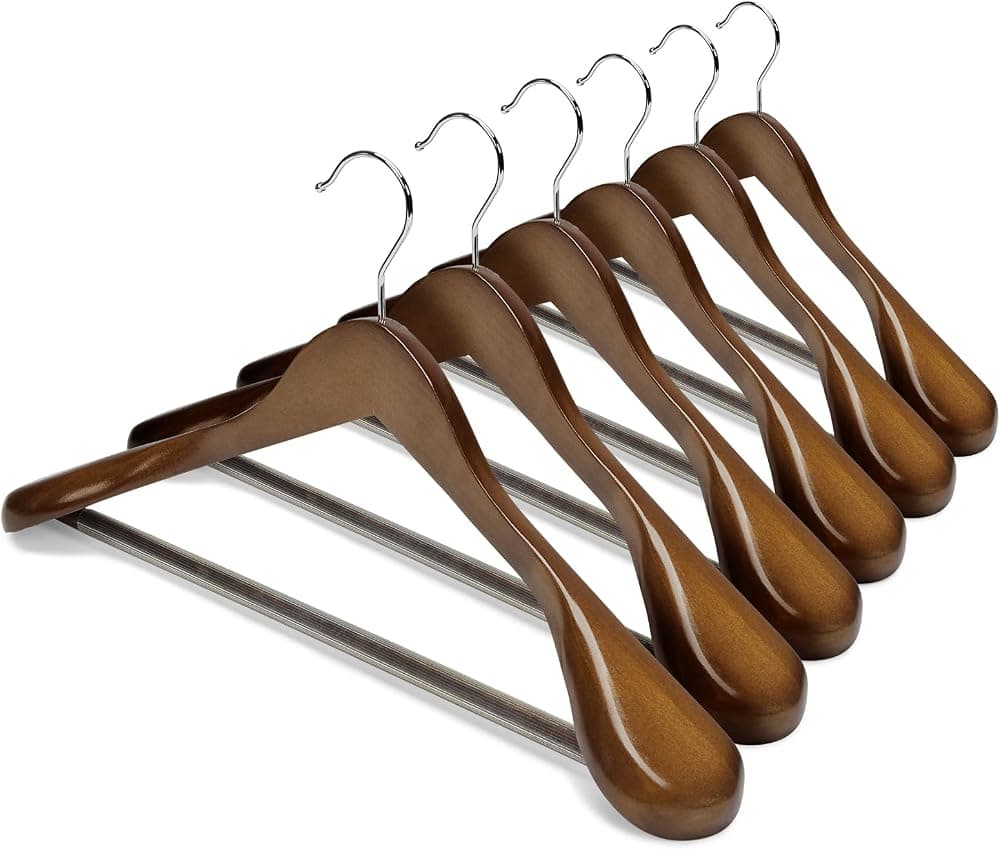
Wide wooden shoulders keep a jacket’s shape — the cheapest way to make any suit last.
View on Amazon →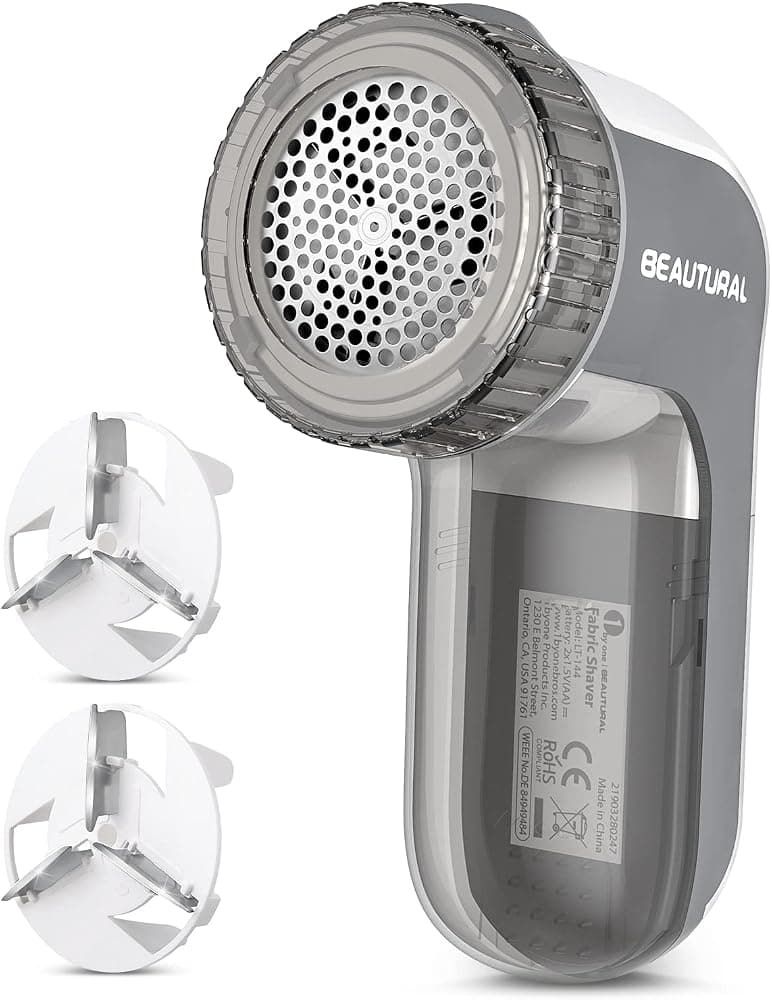
Shaves pills off wool so a two-year-old suit reads brand-new. 140k+ five-star buyers.
View on Amazon →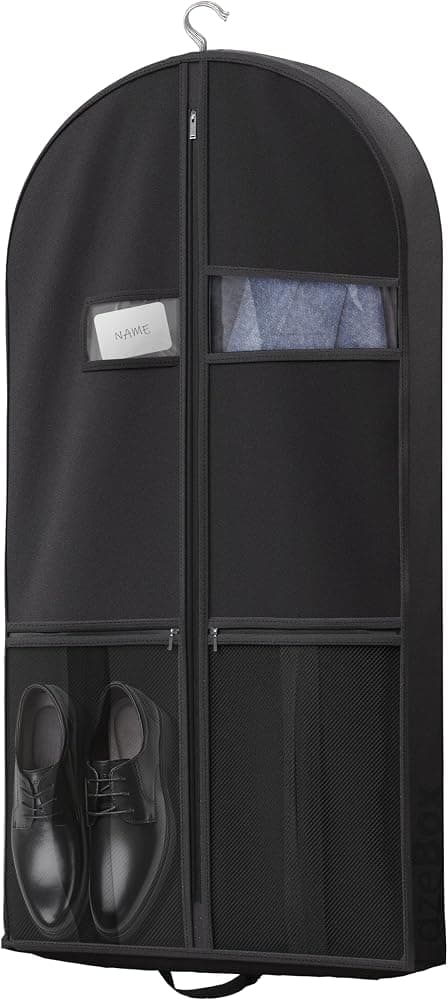
Folds a suit for a carry-on without the creases. Under ten dollars.
View on Amazon →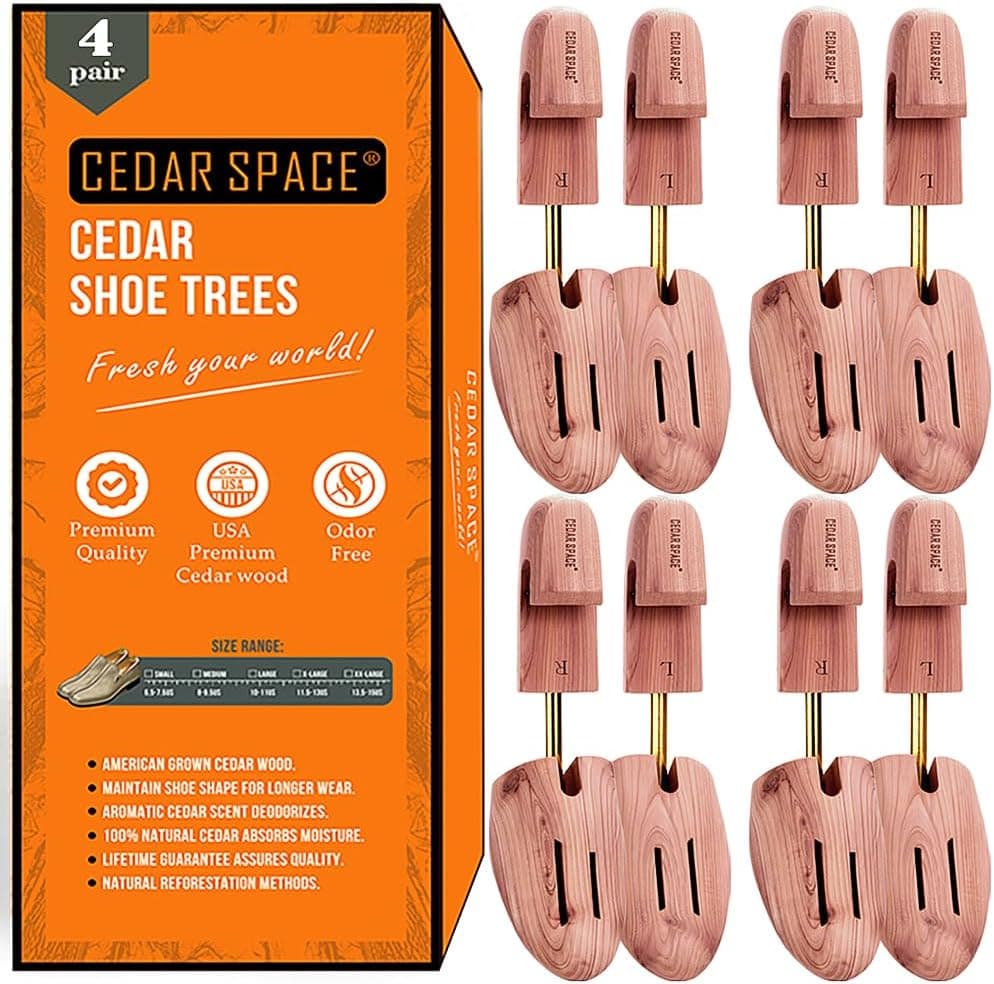
Cedar pulls moisture and holds the shape — dress shoes last years longer.
View on Amazon →As an Amazon Associate, Nathan Tailors earns from qualifying purchases — at no extra cost to you. Prices are approximate; see Amazon for current pricing.
Who Should Shop Where: Honest Recommendations
I am not going to pretend Men's Wearhouse and Jos A. Bank have no place in the market. They do. Here is when each option makes sense:
Go to Men's Wearhouse If...
- You need a suit within 48 hours for an urgent event
- You want to physically try things on and you have a standard body type (5'9" - 6'1", proportionate build)
- You need a rental for a one-time event and you truly have zero lead time
- You value the brand names (Calvin Klein, Ralph Lauren) on your label
- You want free lifetime pressing and live near a store
Go to Jos A. Bank If...
- Your budget is genuinely under $250 and you need something this week
- You want a conservative, traditional business suit and do not care about modern slim or tapered fits
- You are buying multiple suits at once and want to take advantage of bundle promotions
- You do not mind the sales theater and can evaluate the suit at its actual price, not the crossed-out price
Go Custom If...
- You want a suit that actually fits your specific body -- not a template's body
- You can wait 2 - 4 weeks (which covers most planned events: weddings, new jobs, seasonal wardrobe)
- You want to choose every detail -- fabric, lapel style, pocket type, lining, buttons, monogram
- You care about cost per wear and want something that lasts years, not months
- You want better fabric and construction for the same or less money than the all-in OTR cost
- Your body does not match standard OTR sizing (athletic build, longer arms, shorter torso, asymmetric shoulders -- basically, most people)
Which Is Right for You? A 60-Second Decision Matrix
Enough analysis paralysis. Pick the row that matches your actual situation and go:
| Your Situation | Best Pick | Why |
|---|---|---|
| Funeral / emergency in under 72 hours | Men's Wearhouse | Only option with same-day walk-out |
| Budget under $250, need it this week | Jos A. Bank (Signature line on sale) | Lowest in-person entry price; acceptable for occasional wear |
| Wedding in 4+ weeks | Custom (Nathan Tailors wedding suits) | Photos last 50 years; the fit matters more than you think |
| Prom with 3+ weeks runway | Custom (Nathan Tailors prom suits) | Costs less than a rental, you keep the suit |
| First real suit for a new job | Custom, half-canvas wool | Lasts 5-8 years vs 2-3 for fused OTR |
| Athletic / non-standard build | Custom (any route) | OTR literally cannot fit a drop-8 or drop-10 body |
| Want to pick the actual fabric | Custom (browse Italian wool, linen, cashmere) | OTR picks the fabric for you |
| Groomsmen / group coordination | Custom (remote group order) | Same fabric batch, measurements collected via app |
Updated 2026 Pricing: What You Actually Pay This Year
Pricing has shifted heading into 2026. Men's Wearhouse quietly raised entry-level prices after the parent company exited bankruptcy restructuring. Jos A. Bank maintained their perpetual "sale" model but the real transaction price crept up to $219 - $419 at the most common tiers. SuitSupply's US prices jumped after store-footprint expansion. Here is the 2026 reality:
- Men's Wearhouse 2026: $229 - $829 ticketed; typical paid price $319 - $529 plus $75 - $150 alterations = $394 - $679 all-in
- Jos A. Bank 2026: $219 - $419 paid at sale; plus $75 - $150 alterations = $294 - $569 all-in
- Indochino 2026: $449 - $899 (up from $399 - $799 in 2024); alterations credit included but fit often needs two rounds
- SuitSupply 2026: $499 - $1,399; in-person fittings help but retail overhead is baked in
- Nathan Tailors 2026 (Hoi An, shipped worldwide): $149 - $309 for a two-piece wool suit, built to your measurements via our guided measurement app, plus DHL shipping quoted at cost by weight and destination before you pay
The gap between "budget OTR all-in" and "remote custom all-in" has essentially closed in 2026 -- except the custom option arrives pre-fitted and lasts 3x longer.
What About Quality Reviews? Reading Between the Lines
Review data tells a story if you know how to read it. The big chains carry massive customer volume, which naturally generates more negative reviews in absolute numbers, and store-level Google ratings vary widely by location. So treat any single aggregator score as a snapshot that drifts over time, not a verdict. What matters is the pattern -- and as of writing, the recurring themes for both Men's Wearhouse and Jos A. Bank cluster on fit problems, alteration delays, and post-merger quality perception, while the most common complaint about a remote custom workshop like ours is simply international shipping time and timezone lag on messages.
Nathan Tailors has fewer reviews because we are a single workshop, not a national chain. But the ratio tells a story: 530+ reviews and a perfect 5.0 on Google means our customers are genuinely happy, not just satisfied.
The Supply Chain Economics (Why the Price Gap Exists)
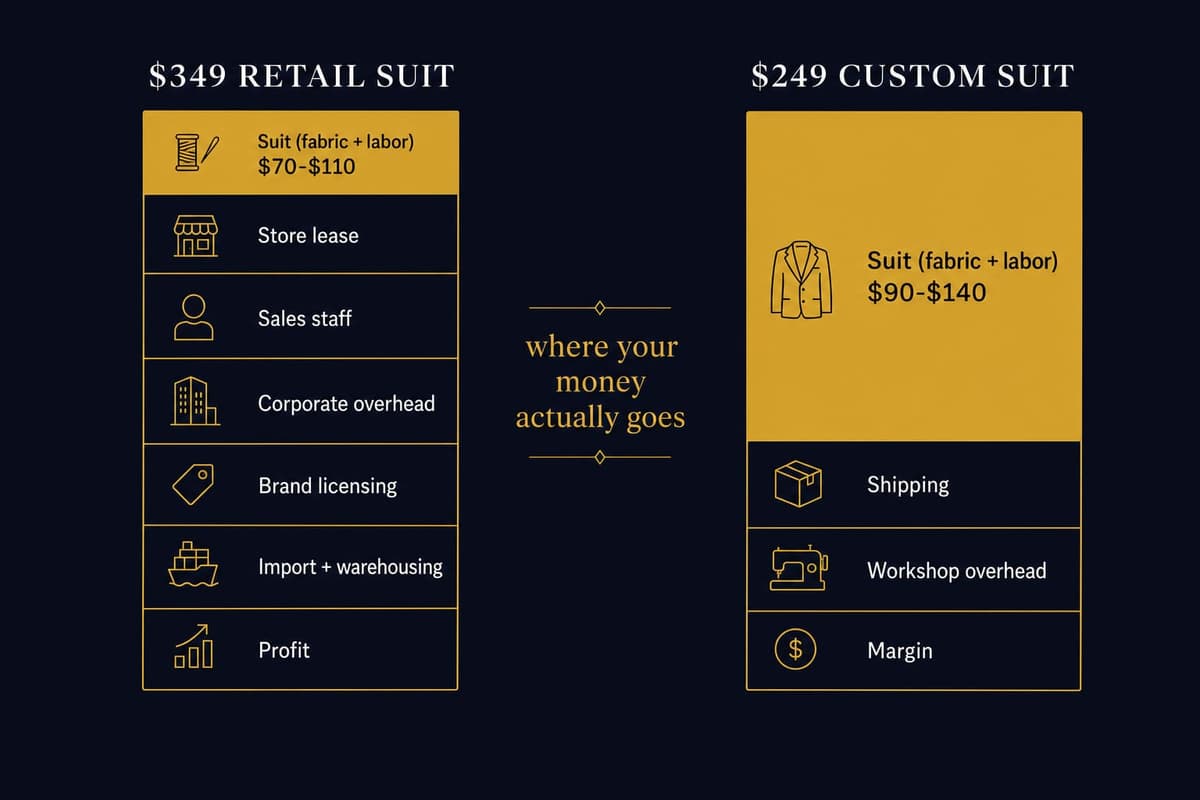
People always ask me: "How can a custom suit cost less than an off-the-rack one?" It sounds counterintuitive. But it makes perfect sense when you see where the money goes. (I trace the full factory-to-rack journey, with sources, in where Men's Wearhouse and Jos A. Bank suits are actually made.)
A $349 Men's Wearhouse suit breaks down roughly like this:
- Fabric and materials: $40 - $60
- Factory production: $30 - $50
- Import, shipping, warehousing: $20 - $30
- Store lease, utilities, build-out: $40 - $60
- Sales staff and store operations: $30 - $50
- Corporate overhead (marketing, executive comp, Tailored Brands HQ): $50 - $70
- Brand licensing fees (Calvin Klein, Ralph Lauren): $20 - $40
- Profit margin: $30 - $50
Add that up: only $70 - $110 of your $349 goes to the actual suit -- the fabric on your back and the labor that put it together. The rest -- roughly 70% -- is overhead, middlemen, and brand tax. This is not unique to Men's Wearhouse; it is simply what a multi-layer retail supply chain costs to run. And it is exactly why a perpetual-discount model -- where the "regular" price is set high to make the markdown feel generous5 -- becomes commercially fragile the moment customers stop believing the sticker.
A $249 Nathan Tailors suit breaks down like this:
- Fabric and materials: $50 - $80 (real wool from established mill suppliers, bought direct)
- Tailoring labor: $40 - $60 (skilled tailors, fair local wages)
- Workshop overhead: $10 - $15 (Hoi An operating costs)
- Quality control, pattern making: $10 - $15
- Shipping (DHL/FedEx): quoted at cost by weight and destination, billed separately
- Business operations and margin: $30 - $50
$90 - $140 goes directly to your suit -- better fabric and more skilled labor than the OTR option. No mall lease. No brand licensing. No five layers of distribution. The math is not complicated. It is just economics.
For the full breakdown, see our detailed guide to how much a custom suit actually costs.
Frequently Asked Questions
Is Men's Wearhouse good quality?
It depends on what you are comparing it to. At the $299 - $499 range, Men's Wearhouse suits are adequate for occasional wear. The branded options (Calvin Klein, Joseph Abboud) use decent fabrics and the in-store experience is helpful for first-time buyers. But the construction is mostly fused -- which means the glued interlining can bubble and delaminate over time, with no effective repair7 -- the fit is generic, and you will likely need $75 - $150 in alterations. For the all-in price of $424 - $649, you could get a superior custom suit made to your exact measurements.
Is Jos A. Bank going out of business?
Not currently. Jos A. Bank's parent, Tailored Brands, filed for Chapter 11 bankruptcy in August 2020 in the US Bankruptcy Court for the Southern District of Texas, which led to some store closures.4 The company emerged from bankruptcy by the end of 2020 and the stores remain open and operating. The brand is not going anywhere, but it has undergone significant changes in quality perception and pricing strategy since the 2014 merger.
Are Men's Wearhouse suits worth it?
For the specific use case of "I need a suit within 48 hours," yes. That convenience has value. For planned purchases where you have 2 - 4 weeks, the value proposition weakens significantly because the same money gets you better fabric, better construction, and a suit built for your body through online custom options. The free lifetime pressing is a genuine perk, and the rental program serves a narrow but real purpose.
How much does a good suit actually cost?
That depends entirely on where you buy it and how many middlemen stand between you and the tailor. A well-made custom suit in good wool with half-canvas construction -- the kind that will last 5 - 8 years -- costs $149 - $349 from a direct-from-workshop source like Nathan Tailors, $399 - $699 from an online MTM brand like Indochino, $499 - $1,299 from SuitSupply, and $800 - $2,000+ from a domestic bespoke tailor. The fabric and construction quality at these price points can be very similar. The price difference is almost entirely overhead and margin.
Can you really get a custom suit for under $300?
Yes. Nathan Tailors' two-piece suits start at $149, and a premium wool blend option with full customization (pick your lapels, pockets, lining, buttons, everything) runs into the low-to-mid $200s, with premium cloths reaching $349. Shipping to the US via DHL is $25 - $40 and takes about a week. We offer a free online Guided Measurement App that walks you through every measurement with photos, WhatsApp consultations, and every garment is cut with generous seam allowances and ships with a piece of the same fabric so a local tailor can adjust the fit if needed. It sounds too good to be true until you understand the economics: no mall lease, no brand licensing, no five layers of distribution. Just fabric, labor, and your measurements.
Should I rent or buy a suit for a wedding?
Buy. Almost always buy. A Men's Wearhouse rental costs $150 - $230 per event. Two events and you have spent $300 - $460 with nothing to show for it. A custom suit from $149 is yours forever and will fit better than any rental. The only exception: you need matching groomsmen tuxedos in an extremely specific style and have less than a week to figure it out. Even then, consider that coordinated custom suits from Nathan Tailors start at $149 each and we handle group ordering . Read our guide to ordering custom clothes online if you are ordering remotely for the first time.
The Bottom Line
Men's Wearhouse and Jos A. Bank are not bad companies. They serve a real purpose: getting guys into suits quickly and affordably at physical stores with in-person help. If urgency is your primary constraint, they earn your money honestly.
But if you have two to four weeks -- and for most suit-buying occasions, you do -- the math overwhelmingly favors custom. You get better fabric, better construction, a suit that actually fits your body, and you pay less all-in. Not because we are undercutting anyone. Because we skipped the layers of overhead between a bolt of wool and your closet.
That is not a sales pitch. That is just how supply chains work.
If you want the full breakdown of what we cut, what we charge, and what construction lands at each tier, our bespoke suits and custom tailored suits page walks through the three tiers from a Hoi An custom tailor with the fabric library and construction details specced out.
If you want to see what we mean, check our full pricing menu or message us on WhatsApp. Linda will probably ask you "Why are you so handsome?!" -- fair warning. But she will also help you figure out exactly what you need, no pressure, no upsell. We have been doing this for 25 years.