Every few weeks someone sends me a photo from a Primark changing room with the same message: "Made in Bangladesh, feels fine, looks fine -- what's actually wrong with it?" It's a better question than most menswear writing gives it credit for, because the honest answer is not "everything." A Primark suit at roughly fifty pounds all-in is, for certain jobs, a genuinely smart purchase, and I'll tell you exactly which jobs. But there are three specific things about how that suit is specified -- not where it's made, and not even mostly what the label says -- that decide whether you'll be happy with it in year two. I'm Jay, I help run Nathan Tailors in Hoi An, Vietnam, where we cut bespoke suits and custom tailored suits for a living, so read me with that bias declared. I'll try to earn your trust by being fair to Primark first.
- The shell is better than you think. Primark's standard suit jacket and trousers are 51% wool / 45% polyester / 4% elastane1 -- a genuine wool-majority blend, not the "pure plastic" people assume. (Their dressier "occasion" jackets are more synthetic, around 69% polyester -- check the label of the exact piece.)
- The country is not the problem. Bangladesh is the world's second-largest garment exporter3, and Bangladeshi factories sew tailoring for M&S and H&M2. The factory sews to whatever spec it's handed; the spec is a price decision made in a head office.
- The three real catches: a 100% polyester lining (the layer that actually sits against you and runs hot), an almost-certainly fused front at this price, and minimal seam allowance -- which together make it a suit that can't breathe, can't be reshaped, and can't be altered as you change.
- Buy it for once. One interview, a school formal, a single wedding as a guest -- a ~£50 Primark suit does that job with full marks6. The disappointment is a repeat-wear story: sheen at the elbows, heat in warm rooms, shape loss over months.
- The alternative isn't snobbery, it's physics: natural-fibre cloth, a canvassed chest, and real seam allowance are what make a suit alterable and wearable for years. That's the whole difference -- at any price.
First, the part everyone gets wrong: the country
"Made in Bangladesh" on a label tells you almost nothing about quality, and what it does tell you is mostly good. Bangladesh is the second-largest ready-made-garment exporter on earth3, its industry rebuilt itself after the 2013 Rana Plaza disaster into a global leader in certified, audited factories, and it is actively moving up-market into structured tailoring -- Bangladeshi factories such as Universal Menswear cut suits and jackets for Marks & Spencer and H&M2. Primark itself publishes its full factory list on a public sourcing map7, which is more transparency than most fashion brands offer.
Here is the sentence that should reframe the whole question: the factory that sewed your £30 Primark jacket could sew a £600 jacket tomorrow, if someone handed it £600 cloth and a £600 spec. The stitching on a Primark suit is usually perfectly competent -- that's why it looks fine on the rack. What a head office decides, to hit a fifty-pound price, is the specification: which cloth, which lining, which internal construction. Those three decisions are where your money went, or didn't. So let's look at them.
The label surprise -- and the lining tell
Flip the jacket open and read the composition label, because it's better than the folklore says. Primark's standard suit jacket and matching trousers are 51% wool, 45% polyester, 4% elastane1. Wool-majority. That is a more respectable shell than "Primark suit" jokes assume, and it's worth saying plainly. (One caveat from the same label-reading: their dressier occasion jackets -- the ivories and textured weaves -- drop to roughly 69% polyester with viscose, so the exact piece in your hand matters. Thirty seconds with the label settles it.)
Now read the second line, the one nobody reads: lining -- 100% polyester. This is the tell, and it's the detail most reviews miss entirely. The lining is the layer that actually touches your shirt and wraps your body heat; the wool content of the shell can't help you through a layer of plastic. Polyester is hydrophobic -- it doesn't absorb or release moisture -- so a fully-poly-lined jacket runs hot and clammy in exactly the rooms suits get worn in: offices in July, wedding marquees, dance floors. There's peer-reviewed science on the unglamorous consequence, too: polyester holds onto body odour markedly more than natural fibres do, because its surface retains the compounds and bacteria that cause it4. A suit you can't easily wash, in a fibre that holds smell, worn hot -- that's the real cost of the lining line on the label.
And polyester in the blend brings its signature ageing problem: sheen. Synthetic fibre polishes itself at friction points -- elbows, seat, lapel edges -- and shines under flash photography and hard office light5. New, the suit photographs fine. Twenty wears in, the elbows start announcing the price.
The two catches you can't see on the label
The front is almost certainly fused. No Primark listing states the construction method, so I won't claim it as fact -- but at this price, everywhere in the industry, the jacket front is glued (fused) rather than built on a floating canvas. A fused front is flat and lifeless compared to canvas, and over years of steam, rain and dry-cleaning it can delaminate -- the "bubbling" you see on old cheap suits. If you want the wider context on how construction tiers work, our bespoke vs made-to-measure vs off-the-rack explainer covers it; the one-line version is that canvas is the difference between a jacket that moulds to your chest and one that sits on it like card.
The seams have nowhere to go. Budget garments are cut with minimal seam allowance -- the spare cloth inside the seams that a tailor lets out when your body changes. Combined with the fused front, this makes a Primark suit essentially unalterable beyond a trouser hem. It fits the you of today, exactly as the rack sized you, and that's the deal. This, more than any fibre percentage, is what makes it a garment with one owner, one shape, one era of your life.
Fairness cuts both ways. Polyester and elastane in the blend are why a Primark suit shrugs off creases -- it will come out of a suitcase looking better than many worsted wools, it holds its colour, it costs almost nothing, and it needs no careful ownership. One warning it does deserve: keep the iron low and use a press cloth, because polyester scorches into a permanent shiny patch at temperatures wool would tolerate. For a garment that needs to look sharp out of a bag twice a year, these are real virtues, not consolation prizes.
When the Primark suit is the right call
Real owners are the best reviewers, and the verdict across student forums and menswear blogs is remarkably consistent: a Primark suit is a "nice cheap suit that actually looks decent but is by no means designed to last." One menswear reviewer bought the full summer suit with change from a fifty-pound note and gave it full marks for exactly what it is6. So, honestly:
- Buy Primark for: a first job interview, a sixth-form formal, a single wedding you're attending as a guest, a costume-adjacent occasion, or a growing teenager who'll be a size bigger by spring. One event, low stakes on longevity, ~£50 -- it's the rational choice and nobody should sneer at it.
- Don't buy Primark for: a suit you'll wear weekly to work, your own wedding, or "the one good suit" you plan to own for years. Every mechanism above -- the poly lining's heat and odour, the developing sheen, the fused front, the unalterable seams -- is a repeat-wear problem. The suit isn't bad; it's specified for once.
If you're weighing the next rungs of the ladder, we've compared the UK high street in detail -- M&S is the natural step up (full suits start around £96-£1288), and our brand comparison engine covers the rest, including how we stack up against M&S. For the hire-counter version of this decision, see our UK suit hire vs buying guide.
What more money should actually buy you
Here's the part where I have an interest, so I'll keep it to physics rather than poetry. When you pay more for a suit -- from us or from anyone honest -- you should be buying three specific things, because they're the exact three things the £50 spec traded away:
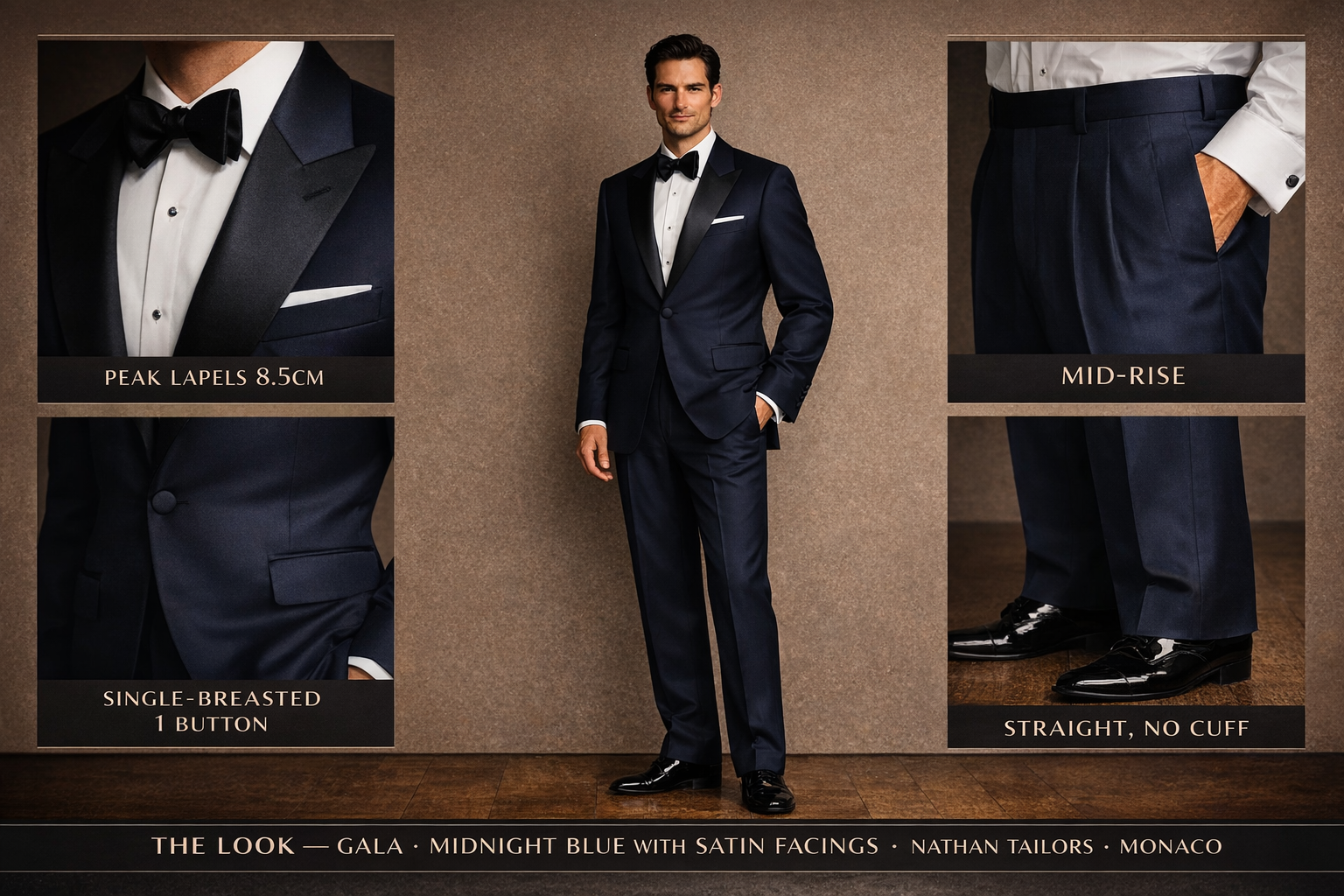
- Natural-fibre cloth, shell and out. Wool breathes, recovers, drapes, and ages by softening rather than shining. Our suits are cut in wool blends up to premium merino blends ($149-$309 depending on cloth) -- not because wool is magic, but because it's the material that behaves like a suit for years instead of months. The full tour of what different cloths do is in our fabric guide.
- A canvassed chest. Half-canvas construction -- a floating layer that moulds to your body with wear -- instead of glue. It's the single biggest structural difference between price tiers.
- Seams with a future. We cut with generous seam allowances and ship spare matching cloth with every suit, so a local tailor can adjust it as your body changes. A suit you can alter is a suit you can keep.
That's the whole honest ladder: Primark for once, the high street for sometimes, and made-to-measure -- ours starts at $149, about the price of three Primark suits -- for the suit you'll actually live in. If that third category is the one you're shopping for, start a free consultation on WhatsApp at +84 905 311 273, or browse the custom tailored suits we cut in Hoi An and ship worldwide. Everything lives at https://www.nathantailors.com.
-- Jay