These Words Get Thrown Around Loosely. Let's Fix That.
I am Jay. I spent 10 years living in the US -- Pennsylvania, New York City, Houston -- buying suits as a customer and learning the hard way what fits and what does not, before settling in Hoi An, Vietnam. I first walked into Nathan Tailors as a customer myself; today I help run the shop, whose tailors have been cutting fabric and building suits for decades, with 530+ five-star Google reviews and 5,000+ clients worldwide.
In that time, I have watched "bespoke" become the most abused word in menswear. Brands that modify a stock pattern by two inches call it bespoke. Online retailers running suits through an algorithm call it bespoke. I once saw a department store hang a "bespoke" sign over a rack of suits that came in S, M, L, and XL.
This is not just sloppy marketing -- it is legally allowed sloppiness. In 2008 the UK Advertising Standards Authority ruled that both bespoke and made-to-measure count as "made to order," which meant the word "bespoke" could be applied even to partly machine-made garments.1 That ruling is the precise reason the term lost its edges. So you cannot trust the label. You have to look at the process.
This matters because you are making a buying decision based on these words, and the industry is counting on you not knowing what they actually mean. The difference between bespoke, made-to-measure, and off-the-rack is not just marketing language -- it determines the pattern, the construction, the fit, and ultimately whether you are getting what you paid for.
Here is what these terms actually mean from the perspective of someone who makes the suits, not just someone who sells them.
The Definitions, Straight From the Trade Body
Before the marketing departments got hold of these words, they had specific meanings -- and the body that polices them, the Savile Row Bespoke Association (SRBA), still publishes them. This is the cleanest, most quotable place to start, so let me give you their definitions verbatim in spirit:
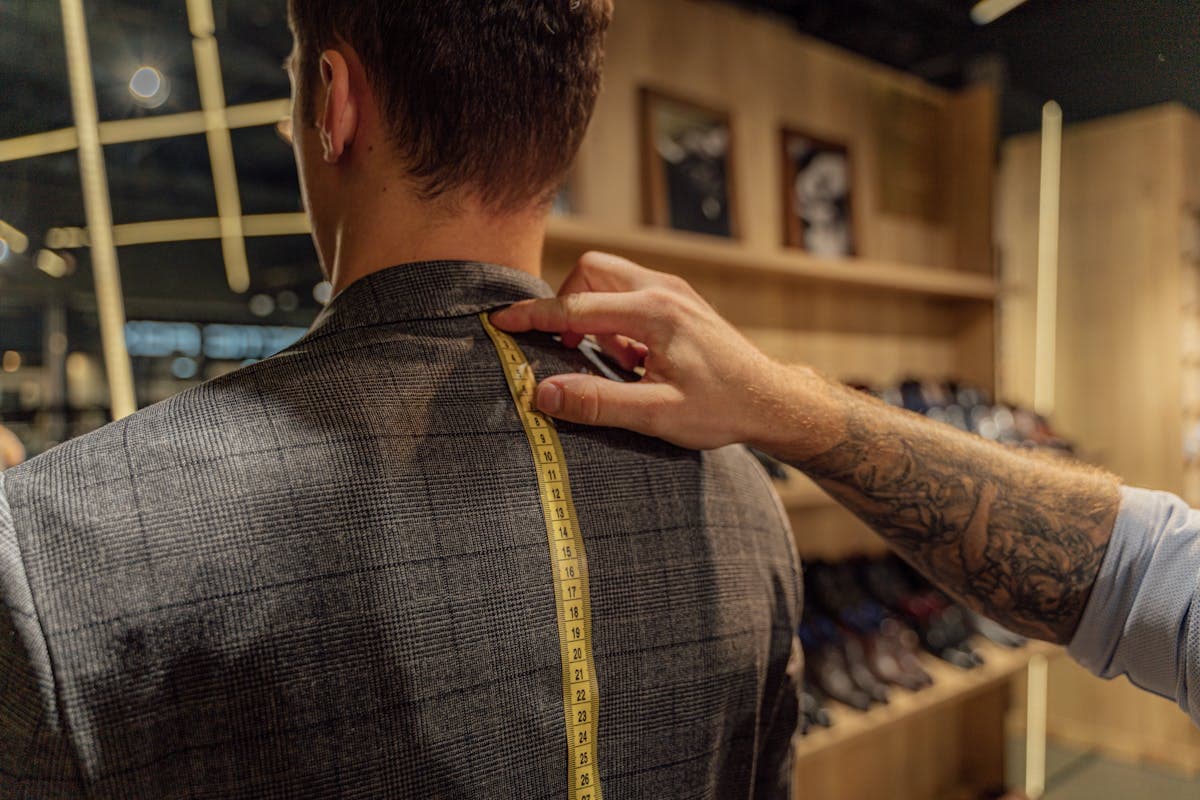
- Bespoke: the SRBA defines it as a suit "bespoken to the customer's specifications... cut by an individual and made by highly skilled individual craftsmen," requiring a minimum of 50 hours of hand work and a series of fittings.2 Wikipedia corroborates the 50-hour hand-labour minimum per two-piece suit.3
- Made-to-measure: the SRBA defines it as a "garment made to a customer's individual requirements, to some extent, but not necessarily by hand."2
That one phrase -- "not necessarily by hand" -- is the entire distinction in miniature. Bespoke is defined by hand labour and an individually cut pattern. Made-to-measure is defined by personalization that a machine and a factory can do. Neither is dishonest. They are simply different products that the market has blurred into one word.
The label is legally fuzzy. A regulator ruled both terms mean "made to order." So judge the process, not the word.
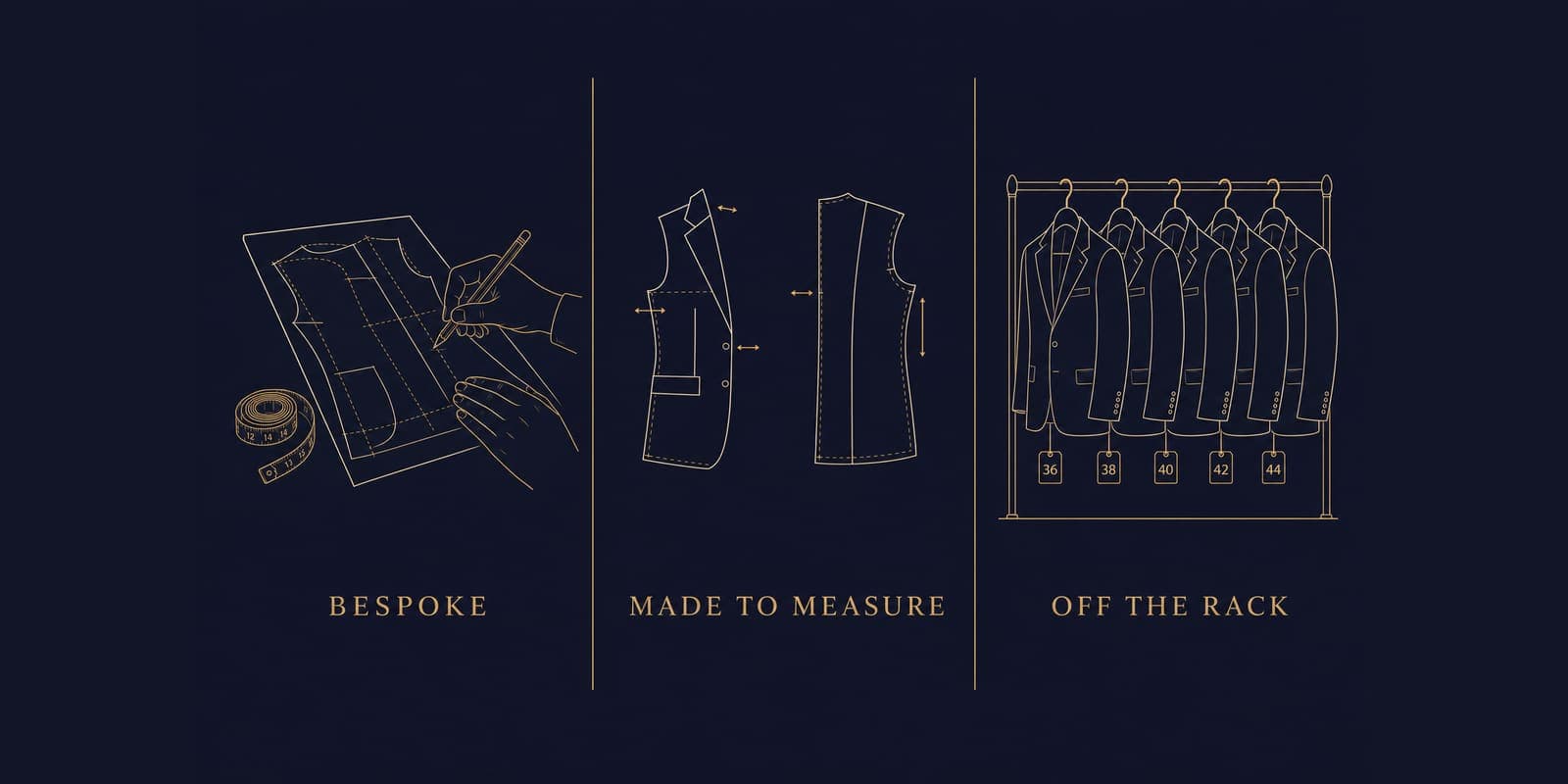
The Quick Comparison: Bespoke vs Made-to-Measure vs Off-the-Rack
Before we go deep on each one, here is the overview. This table is what I wish someone had shown me before I spent $800 on a "bespoke" suit in Manhattan that was really just made-to-measure with a marketing budget.
| Bespoke | Made-to-Measure (MTM) | Off-the-Rack (OTR) | |
|---|---|---|---|
| Pattern | Created from scratch for your body | Adjusted from a base pattern | Standard sizing (38R, 42L, etc.) |
| Measurements Taken | 25-40+ (Huntsman: up to 28) | 10-20 | 0 (you pick your size) |
| Fittings Required | 2-3 minimum | 0-1 | 0 |
| Fabric Selection | Full bolt access, multiple mills | Curated menu (varies widely) | Whatever is on the rack |
| Construction | Hand-stitched, full canvas | Machine + some hand, varies | Often fused interlining |
| Hand Labour | 50+ hrs (up to 80 at top houses) | Limited; mostly machine | Minimal |
| Timeline | 6-12 weeks | 3-6 weeks | Same day |
| Price Range (2026) | $2,000 - $8,000+ | $399 - $1,500 | $100 - $800 |
| Who It Is Best For | Unusual proportions, craft enthusiasts, investment buyers | Most people who want a good fit | Standard body types, need it today |
Now let me explain why each column matters -- and where the marketing spin usually starts.
Bespoke: What It Actually Means
Where the Word Comes From
The word "bespoke" comes from "bespeak" -- to order or speak for something in advance. On Savile Row in London, cloth was said to "be spoken for" by an individual customer: reserved, no longer available to others, before a garment was cut.13 Henry Poole & Co, founded in 1846, is credited as the "Founder of Savile Row."3 In the traditional sense, a bespoke suit means:
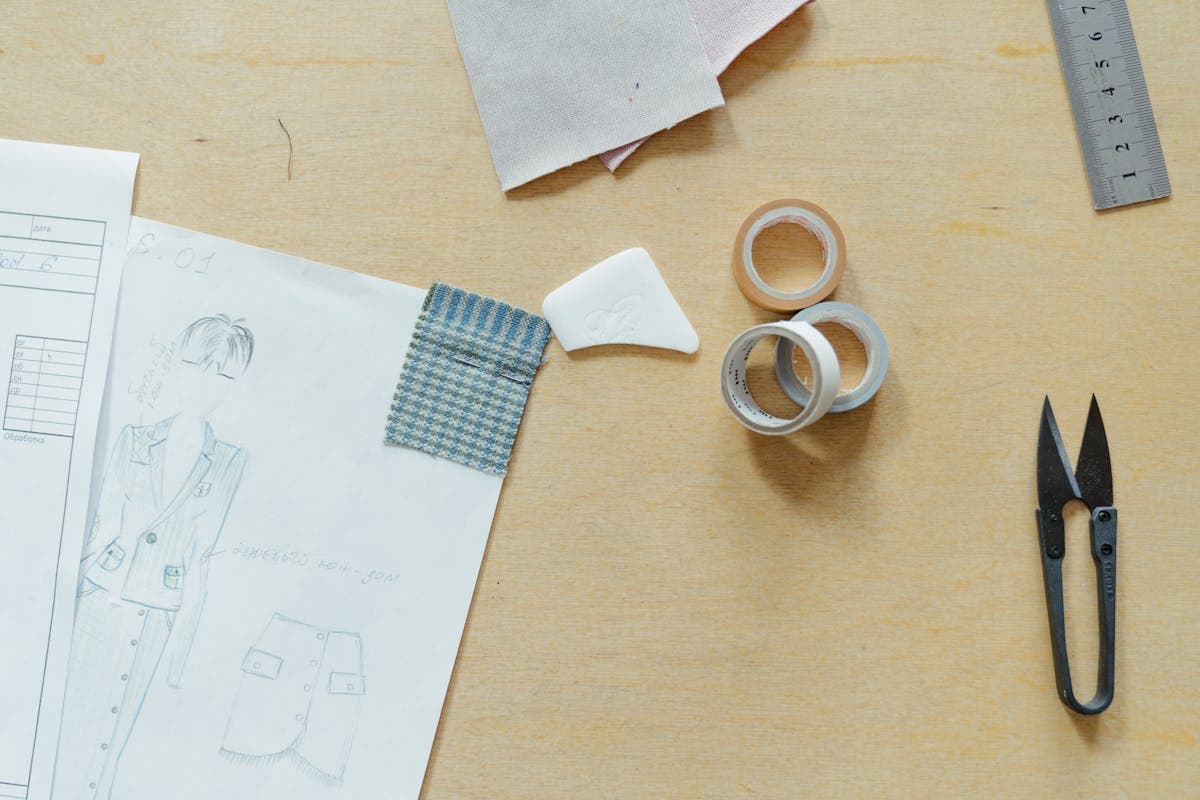
- A unique paper pattern is drafted from scratch -- not modified from a template, but drawn on blank paper based entirely on your body
- 25 to 40+ individual measurements are taken, including posture assessment, shoulder slope, the way your arms hang, and how your body shifts when you move
- Multiple fittings -- typically a baste fitting (the suit assembled in rough form with white stitching), then one or two subsequent fittings for refinement
- Hand-stitched construction throughout -- the canvas is pad-stitched by hand to the cloth, creating a three-dimensional shape that molds to your body over time
- Your pattern is stored permanently -- once created, reorders are easier and the fit improves with each commission
This is the gold standard, and you can see the whole definition come together at a single named house. Huntsman, for example, drafts a unique paper pattern exclusively for the client, takes up to 28 measurements, puts up to 80 hours of handwork into the suit, requires a minimum of three fittings, and starts at £7,000.4 That is the concrete anchor for the whole bespoke column: from-scratch pattern, dozens of measurements, multiple fittings, dozens of hours of hand labour.
On Savile Row in 2026, that craft costs accordingly: $4,500 to $8,000+ for a two-piece suit from houses like Huntsman, Anderson & Sheppard, or Henry Poole. Some reach $10,000 to $15,000+ with premium cloth selections. Cad & The Dandy starts around 1,600 GBP. These are not mass-market prices.
What You Are Actually Paying For
The critical thing most people miss is this: you are paying for the pattern. The individual, unique-to-you paper pattern that only exists because of your body. That pattern is the intellectual property. It is the SRBA's 50-hour minimum of hand work -- up to 80 hours at the top houses -- condensed into a blueprint that no one else shares.24
Everything else -- the fabric, the construction, the finishing -- can be replicated at different price points. But the from-scratch pattern cannot be shortcut. It requires a master cutter with decades of experience, and those people are expensive regardless of where they live.
Where Bespoke Makes Sense
- Unusual body proportions: One shoulder significantly higher than the other, a pronounced stoop, or asymmetric build that no base pattern can accommodate
- Specific functional requirements: A horseback rider who needs extra room in the back, a musician who needs one sleeve cut differently, or anyone whose life demands something a pattern book cannot anticipate
- The craft itself: You appreciate hand-rolled lapels, pick-stitched edges, and the knowledge that a single person guided your garment from paper to finished product
- Long-term investment: You plan to order from the same tailor for years, building a wardrobe on a pattern that improves each time
Where Bespoke Is Overhyped
Here is where I get unpopular with some of my peers: most people do not need bespoke.
If your body falls within a reasonable range of standard proportions -- and the majority of bodies do -- a well-executed made-to-measure suit will fit you beautifully. The marginal improvement from a from-scratch pattern versus a well-adjusted base pattern is real, but for most people it is not worth the 3x to 10x price premium.
The bigger problem is brands calling MTM "bespoke" to justify higher prices -- and as we saw, a 2008 regulator ruling made that legally defensible.1 If someone takes 10-12 measurements, plugs them into software that adjusts a base pattern, and sends it to a factory -- that is made-to-measure. It can be excellent made-to-measure. But it is not bespoke, regardless of what the marketing deck says.
How to spot the difference: Ask the tailor, "Do you draft an individual pattern for me from scratch, or do you adjust a base pattern?" If they hesitate or get vague, it is MTM with a rebrand.
Made-to-Measure: The Sweet Spot for Most People
How It Actually Works
Made-to-measure starts with a pre-existing base pattern -- a template that represents a standard body in a given size -- and adjusts it based on your individual measurements. The tailor takes 10 to 20 measurements, and those measurements modify the base pattern's proportions: longer sleeves, wider chest, narrower waist, higher armholes, and so on. This is exactly what the SRBA means by a garment "made to a customer's individual requirements, to some extent, but not necessarily by hand."2
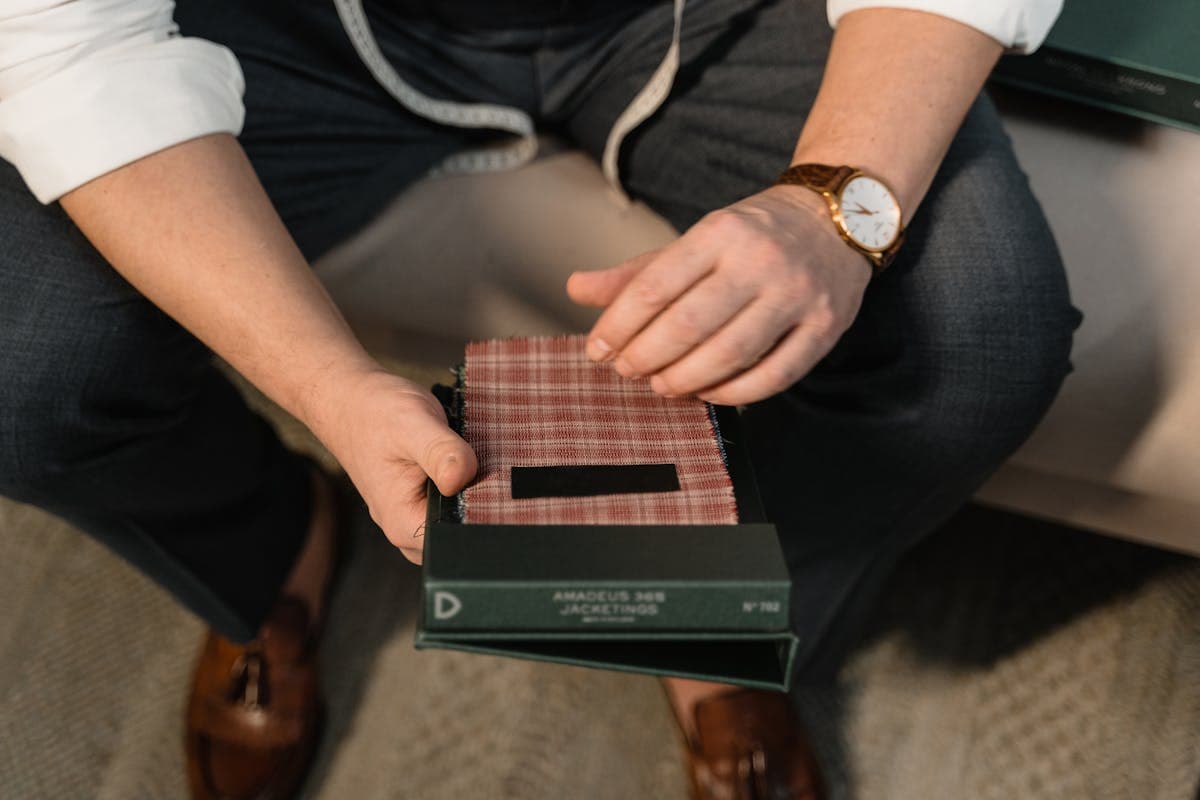
The result is a suit that is personalized to your body without the from-scratch pattern drafting that defines bespoke. You still get to choose your fabric, your lapel style, your button configuration, your pocket style, and your lining. You still get a garment that is cut specifically for you. You just do not get a pattern that was born on a blank piece of paper.
The Spectrum Within MTM
This is where it gets complicated, because not all MTM is created equal. The category spans a huge range:
| MTM Tier | What They Actually Do | Examples | Price Range |
|---|---|---|---|
| Basic MTM | Adjust 5-8 measurements on a base pattern. Minimal customization. Often just sleeve and trouser length. | Department store MTM programs, some online brands | $300 - $500 |
| Mid-Range MTM | Adjust 10-15 measurements. Good fabric selection. Some construction choices (canvas vs fused). | Indochino ($399-$699), SuitSupply MTM ($699-$1,299) | $399 - $1,300 |
| High-End MTM | 15-20+ measurements. Full canvas construction. Premium fabrics. Multiple fittings. Approaches bespoke. | Independent tailors, Nathan Tailors, high-end ateliers | $500 - $1,500+ |
The difference between the low end and the high end of MTM is often bigger than the difference between high-end MTM and entry-level bespoke. A basic MTM program that adjusts five measurements on a factory-produced suit is a completely different product from a skilled tailor who takes 15+ measurements and hand-adjusts the pattern with years of experience guiding every decision.
Online MTM vs In-Person MTM
Online MTM brands like Indochino and Black Lapel have made custom suiting accessible to millions of people, and that is genuinely good for the industry. But there is a real trade-off with remote ordering: nobody is looking at your body.
Numbers on a tape measure do not capture everything. An experienced tailor sees that your left shoulder sits half an inch higher. They notice that you lean slightly forward. They see where your body carries tension and how that affects the way fabric drapes. These observations go into the pattern adjustments but are nearly impossible to capture through self-measurement alone.
That said, online MTM has gotten remarkably good -- especially for people who already know their measurements from a previous fitting. If you want to learn how to measure yourself accurately for remote ordering, we have a step-by-step visual measurement guide that walks you through the process. And when you are choosing cloth remotely, our fabric catalog shows you exactly what you are picking before anything gets cut.
Honest Trade-Offs of MTM
- Still a modified pattern: You are getting an adjusted version of a template, not a pattern that was born from your body alone
- Fit ceiling: For truly unusual proportions, MTM adjustments can only go so far before the base pattern distorts
- Quality varies wildly: "Made-to-measure" covers everything from excellent to barely better than OTR
- But for most people: A well-executed MTM suit is 90-95% as good as bespoke at 30-50% of the price
Off-the-Rack: When It Makes Sense (and When It Does Not)
What "42R" Actually Means
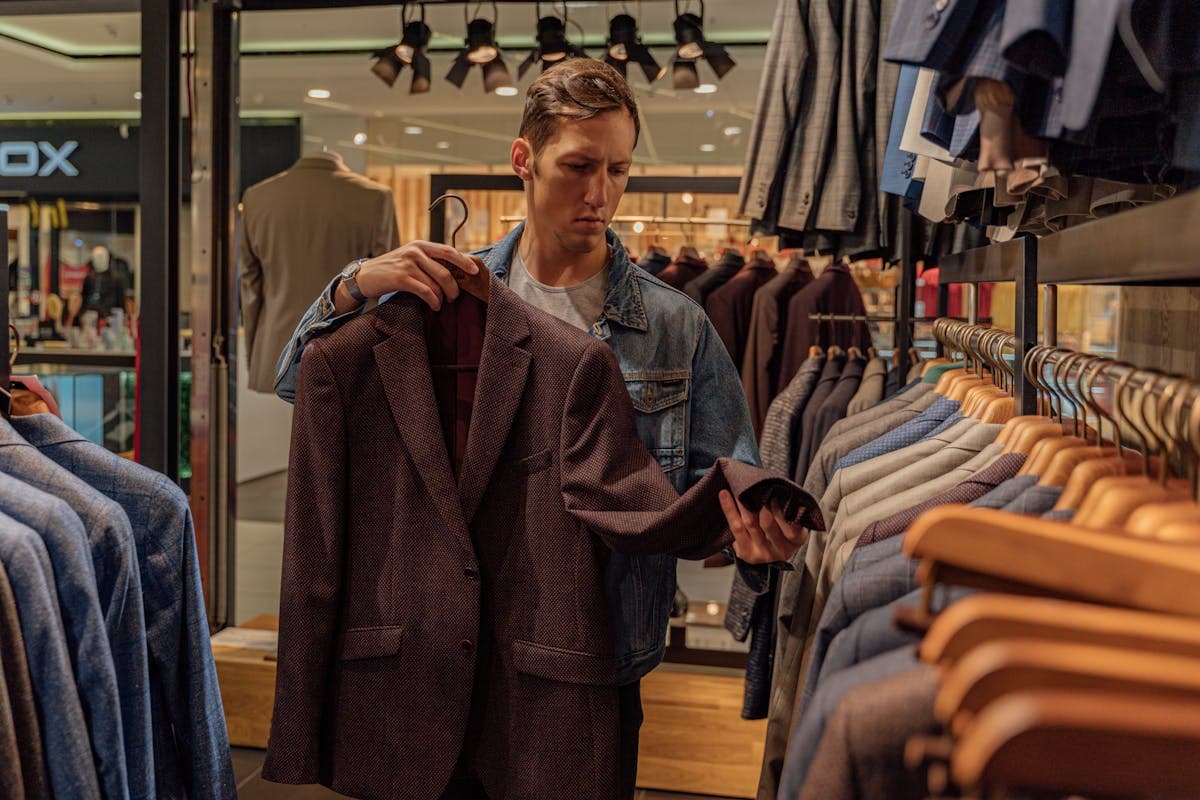
An off-the-rack suit is manufactured in standard sizes based on a set of average body proportions. When you pick up a "42R," you are getting a suit designed for someone with a 42-inch chest in a "Regular" length (R/S/L = Regular/Short/Long).7 Everything else -- shoulder width, arm length, waist suppression, trouser rise, jacket length -- follows a set of proportional assumptions baked into that size.
The clearest example is the "drop." Off-the-rack sizing pairs a jacket with a trouser waist a fixed amount smaller -- conventionally a 6-inch drop, so a size 40 jacket comes matched to size 34 trousers. That ratio is designed for a statistically "average" man.7 The trouble is that ready-to-wear is built for an average body that does not really exist: anyone whose chest-to-waist ratio differs from that 6-inch drop -- the athletic V-taper, the fuller midsection, the lean runner -- has to compromise on fit or pay for alterations.7 Most bodies do not match the standard drop. That is the mechanism behind every "it just does not sit right" complaint.
Who OTR Actually Works For
- Standard proportions: Your chest, waist, and arm length fall within the brand's expected ratios for your size
- Need it today: You have an event tomorrow and there is no time for anything custom
- Budget-limited: You need a suit for under $200 and MTM is not an option right now
- Trying something new: You are experimenting with a style or color you are not sure about and do not want to commit MTM money to a test
The Alteration Reality
Here is what nobody tells you at the register: most OTR suits need $75 to $200+ in alterations to fit properly. Sleeve shortening, trouser hemming, waist suppression, maybe shoulder adjustment. By the time you factor in alterations, a $500 OTR suit becomes a $600 to $700 suit that still cannot match the fit of a MTM garment that was cut for you from the start.
And there are things a tailor cannot fix after the fact. Shoulder width. Armhole height. Chest pitch. If these are wrong in the original garment, no amount of alteration will make them right. You can read more about what can and cannot be altered in our guide to suit fit problems.
Good OTR Exists
I am not here to tell you OTR is always bad. It is not. Suitsupply's ready-to-wear line uses canvas construction -- the brand describes both half-canvas and full-canvas options on its own site, not fully fused garments6 -- which is a big reason its suits punch above their price. J.Crew Ludlow is a solid entry point in the $350-$500 range. Brooks Brothers has been dressing American professionals for over 200 years and their 1818 line delivers consistent quality.
But even the best OTR suit is designed for a hypothetical average body. You are adapting your body to the suit, not the suit to your body. That is the fundamental difference, and for many people it is the difference between a suit that looks "fine" and one that makes people say "that fits you perfectly."
The Construction Spectrum: What Is Inside Your Suit Matters More Than You Think
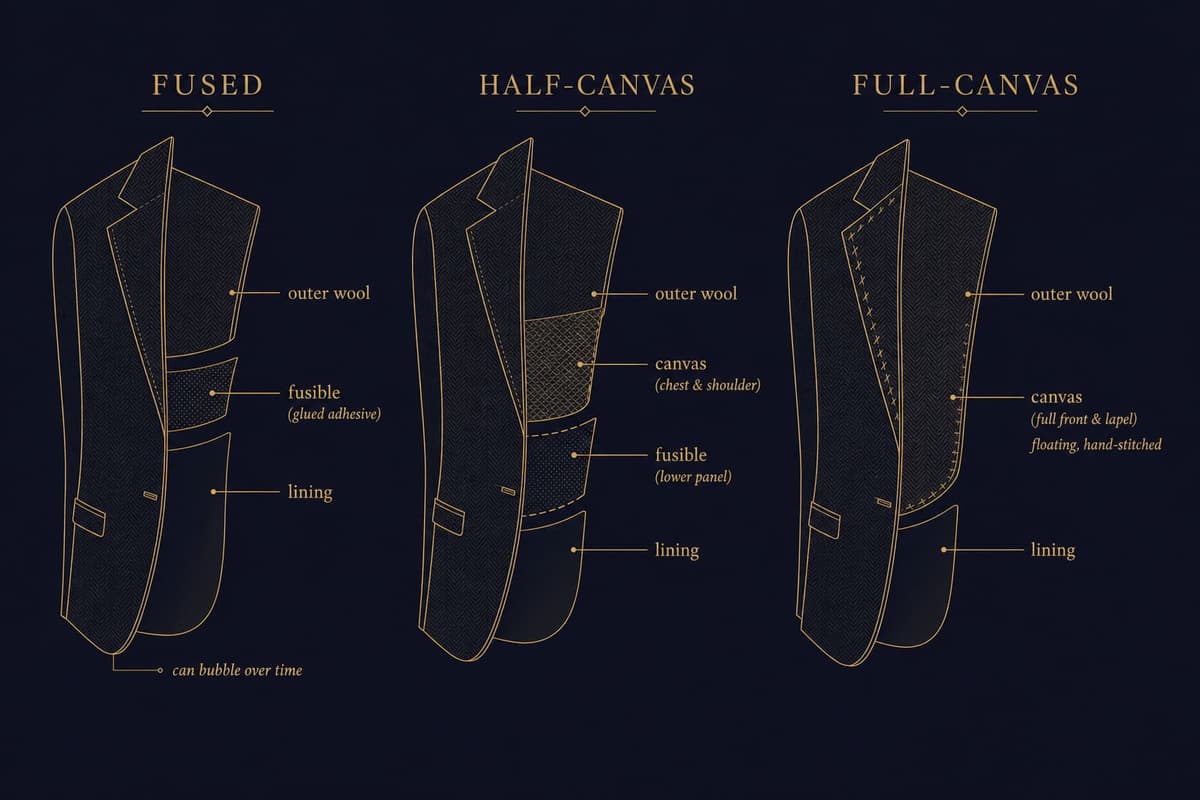
Most conversations about bespoke vs MTM vs OTR focus on fit. But construction -- what is happening inside the jacket, between the outer fabric and the lining -- determines how the suit drapes, moves, ages, and breathes. This is where a huge portion of the cost difference lives, and where brands cut corners first. The clearest plain-English breakdown of these three constructions comes from the menswear retailer Black Lapel, and I am leaning on their definitions here.5
Fused Construction (Most OTR Suits)
A fused suit uses a fusible interlining glued to the wool shell -- heat-activated adhesive bonding a synthetic layer directly to the outer fabric.5 It is fast, cheap, and produces a flat, uniform structure. The majority of suits under $500 -- and many suits above that price -- use fused construction.
The problem: over time the glue can separate and air gets in between the layers, which is what causes the bubbling or delamination you have seen on older suit lapels.5 Once it starts, there is no fixing it. The suit is dead.
A fused suit typically lasts a few years with regular wear before the structure starts to go. For a suit you wear once or twice a year, fused is fine. For something you wear weekly, it is a ticking clock.
Half-Canvas Construction (Good MTM and Better OTR)
A half-canvas suit adds a canvas layer stitched from the shoulder through the chest, on top of a fusible in the lower portion.5 This gives you the drape and shape benefits of canvas where they matter most (the chest and lapels) while keeping costs down.
Half-canvas is the sweet spot for most people. It breathes better than fused, drapes more naturally, and will not bubble the way a fully fused jacket can. Suitsupply describes its half-canvas as ensuring a natural form to the chest of the jacket;6 most good MTM brands offer half-canvas as standard or as an upgrade.
Full Canvas Construction (Bespoke and Premium MTM)
A full-canvas suit has canvas spanning the entire front panels and lapels, hand-stitched loosely as a "floating" canvas so the garment moves with you.5 Crucially, the canvas conforms to your body over time and the jacket fits better the more you wear it.5 Suitsupply describes its own full-canvas as a full-body construction with a firm structure that keeps the whole jacket in shape.6
This is why a well-worn full-canvas suit fits better after 50 wears than it did new. The canvas is literally reshaping itself to mirror your posture, your chest, the way you hold your arms. It is also why a full-canvas suit breathes noticeably better -- there is no continuous layer of adhesive blocking air circulation.
Full canvas adds $100 to $300+ to the cost of a suit depending on where it is made. At Nathan Tailors, full-canvas construction is available on premium suits. For a detailed breakdown of fabrics and what to pair them with, see our complete suit fabric guide.
How to Check What You Are Getting: The Pinch Test
Here is a trick that takes three seconds, described almost verbatim by Black Lapel: pinch the front of the jacket between the buttonholes and feel whether there is a separate layer between the lining and the outer fabric.5 If you feel a distinct middle layer that moves independently, there is a canvas in there. If you only feel two layers bonded together that will not separate, it is fused.
If a salesperson tells you a suit is "half-canvas" or "full-canvas," do the pinch test anyway. Trust, but verify.
The Real Question: What Level Do You Actually Need?
Forget the marketing. Forget the prestige. Here is a practical decision framework based on your actual situation:
You Own 0-1 Suits and Need Something Reliable
Go made-to-measure. Your first real suit should fit you properly. An MTM suit in a versatile navy or charcoal from a reputable brand will cover job interviews, weddings, funerals, and client meetings. Budget $399 to $600 from a mainstream MTM brand, or from $149 with a Vietnam-based tailor like Nathan Tailors. See our full custom suit cost breakdown for the detailed economics.
You Own 3+ Suits and Want Something Special
Consider bespoke for your go-to suit. If you have a working rotation and want one suit that is genuinely yours -- pattern stored, fit perfected over multiple commissions -- bespoke makes sense for that piece. Keep the rest of your rotation MTM.
You Need It by This Weekend
OTR plus a good tailor. Buy the best OTR suit you can afford in a size that fits your shoulders (shoulders are the hardest thing to alter). Then take it to a local tailor for sleeve shortening, trouser hemming, and waist suppression. Budget $75 to $150 for alterations. This will not be perfect, but it will be presentable.
You Are Budget-Conscious But Want Real Quality
Vietnam-based custom tailoring. This is what we do at Nathan Tailors, and it is the category that confuses people the most because it does not fit neatly into the bespoke/MTM/OTR boxes.
Our process is closer to bespoke: we take 15+ measurements, our tailors build patterns with individual adjustments, and we offer multiple revision rounds until the fit is right. But our prices sit in the MTM range -- suits starting at $149, shirts from $39 -- because we operate in Hoi An, Vietnam, where our overhead is a fraction of what a shop in Manhattan or London pays.
The economics are simple: our tailors are equally skilled (many have 20+ years of experience), we work with real wool from established mill suppliers (and we tell you the exact blend composition upfront), and our rent, labor costs, and lack of middlemen mean more of your money goes into the actual garment instead of subsidizing retail overhead. We are not pretending our cloth tier matches what a $4,000 brand uses. For a deeper comparison of how this stacks up against the major MTM brands, see our Indochino vs SuitSupply vs Nathan Tailors comparison.
The Nathan Tailors Approach: Bespoke Process, MTM Price
I want to be transparent about what we offer because I think it is genuinely different from both the traditional bespoke model and the standard online MTM model.
| Factor | Savile Row Bespoke | Online MTM (Indochino, etc.) | Nathan Tailors |
|---|---|---|---|
| Pattern Approach | From-scratch by master cutter | Software-adjusted base pattern | Individual pattern adjustments by experienced tailors |
| Measurements | Up to 28 (Huntsman) | 10-12 (self-measured) | 15+ (guided or in-person) |
| Fitting Process | Minimum 3 in-person fittings | Ship, try, request alterations | Multiple revision rounds, remote photo review |
| Fabric Source | Top-tier heritage mills | In-house sourced, varies | Wool blends to premium worsted wool from established mill suppliers |
| Construction | Full canvas, hand-stitched | Half-canvas or fused | Half-canvas standard, full-canvas available |
| Hand Labour | 50-80 hrs | Mostly machine | Hand finishing on key seams; full-canvas pad-stitched |
| Timeline | 8-12 weeks | 3-5 weeks | 2-4 weeks |
| Suit Price | $4,500 - $8,000+ (Huntsman from £7,000) | $399 - $699 | From $149 |
| How we handle fit | Unlimited adjustments in-person | $75 alteration credit (Indochino); 30-day returns (SuitSupply) | Seam allowances + extra cloth for local alterations |
We are not trying to be Savile Row. We are not competing with the master cutters who have spent 30 years perfecting the art of bespoke pattern drafting. What we are doing is delivering a level of personalization and quality that most Western MTM brands charge 3-5x more for, because our cost structure in Vietnam allows it.
Our tailors are not cheaper because they are less skilled. They are cheaper because rent on Tran Hung Dao Street in Hoi An is not $25,000 per month like it would be in SoHo. Because we do not need a $2 million marketing budget. Because we sell direct to customers instead of through a chain of middlemen who each take their cut.
Comparable wool and construction techniques from established mill suppliers -- at a fraction of the overhead. The cloth is real, you can see it before we cut, and the difference in price is the cost structure -- which goes directly back into your pocket. For a deep dive into how these economics work, read our guide to ordering custom clothes online.
Common Mistakes When Choosing Between the Three
Mistake 1: Paying Bespoke Prices for MTM Quality
Some brands in major cities charge $2,000+ for what is fundamentally a made-to-measure process with a fancier storefront -- and because the regulator blurred the words, they can legally call it bespoke.1 Ask the specific questions: Is the pattern drafted from scratch? How many measurements are taken? Is the canvas pad-stitched by hand? If you are paying bespoke prices, you should be getting bespoke process.
Mistake 2: Assuming All MTM Is the Same
The gap between basic MTM and high-end MTM is enormous. A brand that adjusts five measurements on a factory pattern and a tailor who takes 15+ measurements and hand-adjusts with decades of experience are both called "made-to-measure." The label is the same. The product is not.
Mistake 3: Ignoring Construction Entirely
A $600 fused suit and a $600 half-canvas suit are completely different products. Construction determines longevity, drape, breathability, and how the suit ages. Always ask about canvas versus fused -- and do the pinch test yourself.5
Mistake 4: Forgetting Alterations in the OTR Price
An OTR suit that "costs $500" really costs $575 to $700 after the alterations you will almost certainly need. Factor that into your comparison. At those prices, you are often already in MTM territory.
Mistake 5: Choosing Based on Prestige Instead of Fit
A $200 MTM suit from Vietnam that fits you perfectly will look better than a $2,000 OTR suit from a luxury label that pulls across the chest and bunches at the shoulders. Fit is the single most important factor in how a suit looks on your body. Everything else is secondary.
Frequently Asked Questions
What does bespoke mean?
Bespoke means a garment made from scratch for one specific person. The Savile Row Bespoke Association defines it as a suit cut by an individual and made by skilled craftsmen, requiring a minimum of 50 hours of hand work and a series of fittings, with an individually cut pattern.2 The word comes from cloth being "bespoken for" -- reserved for a customer's commission.3 The term is now widely misused because a 2008 UK Advertising Standards Authority ruling held that both bespoke and made-to-measure count as "made to order," allowing "bespoke" to apply even to partly machine-made garments.1 The key distinction is the pattern: true bespoke creates a new pattern from blank paper; made-to-measure adjusts an existing one.
Is made-to-measure worth it?
For most people, made-to-measure offers the best balance of fit, quality, and value. A good MTM suit delivers 90-95% of the fit benefits of bespoke at 30-50% of the cost. It is especially worth it if you have body proportions that differ from standard sizing -- which, given that off-the-rack assumes a fixed 6-inch drop between chest and waist,7 is most people. The only scenario where MTM might not be worth it is if you need a suit immediately (OTR is faster) or if you have highly unusual proportions that exceed what base pattern adjustments can accommodate (bespoke territory). At Nathan Tailors, MTM suits start at $149, making the value proposition straightforward.
What is the difference between custom and bespoke?
"Custom" is a broad term that covers both bespoke and made-to-measure. All bespoke suits are custom, but not all custom suits are bespoke. In the US market, "custom" usually means made-to-measure -- a suit adjusted from a base pattern to your measurements. In the UK, "bespoke" specifically means a from-scratch pattern and handmade construction.2 When a brand advertises "custom suits," ask whether the pattern is created from scratch or modified from a template. That question will tell you whether you are getting bespoke, MTM, or just marketing language.
How much should a made-to-measure suit cost?
In 2026, a quality made-to-measure suit costs between $149 and $1,500 depending on where and how it is made. Online MTM brands like Indochino run roughly $399 to $699 (sale prices dip lower). SuitSupply's MTM line runs $699 to $1,299. High-end domestic MTM can reach $1,500+. Vietnam-based MTM through shops like Nathan Tailors starts at $149. We are not claiming our cloth matches what $4,000 luxury brands use -- it does not -- but in the SuitSupply / Indochino tier the price gap is mostly geography, overhead, and supply chain rather than cloth. Read our complete custom suit cost breakdown for the full picture.
Can you get bespoke quality at made-to-measure prices?
You can get close. The key elements of bespoke quality -- precise fit, quality construction, good fabrics -- are all achievable at MTM price points when the cost structure is right. What you cannot replicate at MTM prices is the from-scratch pattern drafting by a master cutter, which requires decades of specialized training and the SRBA's 50+ hours of hand labour per suit.2 However, for the great majority of bodies, a well-executed MTM process with 15+ measurements and experienced tailors delivers a fit that is functionally indistinguishable from bespoke. People with significant asymmetries or truly unusual proportions are the ones who genuinely need the bespoke process.
How long does each type of suit take?
Off-the-rack is same-day -- you walk in, find your size, and walk out. Made-to-measure typically takes 3 to 6 weeks depending on the brand. Online MTM brands like Indochino and SuitSupply generally deliver in 3 to 5 weeks. Nathan Tailors completes remote orders in 2 to 4 weeks including shipping via DHL or FedEx. Traditional bespoke takes 6 to 12 weeks because of the pattern drafting process and multiple fittings.4 If you are visiting Hoi An in person, we can complete suits in as few as 3 days with daily fittings.
The Bottom Line
Here is the honest summary from someone who has been on both sides of the measuring tape:
- Bespoke is a luxury craft worth experiencing if you value artisanship, have unusual proportions, or plan to build a long-term relationship with a tailor. It is defined by an individually cut pattern and 50+ hours of hand work.2 Budget $2,000+ minimum in Asia, $4,500 to $8,000+ on Savile Row.
- Made-to-measure is the right choice for most people. A good MTM suit fits better than any OTR suit ever will, and the price range -- from $149 at shops like ours to $1,300 at Western brands -- means there is an option for every budget.
- Off-the-rack makes sense when you need something today, when you are on a tight budget, or when your body happens to match a brand's standard sizing and its 6-inch drop.7 Just factor in $75 to $200 for alterations and know the fit ceiling.
The most important thing is not which category you choose -- it is understanding what you are actually getting for your money. Ask about the pattern. Ask about the canvas. Do the pinch test. And do not let anyone charge you bespoke prices for a modified base pattern and a marketing deck.
If you have decided you want bespoke-style construction without the bespoke price tag, our bespoke suits and custom tailored suits page walks through the three pricing tiers, the fabric library, and exactly what construction details land on the garment at each tier -- directly from a Hoi An custom tailor.
If you have questions about what level of custom is right for your situation, or if you want to explore what Nathan Tailors can do for you, message us on WhatsApp. Linda -- our charming Vietnamese Lady Boss -- will probably greet you with "Why are you so handsome?!" but do not let that distract you. She also happens to know more about suit construction than most people in the industry.
We are at 127 Tran Hung Dao Street, Hoi An, Vietnam, and we ship to 50+ countries worldwide. Whether you visit us in person or order remotely, we treat every customer like family -- because that is how we have built 25+ years of trust and 530+ five-star reviews.