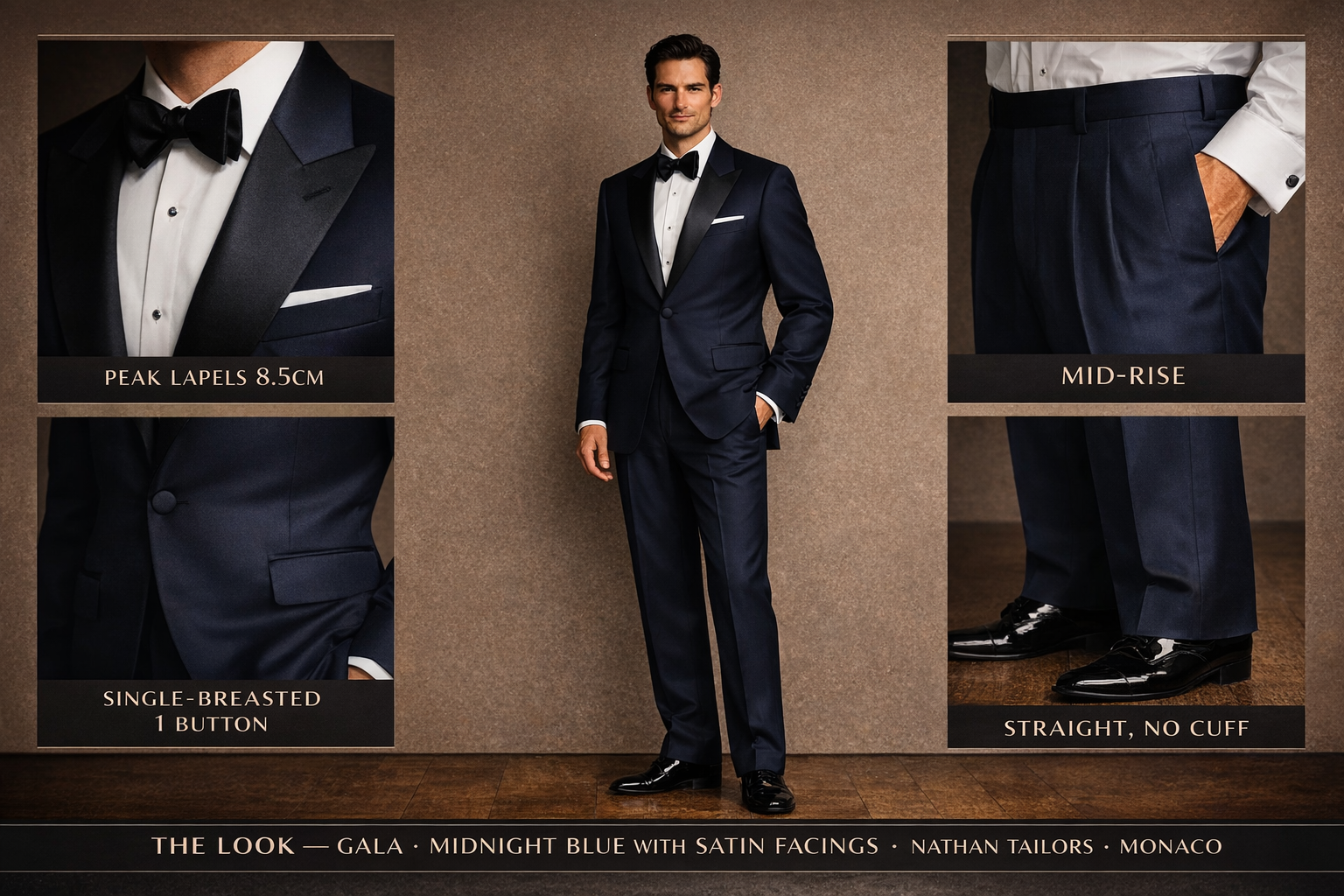
The Line Most of Menswear Forgets to Draw
The modern Asian custom-suit industry — the one that serves expats, businesspeople, and menswear enthusiasts around the world — was built by Shanghainese tailors who fled China in 1949, settled in Hong Kong, and within a generation were dressing Savile Row's most demanding clients. Hoi An, the quiet river-port that Nathan Tailors calls home, is part of the same story: its tailoring tradition was seeded by Chinese merchants who'd been settling the town continuously since the 16th century. The line from Nanjing silk to Shanghai bespoke to Hong Kong's Kowloon tailors to Hoi An's atelier quarter isn't folklore. It's a single, traceable thread, and it explains why custom menswear in Asia is genuinely world-class — not a cheap copy of Western craft, but the parallel descendant of the same tradition.
Most people shopping for a custom suit in Asia have no idea they're walking into a 400-year-old industry. This piece fixes that.
Shanghai, 1920s–1940s: The Golden Age
By the 1920s Shanghai was the commercial capital of East Asia — a treaty-port city of four million people, seven nationalities, and the highest concentration of silver in the Pacific. Western businessmen poured in; so did Russian émigrés, Japanese industrialists, Parsis, Sephardim, and the new Chinese bourgeoisie. Everyone needed a suit.
What emerged on the blocks around Nanjing Road was the Ningbo tailoring tradition — craftsmen who'd migrated from Ningbo Prefecture (modern Zhejiang) and who fused European cutting technique with Chinese hand-finishing. They learned from British fitters working for Jardine, Matheson & Co. and French cutters at the French Concession's tailoring houses. Within twenty years they'd built something the British had never seen: tailors who could copy a Savile Row pattern flawlessly, finish it by hand using Ningbo silk techniques, and deliver in a quarter of the London time.
By 1945 Shanghai had an estimated 3,000 bespoke tailors. The best-known of them were collectively called the "Red Gang" (Hong Bang, 红帮) — not a criminal organization but a guild that dominated the city's high-end menswear. They trained apprentices through seven-year indentures. They kept cut-books that passed between generations. They dressed Sun Yat-sen (the Zhongshan suit they designed became the blueprint for the modern Chinese lounge suit) and later, every industrialist, diplomat, and gangster who could afford them.
1949: The Exodus to Hong Kong
When the Communist Party took Shanghai in May 1949, the tailors had a choice: stay and risk denunciation as bourgeois parasites, or flee with their cut-books and go elsewhere. Thousands chose Hong Kong.
They arrived with almost nothing — their tools, their patterns, and a trained hand. Within five years they'd rebuilt the Shanghai industry on the other side of the border. By 1955 Kowloon and Tsim Sha Tsui had more bespoke tailors per square kilometre than anywhere on earth except Savile Row itself. American military personnel stationed in Hong Kong during the Korean War discovered them first; British expats followed. The pipeline to London was built within a decade.
Three names anchor the Kowloon generation: W.W. Chan & Sons (founded by a Shanghai Red Gang master who'd fitted Chinese president Chiang Kai-shek), Ascot Chang (who'd apprenticed on Nanjing Road and opened in 1953), and Sam's Tailor in Tsim Sha Tsui (who became the go-to for visiting US presidents, CEOs, and the original jet-set). All three are still cutting today. All three train their next generation in the Shanghai Red Gang techniques, unchanged.
Why this matters for the rest of us
By the 1970s the Kowloon tailors were flying to New York, London, Boston, and Singapore on rotating "trunk-show" schedules — a model that still exists. They dressed Henry Kissinger, George H.W. Bush, Bill Clinton. They were quietly the reason why "Hong Kong tailoring" entered the English menswear vocabulary as synonymous with fast, precise, and excellent. Every online made-to-measure brand today — Indochino, Hockerty, Proper Cloth — is, structurally, a descendant of this tradition. The pattern-book-plus-remote-measurement model was invented by Shanghainese tailors trying to serve clients they'd never meet in person.
Hoi An: The Other Branch of the Same Tree
The story most Western menswear writers miss is that Hoi An's tailoring tradition is older than Shanghai's. By several centuries.
Hoi An — Faifo to the Portuguese traders who called there in the 1500s — was the primary international port of central Vietnam for nearly 400 years. Chinese merchant families from Fujian, Guangdong, and Hainan settled the town continuously from the 16th century onward. They built the Fujian Assembly Hall (1690), the Cantonese Hall (1885), and the dense network of shophouses that still defines the Old Town today. With them came silk merchants, cotton traders, and tailors. The Vietnamese court at Hue bought court robes from Hoi An's Chinese tailors. Japanese traders — who had their own enclave in the town — bought kimonos and haori. Dutch East India Company officers commissioned Western-style coats from tailors who'd been cutting both Chinese silk gowns and Portuguese waistcoats since their grandfathers' generation.
By the 19th century Hoi An had over 200 working tailors — extraordinary for a town of its size. The skills were passed father-to-son within the Chinese merchant clans, and later extended outward as intermarriage blurred the line between the town's "Minh Huong" (naturalized Chinese) and ethnically Vietnamese populations.
When the Shanghainese diaspora of 1949 scattered across Asia, some branches landed in Saigon and, by the 1960s-70s, in central Vietnam. They found a local tailoring tradition that already spoke their professional language: the same silk techniques, the same hand-finishing, the same cultural assumption that a tailor was a respected master rather than a service worker. The two traditions — Shanghai bespoke and Hoi An shophouse — merged over thirty years. The workshop we operate today inherits both.
The Vietnamese Synthesis: What Hoi An Does That Hong Kong Doesn't
By the 2000s the Hong Kong tailors had been working at the luxury end of the market for so long that their prices had drifted into genuine Savile Row territory — $3,000-$5,000 for a two-piece at W.W. Chan, more at Ascot Chang. Skilled, yes. Accessible to most, no.
Hoi An became the answer. Three things distinguish the Vietnamese branch of the tradition from its Hong Kong cousins today:
1. Craft at a fifth of the price
A genuinely custom two-piece from Nathan Tailors starts at $149 (wool blend), or $218 as a three-piece. The equivalent at a Hong Kong Kowloon tailor will be $800-$1,500; at Savile Row, $4,000-$6,000. The craft is comparable — same hand-finishing, same silk button holes, a real half-canvas chest piece as standard (full canvas on request) — but the rent, labour, and overhead costs are structurally lower in Hoi An.
2. Volume + speed
A full wedding party of ten suits can be cut, constructed, and delivered inside four weeks. Hong Kong quotes this at six to eight weeks minimum; Savile Row, four to six months. The Hoi An workshop density (over 300 tailors within a kilometre of the Old Town) means parallel production on a scale other cities can't match.
3. Remote-first from day one
We've been fitting clients who've never set foot in Vietnam since before "made-to-measure" was a startup category. The measurement protocols, the fabric swatch shipping, the video fitting sessions — all mature. Our measurement flow is a formal descendant of the trunk-show rotation the Kowloon tailors built in the 60s, done over WhatsApp.
The Chinamaxxing Connection
The Chinamaxxing trend that hit TikTok and then Fortune last week is, in one reading, the mainstream West catching up to an aesthetic that Shanghainese tailoring has articulated for a hundred years: quiet palette, natural fiber, relaxed silhouette, no logos, the well-made garment worn without fuss. None of that is new. What's new is Gen Z naming it.
So when you order a custom suit from a Hoi An atelier — or a W.W. Chan Kowloon tailor, or any of the remaining Shanghai Red Gang descendants still working — you're not adopting a trend. You're participating in the tradition the trend is belatedly discovering. It's a distinction that matters, because the trend will pass. The craft won't.
What This Means if You're Buying a Suit
Three practical takeaways:
- Asian bespoke is not a cheap alternative to Western bespoke. It's a parallel descendant of the same tradition. Savile Row and Shanghai both emerged from the 1920s boom in hand-tailoring; they diverged geographically, not philosophically. The Shanghai line — through Hong Kong, through Hoi An — preserved and refined the same techniques. You're not making a compromise; you're choosing a branch of the lineage.
- The Vietnamese workshops that opened in the 1990s-2000s tourist boom are not the tradition. A lot of what visitors to Hoi An see in "three-hour suit" shops is fast volume, not craft. The real tradition sits in the older ateliers — usually second- or third-generation family shops — that take weeks, not hours, and that inherit directly from the Chinese merchant / Shanghainese diaspora line. Ask a tailor who their master was and how long they apprenticed. If they can answer in detail, you're in the right shop.
- The heritage is the quality control. A pattern book that's been refined over three generations is a research corpus you can't replicate with a CAD system. Fit problems that took fifty years to solve have already been solved; you're buying access to that accumulated knowledge. That's the actual value of craft heritage — not nostalgia, but compounded correctness.
The Workshop, Now
Nathan Tailors operates out of 127 Tran Hung Dao Street in Hoi An's Old Town, about a hundred metres from the Cantonese Assembly Hall Hoi An's Chinese merchants built in 1885. Our tailors work inside that lineage — the Shanghainese-influenced cutting tradition that travelled south through Saigon and settled in Hoi An's workshops over the decades.
Our customers are in 50+ countries, mostly remote. We cut wool-cashmere for NYC winters, linen for Dubai summers, midnight blue for weddings on five continents. We ship in about 3 weeks door-to-door. You can render your suit first in the Atelier if you want to see it before you commit, or book a fitting to start directly.