The short version: Every collar guide on the internet explains what the shapes are called. That is not the decision. The decision is three numbers — how wide the points spread, how tall the band stands, and whether the collar rolls or lies flat — and on a made-to-measure shirt all three are yours to set. Wide faces want less spread, not more. Short necks want a lower band, and almost nobody tells you the band is adjustable. Get those two right and the shape name takes care of itself.
Why every other collar guide is answering a different question
Read the standard guide and you will get a glossary: point, semi-spread, spread, cutaway, button-down, club, tab. Useful once. Useless twice.
The reason is that those guides are written for someone standing in front of a rack, choosing between shirts that already exist. On a rack shirt, collar height and band length are fixed by the manufacturer's pattern. The only variable left is the shape name, so the shape name is what gets written about.
On a shirt cut to your measurements, none of that is fixed. Spread angle, point length, band height, interlining stiffness, roll — every one is a decision on the order form, and every one costs the same: nothing. Which means the real question is not "what is a spread collar?" It is "what should mine be?" That article does not exist, so here it is.
Lever 1 — Spread width, set against your face
The rule is counter-intuitive and most people get it backwards.
A collar's spread does the opposite of what your face does. A wide spread pulls the eye horizontally and makes a face look broader. A narrow point collar draws the eye down and makes a face look longer and leaner.
- Round or wide face → point or semi-spread. The vertical line lengthens what is already broad. A full cutaway on a round face is the single most common collar mistake in menswear.
- Long or narrow face → spread or cutaway. The horizontal line adds width where there is none, and balances a long jaw.
- Oval / average → semi-spread. This is the default for a reason. If you are unsure, this is the answer, and it is the one collar that never looks wrong under a suit.
The tie follows the collar, never the reverse. A wide spread leaves a gap that a four-in-hand knot cannot fill — it wants a half-Windsor or Windsor. A point collar with a fat Windsor jammed under it bulges and lifts the points off the chest. If you wear a four-in-hand (most men should; it is the more elegant knot), do not order a full cutaway.
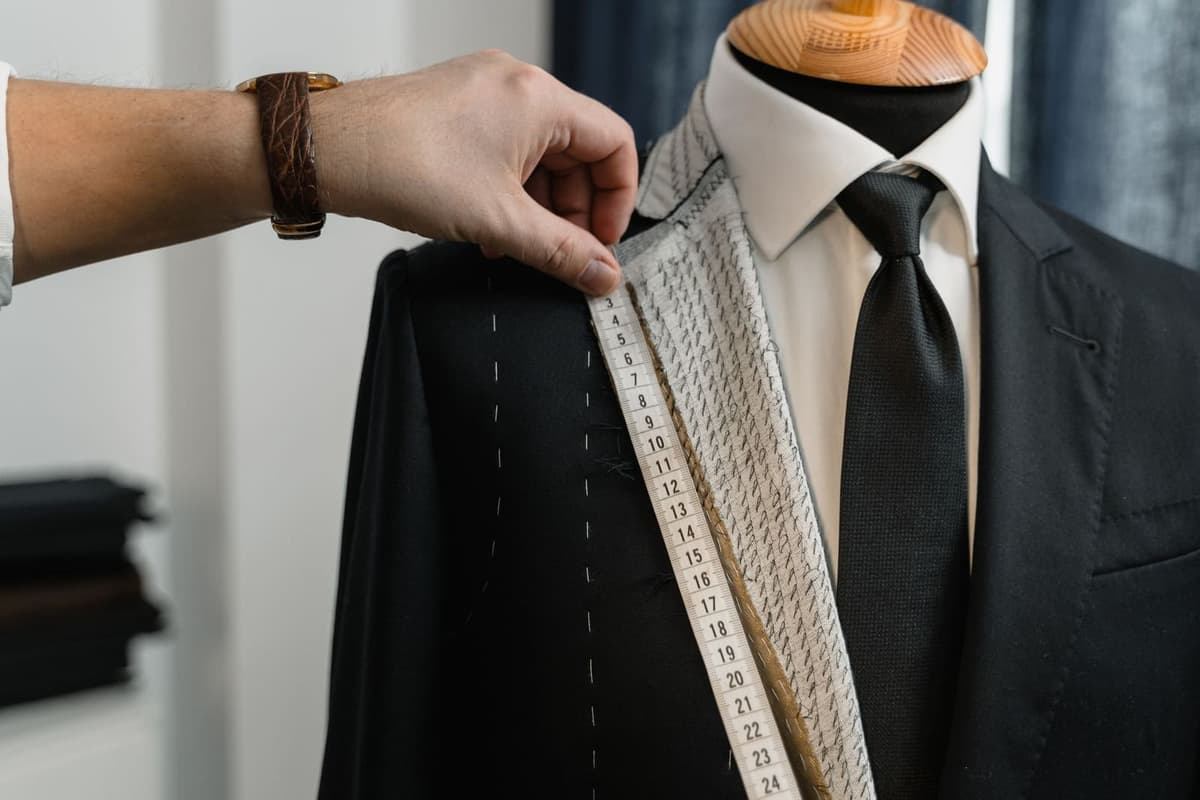
Lever 2 — Collar height, set against your neck
This is the most under-discussed measurement in menswear, and it is the one where made-to-measure genuinely beats a $200 rack shirt.
The band is the strip of fabric that stands up around your neck. Off-the-rack, it is typically 3.5–4 cm and identical on every size, because the pattern scales the body and leaves the band alone. Your neck is not identical to everyone else's.
- Short neck → a tall band swallows you. The collar rides up under the jaw, the shirt looks too big, and you spend the day tugging at it. Ask for a lower band, around 3–3.5 cm, and the whole shirt suddenly fits.
- Long neck → a standard band leaves a bare stretch between collar and jaw that reads gangly, especially in photos. A taller band, 4.5 cm or more, fills it and is the single most flattering change you can make.
Nobody sells this on a rack because it cannot be sold on a rack. It is a number we cut to you, and it changes how the shirt looks more than the collar's name does. If you have ever thought "shirts just look wrong on me" without being able to say why, this is usually the reason.
Related: our neck measuring guide, and if you want to know how your neck compares to the population, the body measurement percentile tool.
Lever 3 — The roll (and why your button-down looks cheap)
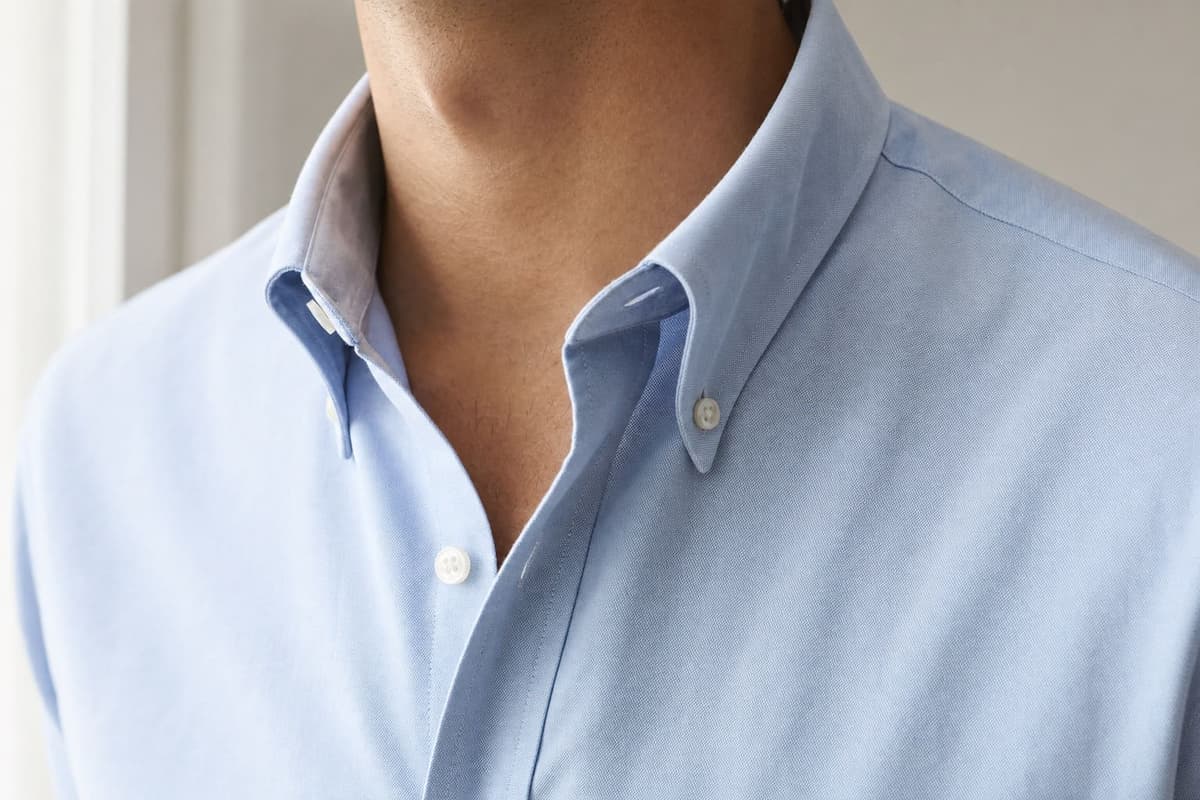
A button-down collar is supposed to roll — to bow outward in a soft arc between the button and the point. That roll is what makes an oxford-cloth button-down look relaxed and expensive instead of stiff and corporate.
You get it from two things: a collar cut slightly longer than the distance it has to span, and no fused interlining. Most mass-market button-downs are fused flat and cut short, so the collar lies dead against the chest. Same shape, completely different garment.
The other thing worth saying plainly: a button-down is business-casual, not suit-and-tie. It is an American sporting collar. It is superb with a blazer, chinos and no tie. Under a formal suit with a tie, it reads as a man who owns one kind of shirt. If you want soft and unstructured under a jacket, ask for an unfused semi-spread instead — same ease, correct register.
Fused versus unfused is the same decision that drives non-iron shirts: the crisper and more wrinkle-proof a collar is, the more chemistry and glue is holding it there, and the shorter its life. Unfused collars soften and get better; fused collars eventually bubble.
The honest default
If you are ordering shirts and do not want to think about it:
- Two semi-spread in white and light blue, band height set to your neck. These go under every suit you will ever own.
- One button-down in oxford cloth, unfused, for jacket-without-tie and weekends.
That is the three-shirt wardrobe that covers a working life. Add a true spread later if you wear a Windsor knot, or a point collar if your face is round and you want the lengthening line.
Face shape → spread width. Neck length → band height. Jacket-and-tie or open collar → fused or unfused. Say those three things when you order and the shirt will fit your head, not just your chest.
What this costs
Nothing, which is the point of the article.
Our custom shirts run $49 to $59 — cotton blend and premium cotton at $49, linen at $59, bamboo-blend stretch at $59. Collar shape, spread angle, band height and fused-or-unfused are all specified at order time at no extra charge, because they are pattern decisions rather than materials.
A $49 shirt with the right band height on your neck will look better than a $200 shirt with the wrong one. That is not a sales line; it is just what happens when a fixed measurement finally becomes a variable.
Message us on WhatsApp with a photo of yourself in a shirt you already own and we will tell you which of the three levers is currently working against you.