
What to Wear to a Wedding in Marrakech in October
North Africa – inland, near the Atlas Mountains · Men's guest guide · researched 2026-07-18
The short answer
- Climate: 28°C/82°F days, 15°C/59°F after dark — Moderate to low; the air is generally dry and comfortable, with muggy conditions rare even when clouds build.[1][2][3][7. Rainfall is low (around 15–22 mm across 3–5 days), usually brief showers or the odd downpour; most weddings won’t be disrupted, but outdoor venues may have contingency tents or indoor salons.[1][2][3][6][8][12][13]
- The suit: Lightweight wool (often labelled tropical wool), high‑twist wool, or wool‑linen blends that breathe well and resist creasing, ideal for warm, dry days and cooler nights. Colours: Mid‑blue, navy, medium grey, or warm stone/taupe, which all sit well against Marrakech’s earthy palette and photograph nicely from bright courtyard light into the evening..
- The register: Expect a polished but lively atmosphere: men in suits or dress jackets, women in glamorous dresses or caftans, and a clear preference for looking elegant and photo‑ready rather than casual, with the reception extending late into the night.
- Feet: Closed‑toe leather Oxford or Derby shoes in mid‑brown or dark brown for daytime, or black for more formal evenings; choose rubber or half‑rubber soles for grip on tiles, marble and uneven stone rather than ultra‑smooth leather soles.[6] Wear thin, breathable dress socks in a colour close to your trousers (navy, charcoal, or taupe) to maintain formality in religious or traditional settings; avoid no‑show socks except at clearly casual
The October climate, in tailoring terms
28°C / 82°F
Daytime high
15°C / 59°F
Evening low
Moderate to low; the air is generally dry and comfortable, with muggy conditions rare even when clouds build.[1][2][3][7
Humidity
Daytime in October feels like standing in dry, clear oven‑warmth where a light suit is perfectly wearable, but once the sun drops behind the medina the air cools quickly and a covered courtyard can feel almost crisp in shirtsleeves.[1][3]
How weddings actually run in Marrakech
Expect a polished but lively atmosphere: men in suits or dress jackets, women in glamorous dresses or caftans, and a clear preference for looking elegant and photo‑ready rather than casual, with the reception extending late into the night.
Black tie is occasional here. Marrakech city weddings skew toward full tailored suits or dressy jackets and trousers, with evening events often more formal than daytime and some luxury hotel or palace venues requesting black‑tie, while bohemian riad and garden celebrations allow refined, relaxed suiting rather than strict tuxedo
- Many Marrakech weddings begin late in the afternoon or early evening and run into the early hours, so your outfit must work in both warm daylight and cooler night air.
- Traditional Moroccan weddings can involve separate spaces or moments for female and male guests and multiple outfit changes for the couple, but foreign male guests are generally expected to stay in one smart outfit rather than changing costumes.
- Women sometimes avoid wearing solid white as it competes with the bride; for men, a pure white suit or very pale cream tailoring can look attention‑grabbing and impractical against the dusty city environment.
- If any part of the ceremony is held in or near a mosque or religious space, shoulders and legs should be covered, and sandals or trainers with bare ankles are frowned upon for male guests.
- Local style mixes rich colours and textures with modest cuts; men’s tailoring tends to be sharp but not overly tight, with shirts properly tucked and accessories restrained rather than flashy.
- Smoking shisha or taking breaks on terraces between courses is common at some venues, so plan a jacket that you’re happy to wear and remove repeatedly without rumpling the whole look.
The complete spec, head to toe
Suit fabric
Lightweight wool (often labelled tropical wool), high‑twist wool, or wool‑linen blends that breathe well and resist creasing, ideal for warm, dry days and cooler nights.
Cloth weight
Around 240–280 gsm (7–9 oz) for wool or wool‑blend suiting, keeping you cool in the afternoon heat but comfortable once temperatures drop after dark.
Colours
Mid‑blue, navy, medium grey, or warm stone/taupe, which all sit well against Marrakech’s earthy palette and photograph nicely from bright courtyard light into the evening.
Colours to avoid
White or very pale cream suits (compete visually with bridal looks and show dust easily); very loud neon colours that feel touristy; head‑to‑toe black in the daytime heat, which reads heavy and funereal rather than festive.
Jacket
Single‑breasted, lightly structured or semi‑unstructured blazer or suit jacket, half‑lined or buggy‑lined for ventilation; moderate length that covers the seat, with soft shoulders that suit both formal hotel ballrooms and relaxed riad courtyards.
Lapel
Notch lapel, 7–8 cm wide for balanced proportions; for a black‑tie or more formal evening, a shawl or peak lapel in satin or grosgrain on a dinner jacket works well without feeling out of place.[1
Shirt
Long‑sleeved dress shirt in breathable cotton poplin or twill, or a cotton‑linen blend; classic spread or semi‑spread collar that takes a tie cleanly; colours in crisp white, pale blue, or very subtle stripes, avoiding casual prints.[13
Trousers
Flat‑front or very soft single pleat trousers with a medium rise that sits at the natural waist; a gentle taper with minimal break or a slight cuff works well on both tiled courtyards and hotel carpets, avoiding overly cropped or extremely
Shoes
Closed‑toe leather Oxford or Derby shoes in mid‑brown or dark brown for daytime, or black for more formal evenings; choose rubber or half‑rubber soles for grip on tiles, marble and uneven stone rather than ultra‑smooth leather soles.[6]
Socks
Wear thin, breathable dress socks in a colour close to your trousers (navy, charcoal, or taupe) to maintain formality in religious or traditional settings; avoid no‑show socks except at clearly casual
Belt
Prefer tailored trousers with side‑adjusters for a clean line and better comfort in heat; if you wear a belt, choose a slim leather one matching your shoe colour so it disappears visually.
Tie
Bring a tie unless the couple specify otherwise: a silk or high‑twist wool tie, about 7–8 cm wide, in deep blue, burgundy, or muted patterns; for more relaxed riad weddings you can remove it after the formal parts of the ceremony.[1
Accessories
A white or soft‑coloured cotton pocket square in a simple puff fold; classic metal watch on leather or steel; discreet sunglasses with dark lenses for arrivals; no hat unless the invitation suggests traditional dress, as fedoras or wide‑brim hats are not typical for male guests here.[1][6][1
Grooming
Keep hair neatly trimmed and styled with light, non‑greasy product that won’t melt in warmth; manage sweat with an antiperspirant, a fresh undershirt if needed, and light face mattifying products so you stay polished in photos throughout a long, warm‑then‑cool evening.[1]
Dress code on the invitation?
The spec above assumes no stated code. If the invitation names one, we translate it against Marrakech's October climate and customs — bright chips are ready; dim ones build themselves in ~3 seconds.
What gives visitors away
- Wearing a full black business suit in the daytime heat – it looks funereal in Morocco and will feel stifling by mid‑afternoon.
- Turning up in very casual resort wear (polo, chinos, loafers) when most male guests are in full tailoring for evening weddings.
- Ignoring the temperature drop and not bringing a light layer – nights can feel surprisingly cool after a hot day.
- Leather soles only, with no grip – polished leather is slippery on tiled riads, marble courtyards and worn stone.
- Very short ankle‑flashing trousers or no socks at all at a mosque or religious ceremony – this reads sloppy rather than stylish.
- White or cream tailoring that visually competes with the groom and bride’s close family in photos.
Adjust for the venue
Riad or medina courtyard wedding
Opt for rubber‑soled dress shoes and be ready for slight temperature and light shifts between open courtyards and indoor salons; your suit should handle moving between sunlit gardens and atmospheric indoor spaces without feeling too casual
Luxury hotel or palace venue
Lean a touch more formal: darker suit (navy or charcoal), polished shoes, and consider a tie even if not strictly required, as hotel staff and many guests will be dressed smartly in these upscale environments.
Garden estate or villa just outside the city
Prioritise breathability and subtle, earthy colours that look natural in photos; avoid very shiny fabrics and make sure your shoes have some grip for garden paths, lawn areas and stone terraces.
Desert‑style camp or Atlas foothills celebration
Choose sturdy but elegant shoes with rubber soles for packed earth and stone, and fabrics that resist dust; if the dress code hints at "cocktail" or "boho chic", a less structured suit and perhaps an open shirt later in the evening will sti
After sunset
After sunset, temperatures often drop from around 25–28°C (77–82°F) into the mid‑teens Celsius (upper 50s–low 60s°F), so the jacket goes back on, terraces feel fresher, and a light layer becomes welcome for rooftop cocktails and late‑night dancing.[1][3]
Packing notes
- · A lightweight garment bag carried on, to keep your suit pristine through flights and any tight riad staircases.
- · Two dress shirts in breathable cotton or cotton‑linen blends so you can change if you sweat through one during the warm daytime or long dancing.[1][11][12][13]
- · A compact stain‑resistant sunscreen that won’t leave greasy marks on collars, cuffs or suit shoulders when reapplied outdoors.[1][11][12]
- · One light sweater or fine‑gauge merino/cotton layer to slide under or over your jacket for late‑night rooftop or garden receptions.[1][3][11][12][13]
- · Rubber‑soled dress shoes plus thin shoe bags, as many riads have tiled or marble floors and dusty lanes that mark leather easily.[6][12][13][16]
- · Discrete sunglasses with a hard case; you’ll need them for bright arrivals and courtyard photos, but they should be easy to stash once the sun sets.[1][6][11][12]
The Wedding Atelier
The suit we’d cut for Marrakech in October
Everything this guide recommends — the cloth, the colour, the construction for October weather — configured as a real tailor brief. One click shows it rendered; one more makes it yours, cut to your measurements from $149.
45-second AI render, no signup to design. Every render is a working tailor brief.
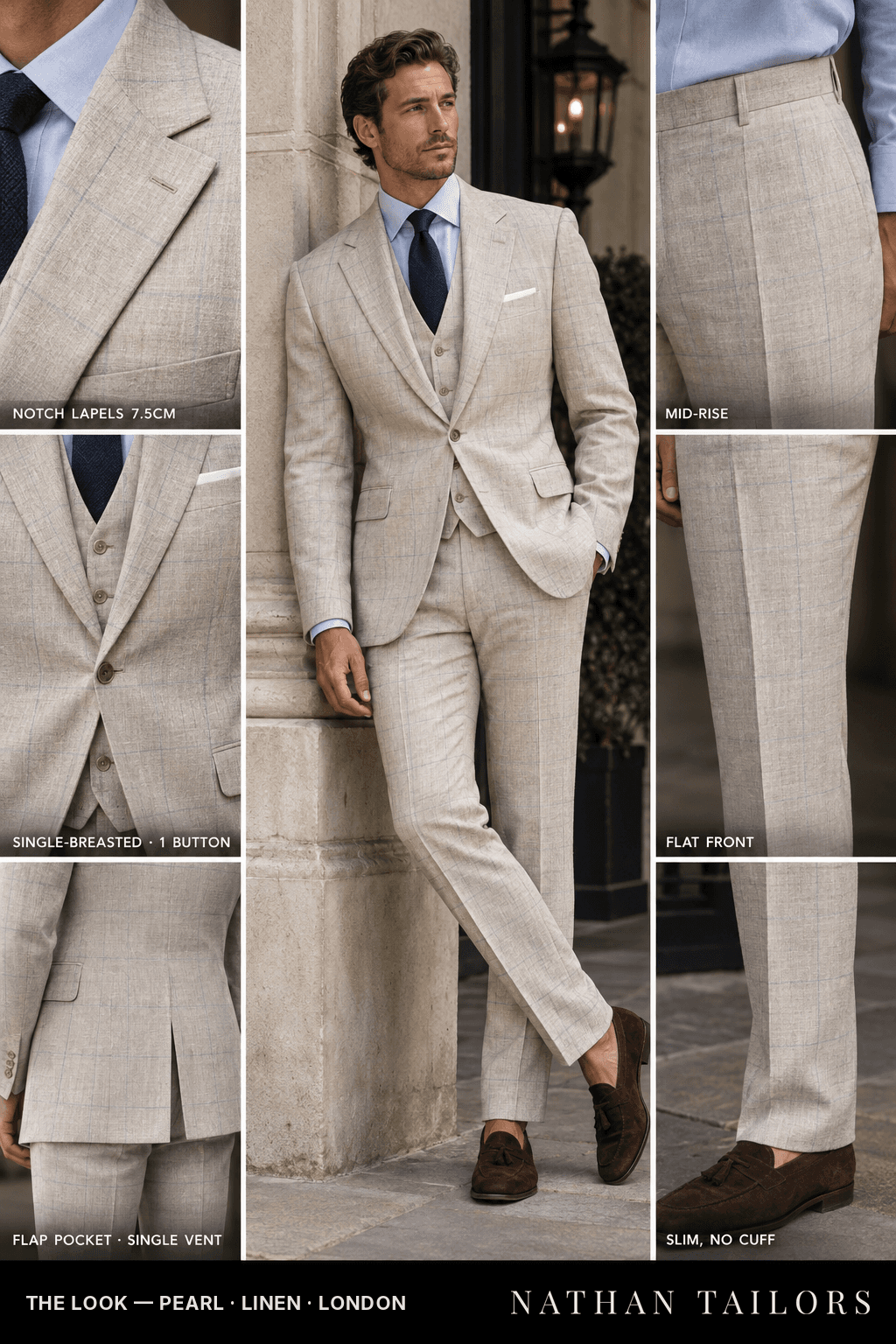
Don't own the right suit for this? That's literally our job.
We're Nathan Tailors, a workshop in Hoi An, Vietnam — we cut bespoke suits and custom tailored suits to your exact measurements in precisely the cloths these briefs call for — real linen, fresco-weave wool, tropical-weight worsted — from $149 to $309, shipped worldwide in 2–3 weeks. Measure yourself at home in ~15 minutes with our guided measurement tool; a master tailor checks every number before cutting. 5.0★ across 500+ reviews.
“Suit arrived! It’s incredible, amazing job thank you.”
“Ordered two suits and four shirts, remotely from the US. They fit great and are great quality! Was able to do everything over WhatsApp for measurements, etc. Will definitely visit if I ever make it to Hoi An. Highly recommend!”
“Being a short and stocky person, I could never truly get clothing that fitted properly. "Off the rack" was never an option... As I opened the small box, I got nervous and wondered if I made a big mistake and basically gambled away a fair amount of money. I ordered a 3 piece suit, 2 shirts and had a pair of leather dress shoes. Everything fitted nicely... the shirts were absolutely PERFECT.”
“Very satisfied; incredibly skillful to make clothes fit so perfectly. Beautiful fabric exactly as promised, very neat — would simply love to order from here again!”
“They did such an amazing job, my suit fits perfectly and the craftsmanship is superb! Linda was a great help and she knows exactly what she is doing. I can't recommend this place enough and I will be getting more suits from them in the future guaranteed!”
“Great place to get perfect suit, they send me to Poland with no problems.”
“WOW! Ordered a suit online with Linda. She contacted me by video call to go through the measuring process and once confirmed measurements again, around 4 weeks later a made to measure suit arrived in the UK. Fitted perfectly and I didn't even visit! Fantastic quality and customer service from Linda. Would definitely recommend!”
“Exceptional experience from start to finish. I ordered a fully custom two-piece double-breasted suit remotely from France, Linda and Jennifer guided me through every step with patience and professionalism. The suit arrived in under 3 weeks and the result is flawless: fabric, cut, lining, silhouette, everything is perfect. Nathan Tailors delivered exactly the vision I had in mind. I will absolutely be ordering again. Highly recommended.”
“This was my first time buying suits online so I was a bit apprehensive. However, the online order form was both easy to use and very thorough, and they did a video call with me to make sure of a couple of measurements that were out of the normal range. Two suits and a shirt arrived here in New Zealand in less than two weeks, are well-made, and fit perfectly. I'm thrilled with the service.”
Marrakech in October: guest questions
Can I wear a linen suit to a religious ceremony in Marrakech?
Yes, linen or cotton suits are fine for a mosque ceremony as long as the cut is smart and you pair them with a proper shirt, closed shoes, and socks. Keep shoulders covered, avoid very bright or flashy colours, and follow any guidance from the couple about modesty when entering religious spaces.
Is a black suit OK for a Marrakech wedding in October?
Black is acceptable for evening weddings, especially in city venues, but it can read more formal or sombre than mid‑blue or grey. In daytime heat, lighter tones are more comfortable and feel more in tune with the local palette of warm neutrals and blues, so reserve black for a clearly formal night event.
Do I need to wear a tie as a male guest at a Marrakech wedding?
Unless the invitation states "smart casual" or "no tie", assume you should wear a tie for a formal Marrakech wedding, particularly if any part of the day involves a religious ceremony or a traditional Moroccan reception. For more bohemian riad or desert‑style celebrations, a well‑cut open‑neck shirt can be acceptable, but check with the hosts.
How late do weddings in Marrakech usually run, and should I dress differently because of that?
Most Marrakech weddings start late in the afternoon or evening and run well past midnight, with multiple courses, music sets and rituals. Eat lightly earlier in the day, plan on staying until at least after the main dessert and dancing, and factor in the cooler night air when choosing your layers.
What kind of shoes work best for Marrakech wedding venues?
For outdoor venues in October, choose leather shoes with rubber or half‑rubber soles for grip on tiles, stone and packed earth. Avoid thin leather soles that slide on polished riad floors or uneven garden paths, and skip very chunky hiking‑style footwear which looks out of place with tailoring.[6]
Should I try to wear traditional Moroccan clothing to blend in at the wedding?
You don’t need a traditional Moroccan djellaba or caftan; as a foreign male guest you will blend in best in a well‑cut Western suit with subtle colours. Some Moroccan guests may wear traditional dress, but it is not expected of visitors and can look like costume if you don’t know the conventions.
Keep planning
Sources
- 1. thomascook.com/holidays/weather/morocco/marrakech/october/
- 2. tui.co.uk/holidays/weather/africa/morocco/morocco-marrakech/october.html
- 3. timeanddate.com/weather/morocco/marrakech/climate
- 4. climatestotravel.com/climate/morocco/marrakesh
- 5. wanderingweather.com/morocco/marrakesh/weather-by-month/
- 6. tuiholidays.ie/f/holidays/weather/africa/morocco/morocco-marrakech/october.html
- 7. weatherspark.com/y/32742/Average-Weather-in-Marrakesh-Morocco-Year-Round
- 8. gotripzi.com/destinations/marrakech-ma/weather/october