
What to Wear to a Wedding in Ireland in August
Ireland in August is mild, changeable, and often a little humid, with enough rain risk that wedding guests need real out · Men's guest guide · researched 2026-07-18
The short answer
- Climate: 18°C/64°F days, 11°C/52°F after dark — moderately humid. Rain is a real possibility in August, with frequent showery weather rather than all-day washouts, so a guest should expect damp ground and sudden changes rather than heat stress.
- The suit: A wool or wool-silk blend, or a wool-linen blend for the warmest, driest-looking option; wool performs best because it breathes, drapes well, and resists looking crushed in changeable weather. Colours: Navy, mid-grey, charcoal, and muted blue-grey are the safest choices; these fit Irish wedding formality and photograph well in overcast or mixed light..
- The register: Aim for smart, tailored, and respectful rather than theatrical. A suit and tie is the safest blend-in choice, with darker or mid-tone tailoring for urban venues and slightly softer textures for countryside or coastal settings.
- Feet: Polished dark brown or oxblood derbies, or refined loafers only if the venue is not formal; choose leather with rubber inserts or a thin rubber sole for wet paths and cobbles. Yes, wear mid-calf socks in navy, charcoal, or dark brown; no-shows read too casual and expose you to weather and church-venue formality.
The August climate, in tailoring terms
18°C / 64°F
Daytime high
11°C / 52°F
Evening low
moderately humid
Humidity
A pleasant mild summer day at about 18°C / 64°F by afternoon, but with a cool breeze, changeable light, and enough humidity and shower risk to make a jacket feel useful rather than optional.
How weddings actually run in Ireland
Aim for smart, tailored, and respectful rather than theatrical. A suit and tie is the safest blend-in choice, with darker or mid-tone tailoring for urban venues and slightly softer textures for countryside or coastal settings.
Black tie is occasional here. Irish weddings are usually well-dressed but not uniformly formal; tailored suits are the norm, and black-tie appears mainly at high-end city, stately-home, or explicitly formal weddings. Day-to-evening events often start polished and become more relaxed after the meal and speeches.
- Many Irish weddings are full-day affairs that start with a ceremony, continue through a long meal and speeches, and then run late, so your outfit needs to survive several dress-code phases.
- Guests tend to dress up properly, but not in a stiff British-morning-dress way; a sharp businesslike suit is more typical than anything costume-like.
- Church weddings still matter culturally, so modest, tidy dress is safer than fashion-forward or skin-heavy tailoring.
- Outdoor and country-house weddings are common in August, so weatherproof footwear and a suit that handles wind and damp are genuinely useful.
- Colour is usually safe if it is understated and elegant; loud novelty looks are more likely to read as touristy than stylish.
- The reception often becomes more casual by late evening, but guests generally arrive fully dressed rather than trying to “under-dress” from the start.
The complete spec, head to toe
Suit fabric
A wool or wool-silk blend, or a wool-linen blend for the warmest, driest-looking option; wool performs best because it breathes, drapes well, and resists looking crushed in changeable weather.
Cloth weight
About 240–280 gsm / 8–10 oz for most August weddings; this is light enough for mild afternoons but substantial enough for cool evenings and coastal wind.
Colours
Navy, mid-grey, charcoal, and muted blue-grey are the safest choices; these fit Irish wedding formality and photograph well in overcast or mixed light.
Colours to avoid
Avoid white, ivory, and bridal-adjacent pale cream; also avoid very bright tropical shades that can look out of place against the generally restrained Irish guest palette.
Jacket
Single-breasted, softly structured or lightly structured, half-lined jacket with a modern but not skinny cut; the goal is polish with enough comfort for a long day and variable temperatures.
Lapel
A medium-width notch lapel, around 7.5–8.5 cm / 3–3.5 in, looks most natural for Irish wedding guest wear and stays versatile across venues.
Shirt
Breathable cotton poplin or a cotton-twill blend in white or very light blue, with a standard spread or semi-spread collar that works cleanly with a tie.
Trousers
Flat-front or very subtle single-pleat trousers with a medium rise and a slight or no break; cuffs are optional, but avoid a heavy break because damp hems are common in August.
Shoes
Polished dark brown or oxblood derbies, or refined loafers only if the venue is not formal; choose leather with rubber inserts or a thin rubber sole for wet paths and cobbles.
Socks
Yes, wear mid-calf socks in navy, charcoal, or dark brown; no-shows read too casual and expose you to weather and church-venue formality.
Belt
Either a belt or side-adjusters is fine, but side-adjusters are the cleaner choice if you want a neater waist and less bulk under a jacket.
Tie
Bring a tie and wear it for the ceremony and formal photos; silk grenadine, matte silk, or textured wool-silk in subdued tones works best.
Accessories
A white linen or silk pocket square, a discreet watch, and sunglasses for travel and outdoor photos; a hat is not typical for male wedding guests. Keep accessories quiet and tailored rather than decorative.
Grooming
Keep hair controlled and lightly product-finished, not overly glossy; plan for humidity with anti-frizz or anti-sweat support so your collar and parting survive the day.
Dress code on the invitation?
The spec above assumes no stated code. If the invitation names one, we translate it against Ireland's August climate and customs — bright chips are ready; dim ones build themselves in ~3 seconds.
What gives visitors away
- A full black suit unless the couple or venue clearly signals black-tie or a very formal city wedding, because in Ireland in August most guests still lean toward tailored but not funeral-dark dressing.
- Linen that wrinkles heavily or a flimsy unstructured jacket, because the weather can swing from warm sun to cool wind and showers in one day.
- Bare ankles, sockless loafers, or delicate suede shoes for outdoor venues, because grass, gravel, wet paths, and church steps are common.
- White or ivory tailoring, because those shades read bridal-adjacent and are unnecessary for Irish guest dress.
- Overly bright tropical colors or beachwear styling, because Irish wedding guest dress is usually polished, restrained, and seasonally practical.
Adjust for the venue
Country house or estate
Country-house or manor wedding: choose a slightly softer navy or mid-grey suit, and wear rubber-soled or grip-sole leather shoes for lawns and gravel.
City hotel
City hotel or ballroom wedding: a darker navy or charcoal suit, sharper shirt collar, and polished derby shoes will look most appropriate.
Church
Church ceremony: keep the look conservative and fully tailored, with tie on, no shirt showiness, and shoes polished rather than relaxed.
Coastal or outdoor venue
Coastal or outdoor reception: favor a wool or wool-blend suit over pure linen, and plan for wind with a pocket square and secure lapels.
After sunset
After sunset it cools quickly toward 11°C / 52°F, so keep the jacket on and expect a tie or pocket square to earn its keep. If the wedding is outdoors or by the coast, a light top layer becomes more important than looking summer-relaxed.
Packing notes
- · Pack a midweight suit in a garment bag so it arrives uncreased and ready for mixed weather.
- · Bring a spare dress shirt, because August showers and warm reception rooms can both leave you wanting a fresh collar.
- · Carry a compact umbrella and a small lint roller, since damp sidewalks and wool tailoring are a common combination.
- · Pack a pocket square and a tie so you can start formal and relax later without looking underdressed.
- · Use a deodorant or anti-chafe product that will not stain shirts, because the day can be long even when the temperature is mild.
- · Choose shoes that can handle wet grass or cobbles, and pack shoe trees or polish if the wedding is in a city hotel or country house.
The Wedding Atelier
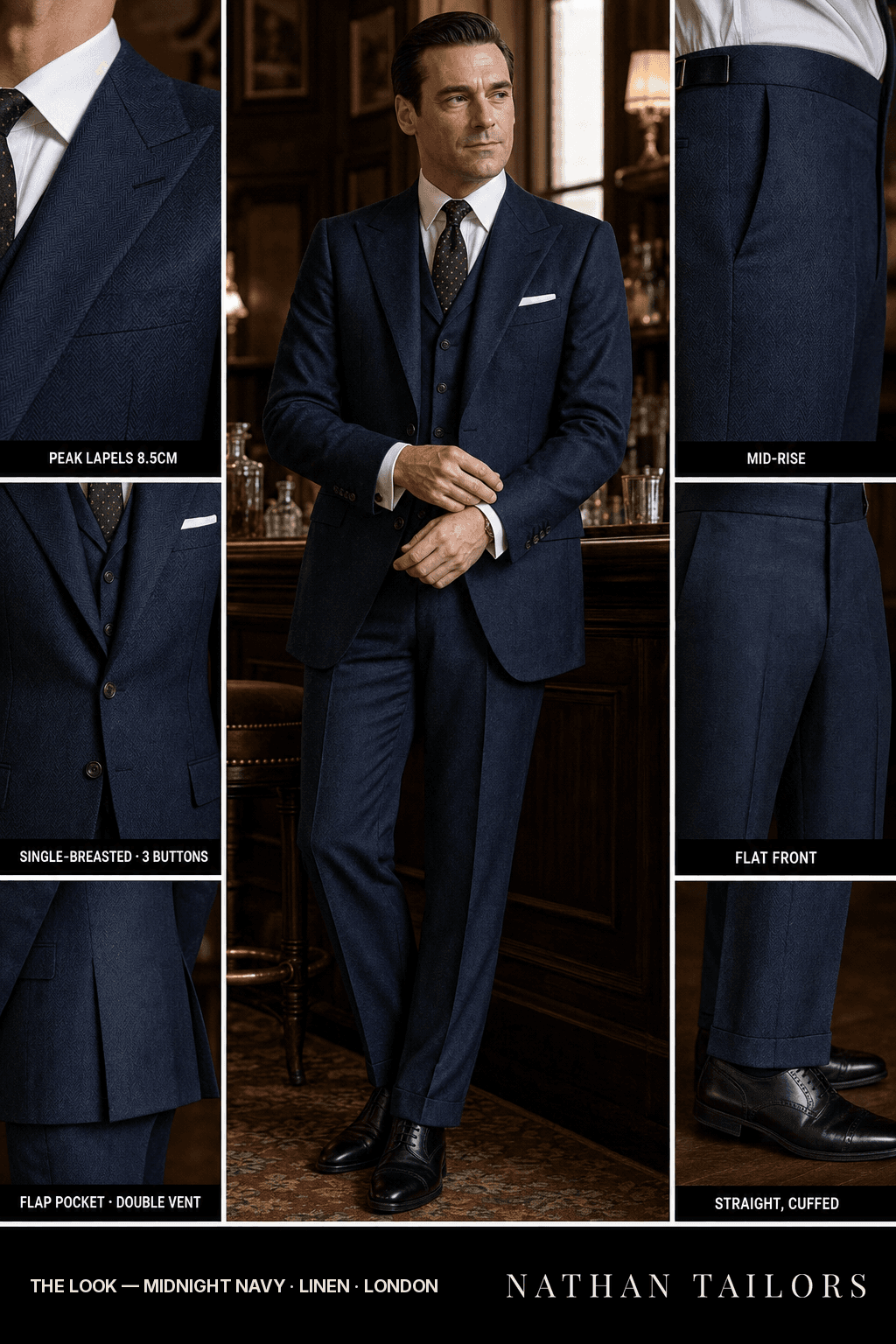
The suit we’d cut for Ireland in August
Everything this guide recommends — the cloth, the colour, the construction for August weather — configured as a real tailor brief. One click shows it rendered; one more makes it yours, cut to your measurements from $149.
45-second AI render, no signup to design. Every render is a working tailor brief.
Don't own the right suit for this? That's literally our job.
We're Nathan Tailors, a workshop in Hoi An, Vietnam — we cut bespoke suits and custom tailored suits to your exact measurements in precisely the cloths these briefs call for — real linen, fresco-weave wool, tropical-weight worsted — from $149 to $309, shipped worldwide in 2–3 weeks. Measure yourself at home in ~15 minutes with our guided measurement tool; a master tailor checks every number before cutting. 5.0★ across 500+ reviews.
“Suit arrived! It’s incredible, amazing job thank you.”
“Ordered two suits and four shirts, remotely from the US. They fit great and are great quality! Was able to do everything over WhatsApp for measurements, etc. Will definitely visit if I ever make it to Hoi An. Highly recommend!”
“Being a short and stocky person, I could never truly get clothing that fitted properly. "Off the rack" was never an option... As I opened the small box, I got nervous and wondered if I made a big mistake and basically gambled away a fair amount of money. I ordered a 3 piece suit, 2 shirts and had a pair of leather dress shoes. Everything fitted nicely... the shirts were absolutely PERFECT.”
“Very satisfied; incredibly skillful to make clothes fit so perfectly. Beautiful fabric exactly as promised, very neat — would simply love to order from here again!”
“They did such an amazing job, my suit fits perfectly and the craftsmanship is superb! Linda was a great help and she knows exactly what she is doing. I can't recommend this place enough and I will be getting more suits from them in the future guaranteed!”
“Great place to get perfect suit, they send me to Poland with no problems.”
“WOW! Ordered a suit online with Linda. She contacted me by video call to go through the measuring process and once confirmed measurements again, around 4 weeks later a made to measure suit arrived in the UK. Fitted perfectly and I didn't even visit! Fantastic quality and customer service from Linda. Would definitely recommend!”
“Exceptional experience from start to finish. I ordered a fully custom two-piece double-breasted suit remotely from France, Linda and Jennifer guided me through every step with patience and professionalism. The suit arrived in under 3 weeks and the result is flawless: fabric, cut, lining, silhouette, everything is perfect. Nathan Tailors delivered exactly the vision I had in mind. I will absolutely be ordering again. Highly recommended.”
“This was my first time buying suits online so I was a bit apprehensive. However, the online order form was both easy to use and very thorough, and they did a video call with me to make sure of a couple of measurements that were out of the normal range. Two suits and a shirt arrived here in New Zealand in less than two weeks, are well-made, and fit perfectly. I'm thrilled with the service.”
Ireland in August: guest questions
Can I wear linen to an Irish wedding in August?
Yes, linen is acceptable, but keep it substantial and well-cut rather than crumpled. In Ireland, a linen blend or textured wool-linen jacket looks more deliberate for a wedding than a fully casual vacation linen suit.
Is black OK for a wedding guest?
Usually yes, especially for daytime or semi-formal weddings, but choose charcoal, navy, or mid-grey rather than a stark black suit unless the invitation says otherwise. Irish guests generally dress neatly and seasonally rather than defaulting to funeral black.
Do I need a tie?
Bring one. Even when the ceremony is relaxed, a tie is still common for Irish weddings, and you can remove it later if the reception loosens up.
Do I need to dress differently for a church ceremony?
Yes for church weddings or any explicitly religious ceremony, with shoulders and overall dress kept respectful and tidy. For civil or hotel ceremonies, the standard is still polished tailoring rather than casual separates.
Are loafers or leather-soled shoes a good idea?
Yes, but use a brown leather sole with some grip and choose a shoe that can handle damp paths. Polished derby shoes or loafers with socks are more practical than delicate dress shoes.
Keep planning
Sources
- 1. theirishroadtrip.com/ireland-in-august/
- 2. roughguides.com/ireland/when-to-go/august/
- 3. en.wikipedia.org/wiki/Climate_of_Ireland
- 4. theirishroadtrip.com/the-weather-in-ireland-by-month/
- 5. globalhighlights.com/ireland/weather-in-august
- 6. vagabondtoursofireland.com/blog/ireland-in-august
- 7. sunheron.com/europe/ireland-weather-august/
- 8. met.ie/climate-statement-for-august-2025