Here is the uncomfortable truth about buying a suit online: you cannot quantify fit before you buy. You can compare fabrics by weight, prices by number, delivery by days. Fit — the one thing that decides whether you ever wear the suit — has no spec sheet. There is nothing to compare until the suit is on your shoulders, and by then the money is spent.
So what can you actually evaluate, before you buy? The process. A suit fits or doesn't fit because of what happened at measurement time. If an online tailor shows you exactly how they capture your body — and that process visibly holds up — the fit follows. If they hand you a blank form and a diagram, the fit is a coin toss no matter how beautiful the fabric page looks.
This post documents our process in full: what we built, what failed, what we removed, and the details most customers will never notice. Not because the details are glamorous — but because the process is the only honest evidence of fit that can exist before a suit does. Judge us on it.
Where Online Suits Actually Fail
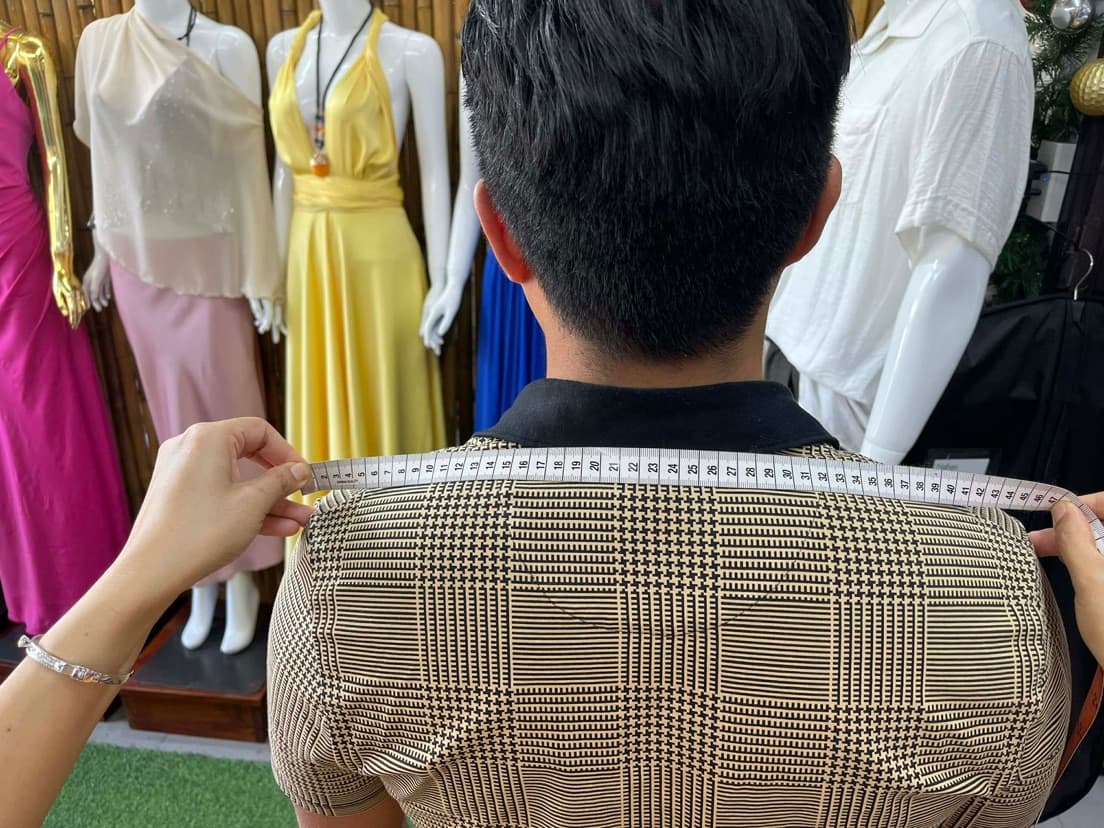
A made-to-measure suit is cut from a handful of numbers. Get the shoulder width wrong by 2 cm and no amount of alteration saves the jacket — the seams sit in the wrong place on your body. Get the chest right but measure it skin-tight, and the jacket buttons but can't be worn. Most remakes in this industry trace back not to bad sewing but to bad numbers captured politely: the customer followed the instructions, and the instructions weren't good enough.
Most online suit companies pour their innovation budget into the designing experience — configurators where lapels rotate and linings shimmer. We enjoy those too. But a beautifully designed suit that doesn't fit is still a bad suit. The designing step was never the risky step. So we spent our effort on the step that actually decides the outcome: how a person standing at home, holding a tape, captures their own body correctly.
Generation One: Hand-Drawn Diagrams (and What 5,000 Fittings Taught Us)
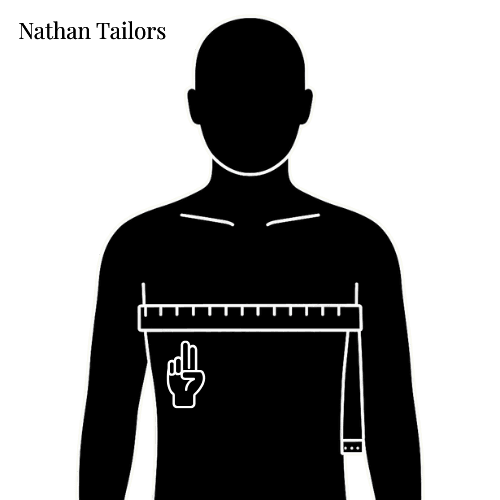
Our first Guided Measurement App walked customers through every measurement with a hand-drawn diagram, typical-range validation, and written instructions refined over years. It worked — thousands of remote customers, suits shipped to 50+ countries. But every fitting in our Hoi An shop and every remote adjustment request was data, and the data kept pointing at the same ceiling:
- A flat drawing cannot show where the tape sits on a curved body. Does the shoulder tape ride over the top of the shoulder or behind it? How high does the armpit tape go? Where exactly does a sleeve end at the wrist? In 2D, the customer guesses — and a guess repeated across 13 measurements compounds.
- The failure points were consistent. Shoulder width, sleeve length, and armpit depth were involved in the majority of fit corrections — precisely the measurements whose tape path is three-dimensional and can't be flattened into a diagram.
- More measurements did not mean more accuracy. Our original form asked for 16-17 numbers. Redundant measurements (torso circumference, upper hip, back curve) contradicted each other more often than they cross-confirmed, because each extra number was one more chance for a home measurer to err.
The Road We Didn't Take: AI Photo Measurement
Before building anything, we evaluated the technology everyone expects us to use: AI body measurement from two photos. Stand against a wall, front shot, side shot, and a model outputs your measurements. We tested it seriously — it would have been the easiest product to ship and the easiest headline to write.
We vetoed it, and the reason is arithmetic. The vendors' own pitch is "about 95% accuracy" per measurement. That sounds excellent until you remember a suit is a conjunction: it needs the shoulder AND the chest AND the sleeve AND the waist right, simultaneously. At 95% per number across thirteen numbers, the chance that every measurement lands is roughly a coin flip — and it only takes one bad shoulder or one short sleeve for the suit you spent weeks anticipating to simply not fit. A t-shirt tolerates 5% error. A canvassed jacket does not.
There was a deeper problem: when the AI is wrong, nobody in the loop knows which number is wrong — not the customer, not us — until the suit exists. A tape measure in a guided hand fails loudly; a confident model fails silently. So we chose the opposite architecture: don't estimate the customer's body — teach the customer to capture it, through the clearest communication medium we could build. The 3D studio is exactly that: a direct, visual transfer from a master tailor with twenty years of measuring, to the person standing in front of the screen with a tape in hand. (Your photos are still collected — but as a human cross-check for posture and build, never as the source of the numbers.)
Generation Two: The 3D Measurement Studio
So we rebuilt the whole thing. The 3D Measurement Studio puts an interactive, photorealistic 3D body on your screen, and for each measurement, a glowing tape draws itself onto the body — exactly where your real tape should go. You drag to rotate, pinch to zoom, look at the line from behind. A recorded voice reads each step aloud so your hands stay on the tape, not scrolling instructions.
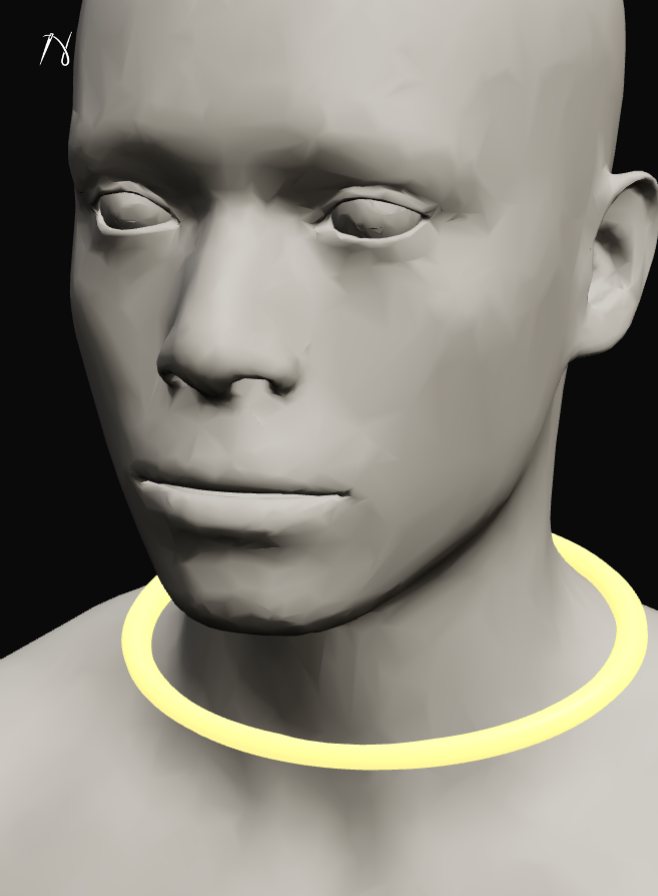
The critical part is who drew the lines. Every tape path in the studio was placed and approved by our master tailors — cutters with more than twenty years of daily measuring behind them — working side by side with our animator. The tailor placed anchor points directly on the 3D body by hand: the shoulder seam, the elbow, the wrist bone. The tape then wraps the body's actual surface between those points, the way real tape lies on real skin. Nothing is procedurally guessed; every line is a tailor's knowledge made visible.
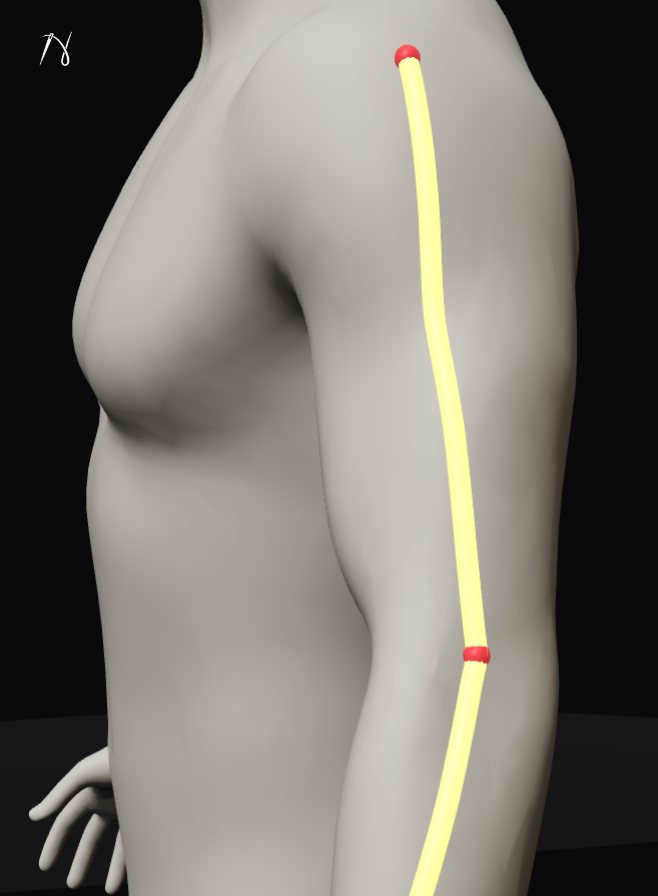
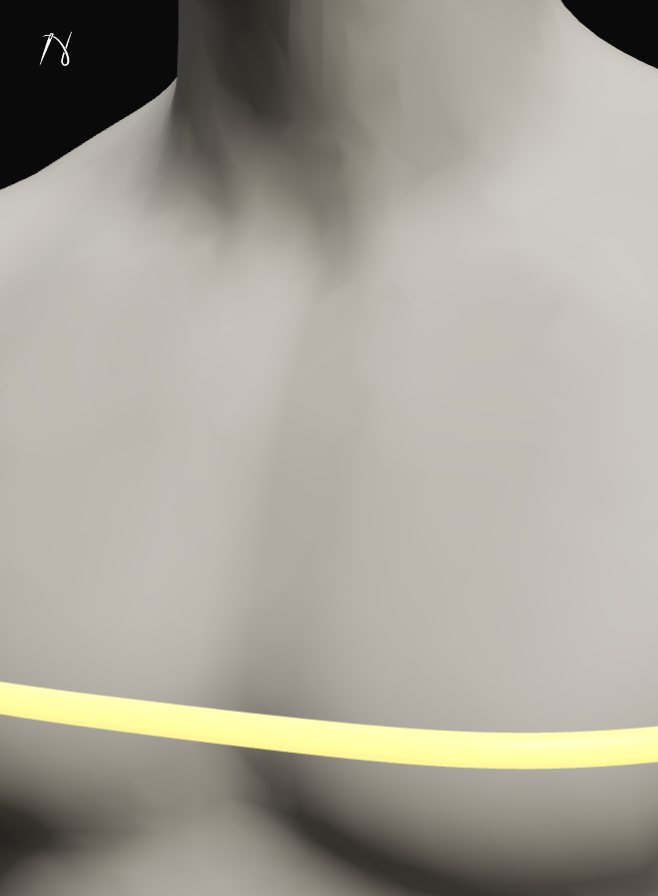
And then we iterated — against real customers. Early versions of the shoulder line sagged into the trapezius; we redrew it as a taut tape. The neck ring rendered as a body-hugging oval that read misleadingly on screen; we replaced it with a perfect circle of equal circumference, so what you see corresponds to the number your tape will show. The chest ring on our female prototype floated where a real tape would pull snug; we rebuilt it so the ring's length always equals the body's true contour — because a pulled-snug tape has the contour's length, not the silhouette's. These are the kinds of details nobody asks about and everybody's fit depends on.
Why We Ask for 13 Measurements, Not 17
The new studio asks for exactly 13 measurements — down from 16-17. We removed torso circumference, upper hip, back curve, and back jacket length, because our cutting room could derive or verify them from the rest, and each was statistically more likely to introduce a contradiction than to add information. The principle: every number we ask for is load-bearing. Fewer, better-captured numbers beat many noisy ones — a lesson that only shows up when you've cut suits from thousands of home-measured forms.
What surrounds those 13 numbers matters as much as the numbers:
- Per-measurement sanity checks. Every entry is validated against typical ranges for your body type, in your chosen unit. An out-of-range number is flagged on the spot — re-measure now, not after the suit exists.
- Unit-safety. Choose inches or centimetres up front; switch any time and everything already entered converts. A cm/inch mix-up is the single most catastrophic (and most preventable) measurement error.
- Height and weight, required. Two numbers you know cold, which let us cross-check the thirteen you just took. If your stated height and your outside-leg measurement disagree, we catch it.
- Three full-body reference photos — front, side, back — so the cutter sees posture, shoulder slope, and stance that no tape can capture.
- A human reviews everything before cutting. Every submission lands with our master tailor, who checks the numbers against the photos and against each other. If something looks off, we message you before production — not after delivery.
How to Judge Any Online Tailor's Fit Process
Use this checklist on anyone, including us. It's the closest thing to a spec sheet for fit that can exist:
- Does the measurement guide show the tape's path on a three-dimensional body — or a flat drawing you must interpret?
- Who authored the guidance? A working master tailor, or a graphic designer?
- Is every number validated against typical ranges before you can submit?
- Are unit mix-ups structurally prevented, or just warned about?
- Are reference photos collected so a human can see your posture and build?
- Does a human review your submission before cutting — and will they contact you if something looks wrong?
- Is every measurement requested actually used? Padding the form with redundant numbers increases error, not accuracy.
- What happens if it still doesn't fit? A clear adjustment plan -- generous seam allowances, spare matching cloth in the box, pre-ship photo checks -- is the final backstop.
We built the 3D Measurement Studio to pass every item on that list, because it is the list our own fittings taught us. Fit cannot be promised in a headline. It can only be earned in a process — and shown.
Questions People Ask Us
Can a suit ordered online really fit as well as an in-person fitting?
It can get remarkably close — if the measurement capture is done right. In-person fittings win because a tailor controls the tape. The 3D Studio's job is to transfer that control to you: the tailor's tape path is drawn on the 3D body, a voice guides your hands, the software checks your numbers, and a master tailor reviews the result before cutting. The gap that remains is covered by generous seam allowances and the spare matching cloth we ship with every garment, so a local tailor can fine-tune the fit.
How long does it take to measure?
About 10 minutes: 13 voice-guided measurements plus three photos. You need a soft tailor's tape and ideally a friend — a second pair of hands makes every number better. No account, no sign-up; we only ask for your details after the work is done.
What if I make a mistake?
Three nets: live typical-range validation catches implausible numbers as you type; your height and weight cross-check the set; and our master tailor reviews every submission against your photos before anything is cut. If a number looks wrong, we contact you first.
Why should I trust a Hoi An tailor with this?
Hoi An is one of the world's dense centres of made-to-measure tailoring, and our shop has measured tens of thousands of bodies in person — walk-ins, weddings, whole family groups. The 3D Studio is that in-person knowledge, animated. 530+ five-star Google reviews, 5,000+ customers in 50+ countries, suits from $149, delivered in about three weeks.
Ready to see it? Step into the 3D Measurement Studio — or start with the suit itself in The Atelier, where you describe the suit in your head and our AI draws it before we build it.