I wore a tie 250+ days a year for a decade. Ten years on a Wall Street trading floor, every single morning: Windsor knot, dimple centered, collar pinned on Thursdays when the MDs were in town. I have probably tied more ties than most men will in a lifetime.
Now I own a tailor shop in Hoi An, Vietnam, and I will tell you the truth: you do not need a tie for 80% of suit occasions in 2026.
But here is the thing nobody says out loud -- there is a massive difference between a man who chose not to wear a tie and a man who forgot his tie. One looks intentional, confident, modern. The other looks like he got dressed in the dark and realized his mistake in the elevator. This guide is the difference between those two men.
Why the Tie Is (Mostly) Dead
Let me be clear: the tie is not gone. It still has a place. But its place has shrunk dramatically, and 2026 is the year the shift became undeniable.
This is THE defining menswear movement of 2026. Every major house is showing it. Zegna sent models down the runway in double-breasted suits with open collars and loafers. Brunello Cucinelli -- the king of quiet luxury -- showed exactly zero ties in their Spring/Summer collection. Loro Piana paired unstructured blazers with knit polos. Ralph Lauren showed camp collar shirts under sport coats. The message from every corner of high fashion is unanimous: the suit is a versatile outfit, not a boardroom uniform.
The cultural shift runs deeper than runways. Remote work killed the daily tie requirement. Return-to-office mandates brought people back to offices but not back to neckwear. Tech money made casual acceptable at every price point. And the younger generation of finance, law, and consulting professionals -- the industries that held on longest -- have quietly stopped wearing ties to everything except the most formal occasions.
Two buttons open at the collar is now the default suit look. Loafers have replaced oxfords as the default suit shoe. Knit polos under blazers are everywhere. Camp collar shirts with sport coats are standard summer fare. The deformalized suit is not a trend anymore. It is the new normal.
But deformalized does not mean careless. That is where most men get it wrong.
The 5 Things That Work Under a Suit Instead of a Tie
When you remove the tie, what you wear underneath the jacket becomes the entire focal point of the outfit. The tie used to do a lot of heavy lifting -- it drew the eye, added color, created a visual anchor. Without it, the shirt (or whatever replaces it) has to carry that weight. Choose wrong and the outfit looks incomplete. Choose right and it looks better than any tie ever could.
1. Dress Shirt, Open Collar
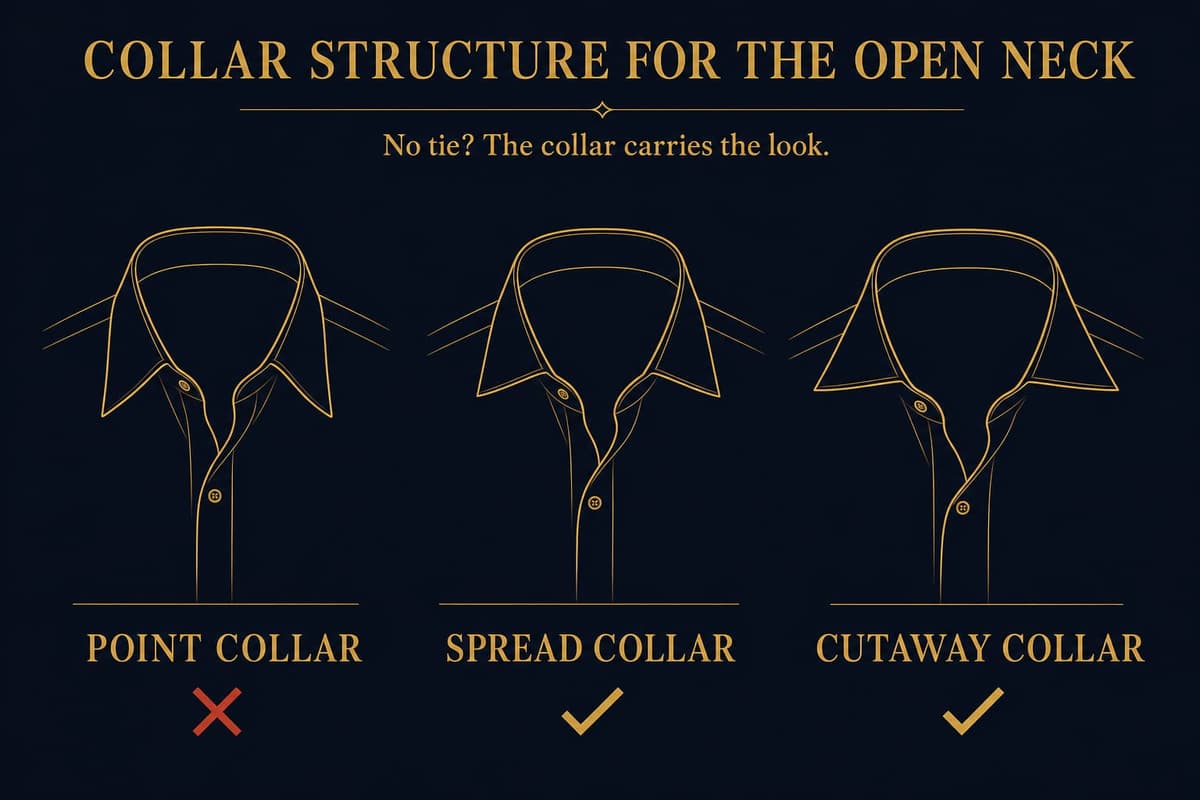
This is the most common no-tie look and the one most men get wrong. The mistake is universal: they wear the same point-collar dress shirt they would wear with a tie, just without the tie. The collar flops. The points splay outward or curl under the lapel. It looks exactly like a man who forgot his tie.
The fix is collar structure. Spread collars and cutaway collars hold their shape without a tie. The wider angle between the collar points means they sit flat against the chest, framing the open neck cleanly. Point collars collapse because they are engineered to be held together by a tie knot -- remove the knot and the architecture falls apart.
The details: unbutton two buttons, no more. Fabric should have some body -- a poplin or a twill, not a thin broadcloth that wilts. White is classic. Pale blue is safe. Light pink if you have the confidence. French cuffs without a tie is a power move if you can pull it off -- it signals that you dressed deliberately, not lazily.
Best for: Office, client meetings, interviews, cocktail events, weddings. This is the highest-formality no-tie option.
2. Knit Polo
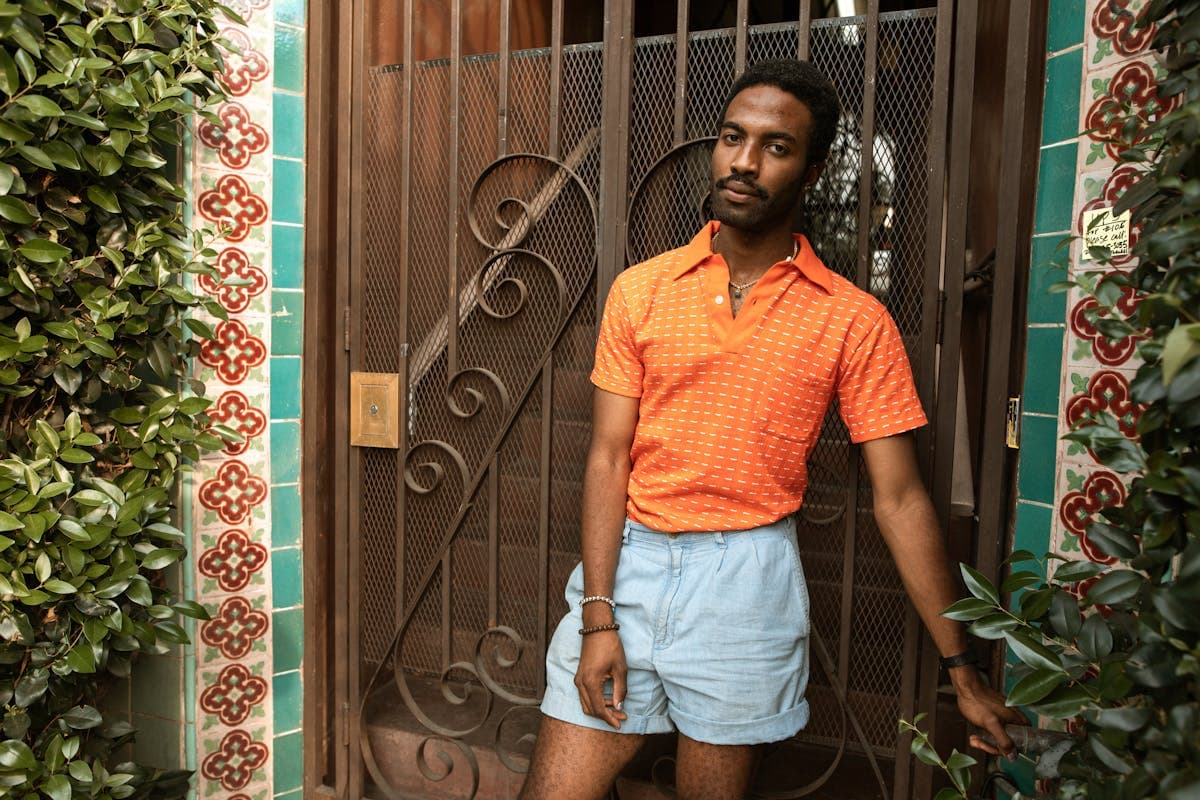
This is the Italian move. Fine-gauge merino or silk knit polos under blazers have peak Riviera energy -- think Marcello Mastroianni in the 1960s, updated for 2026. Every Italian brand is pushing this hard right now, and for good reason. A knit polo fills the visual space that a tie leaves behind. The collar sits naturally under the lapel. The knit texture adds visual interest that a plain dress shirt cannot match.
The rules: Fine gauge only. If the knit is chunky, you look like you are wearing a sweater under your jacket, not a polo. Merino wool, silk, or a silk-cotton blend. Colors: navy is the safest, cream is the most elegant, sage green is the 2026 move. Avoid logos. The polo should end at mid-fly -- not too long, not too short.
Best for: Summer weddings, dinners out, date nights, garden parties, any event where you want to look sharp but not corporate. This is the sweet spot between formal and relaxed.
3. Camp Collar Shirt
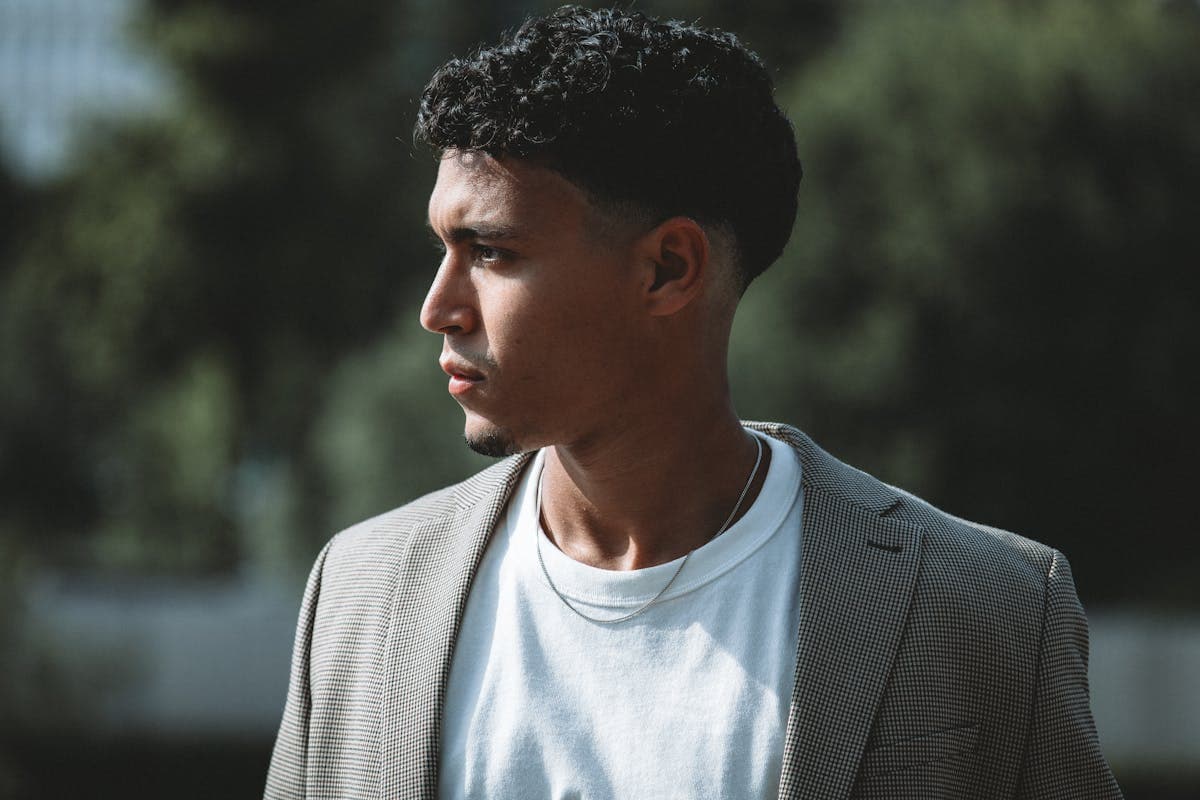
The camp collar (also called a Cuban collar or revere collar) is the most relaxed option that still reads as intentional under a blazer. The open, flat collar sits over or alongside the jacket lapel, creating a layered, summery look that works beautifully with unstructured blazers and linen suits.
The rules: The shirt must be fitted, not boxy. A camp collar shirt that billows under the jacket looks like a Hawaiian shirt your uncle wears to barbecues. Stick to solid colors or very subtle prints -- a tiny geometric or a tone-on-tone pattern. Cream, pale blue, soft olive, dusty rose. The fabric should be light: linen, silk, a cotton-linen blend. And the shirt should be tucked in. An untucked camp collar under a blazer is a different look entirely (and usually a worse one).
Best for: Garden parties, destination events, beach-adjacent weddings, vacation dinners, weekend brunches. This is the look that says "I am on vacation and I still look better than you."
4. Quality Crewneck Tee
This is the fashion-forward option. A clean crewneck tee under a structured blazer is a look that has moved from streetwear into mainstream menswear. But it is the most dangerous option on this list because it is one fit issue away from looking sloppy.
The rules are strict: The tee must be perfect. No logos, no graphics, no visible branding. White, black, or cream -- that is it. The fabric must have enough weight that it does not cling or wrinkle -- a heavy cotton jersey or a cotton-modal blend. The fit should be slim but not tight: no chest outline, no belly show. And the blazer must be structured. An unstructured blazer over a tee looks like you could not decide between casual and dressed up. A structured blazer over a tee looks like a deliberate contrast.
Best for: Date nights, gallery openings, creative industry events, travel days when you want to look sharp without trying too hard. Never for any corporate setting. Never for weddings unless you are the cool friend who can get away with it (and if you have to ask, you are not that friend).
5. Mock Neck or Turtleneck
The fall and winter answer to the no-tie question. A fine-gauge mock neck or turtleneck under a suit adds formality without a tie -- it fills the visual space at the neck, creates a clean line, and has an undeniable European sophistication. Steve McQueen wore turtlenecks under blazers. So did every Bond actor at some point. It works.
The rules: Fine gauge only -- merino wool, cashmere, or a cashmere blend. The mock neck is more modern and slightly less formal than a full turtleneck. Black is the classic. Navy is versatile. Cream under a navy or charcoal suit is stunning. Avoid bulky knits that make the jacket pull across the chest. And make sure the jacket was cut with enough room in the chest and neck to accommodate the extra layer without straining.
Best for: Fall events, European travel, art world gatherings, dinner parties, anything from October through March where you want to look polished without reaching for a tie. The mock neck under a charcoal suit is one of the most sophisticated cold-weather looks in menswear.
The Rules Nobody Tells You
Removing a tie from a suit is not just a subtraction. It changes the physics of the entire outfit. Here are the rules that separate intentional from accidental.
Fit Is Everything
A tie forgives a lot of sins. It draws the eye to the center of the chest and creates a vertical line that makes the torso look longer and leaner. It distracts from a collar that does not sit perfectly, from lapels that roll slightly differently on each side, from a jacket that is a half-inch too wide in the shoulders. Remove the tie and every single one of those imperfections is visible. Without a tie, fit becomes 10x more important. The jacket must sit perfectly on the shoulders. The collar must hug the shirt collar without gapping. The lapels must lie flat. There is nowhere to hide.
Collar Structure Matters
I said it above but it bears repeating because this is the single most common mistake: point collars collapse without a tie. Spread and cutaway collars hold their shape. If you take one thing from this article, make it this. A point collar without a tie looks unfinished. A spread collar without a tie looks intentional. The wider the collar angle, the better it works tieless.
Suit Construction Matters
Unstructured and half-lined suits work better tieless than fully structured suits. A half-canvas, heavily padded suit is built to be worn with a tie -- it is the sartorial equivalent of a tuxedo without a bow tie. The formality of the construction fights with the informality of the open collar. Unstructured suits -- soft shoulders, minimal padding, half or quarter lining -- are designed for the modern, relaxed silhouette. They welcome the open collar.
Fabric Matters
The same principle applies to fabric. High-shine worsted wools in dark navy or charcoal scream "where is the tie?" Textured fabrics -- linen, cotton-linen blends, tropical wool, hopsack, fresco -- read as intentionally casual. The texture signals that you chose this level of formality on purpose. A navy hopsack blazer with an open collar looks right. A navy sharkskin suit with an open collar looks like something is missing.
The Pocket Square
Optional, but it fills the visual gap that the tie leaves behind. A simple white linen pocket square in a flat fold adds just enough detail to the upper chest that the outfit does not feel empty. It is not required, but it is the easiest upgrade to a tieless suit look.
The Shoes
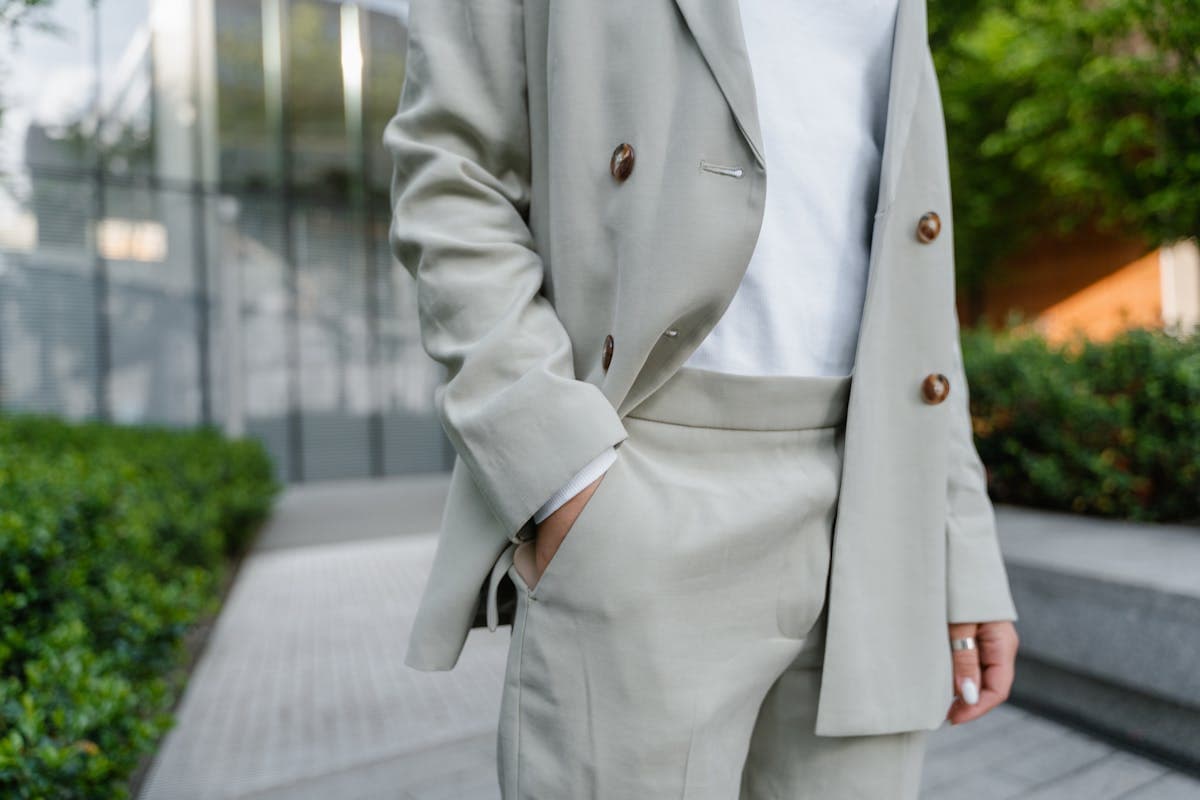
Loafers are the 2026 default suit shoe, and this is not a coincidence. The same deformalization that killed the tie killed the oxford lace-up as the automatic suit shoe. Loafers match the relaxed energy of a tieless suit in a way that cap-toe oxfords never will.
The hierarchy:
- Penny loafers -- the most versatile. Brown leather for warm-weather suits, burgundy for year-round, black for evening. Works with everything from a full suit to a blazer-and-trousers combination.
- Horsebit loafers -- slightly dressier. The Gucci-style metal hardware adds a touch of flash. Best with slim trousers and no break. The Italian choice.
- Belgian loafers -- the insider move. The small bow detail is subtle. Suede Belgians with a linen suit is one of the best warm-weather combinations in menswear.
- Suede chukka boots -- the fall alternative. A tan or snuff suede chukka boot with an unstructured suit is relaxed but put-together. Works from September through April.
- Clean white sneakers -- yes, with a suit. But ONLY with linen or cotton suits in summer. And they must be immaculate. One scuff and the whole thing falls apart. Common Projects or similar minimalist designs only. No chunky sneakers, no athletic shoes.
What to avoid: cap-toe oxfords with a tieless suit look overly formal from the ankle down and too casual from the neck up. The formality mismatch is jarring. Save the oxfords for when the tie comes back on.
When You Should Still Wear a Tie
I spent this entire article telling you to ditch the tie. Now here is the short list of occasions where you absolutely should not:
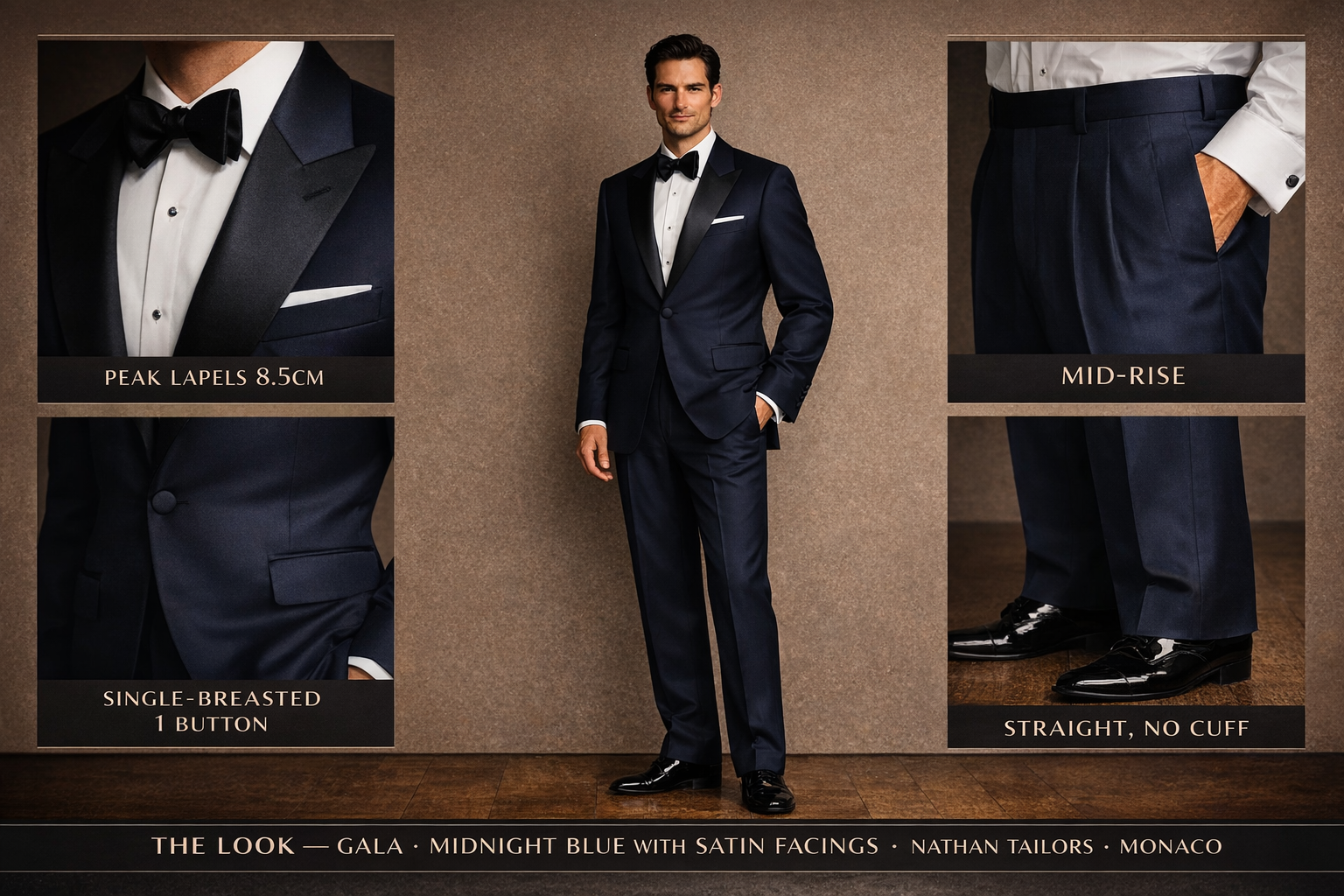
- Black tie events. A tuxedo without a bow tie is not fashion-forward. It is wrong.
- Courtrooms. Judges notice. Opposing counsel notices. Your client notices. Wear the tie.
- Funerals. This is about respect, not style. Dark suit, dark tie, no exceptions.
- Certain interviews. Finance, law, consulting at the senior level -- these industries still expect a tie in interview settings. When in doubt, wear it. You can always remove a tie. You cannot conjure one.
- Meeting your partner's parents for the first time. First impressions with future in-laws are not the time to make a style statement. Wear the tie. Take it off after they love you.
- Any event where the host or invitation specifies formal attire. When someone says "formal," they mean a tie. Do not test this theory.
For everything else -- office days, client dinners, weddings, parties, dates, travel, weekends -- you are free. The tie is optional. And in most cases, going without one is now the better choice.
5 No-Tie Suit Combinations That Always Work
Stop guessing. These five formulas are tested, proven, and appropriate for 90% of suit occasions in 2026. Pick one and go.
1. The Boardroom Without the Tie
Navy suit + white spread collar shirt + tan leather penny loafers
This is the safest no-tie look in existence. The navy suit does the heavy lifting. The white shirt keeps it clean and professional. The tan loafers add just enough warmth to signal that you are not wearing a tie on purpose. Two buttons open, sleeves showing a half-inch of shirt cuff, trouser hem with no break or a slight break. You can walk into any boardroom, any client meeting, any office in America in this outfit and look like the best-dressed person there.
2. The Summer Wedding
Light gray suit + navy knit polo + white minimalist sneakers
This is the outfit that gets compliments. The light gray reads festive without being flashy. The navy knit polo fills the neck space that a tie would occupy and adds texture. The white sneakers keep it modern and comfortable -- critical when you are dancing at a reception in July heat. This works for daytime outdoor weddings, rooftop celebrations, vineyard ceremonies, and any summer event where a tie would have you sweating through your collar by the first toast.
3. The Destination Event
Tan linen suit + cream camp collar shirt + suede loafers
Peak warm-weather elegance. The linen suit breathes. The cream camp collar adds that Mediterranean ease. The suede loafers tie it together without trying too hard. This is the look for destination weddings, resort dinners, garden parties, anything where the setting is beautiful and you want to match it. Tan and cream is a color combination that photographs beautifully and never goes wrong in natural light.
4. The Dinner Date
Charcoal suit + black crewneck tee + black chelsea boots
Monochromatic, minimal, sharp. The charcoal suit provides structure. The black tee provides contrast without clutter. The chelsea boots add edge. This is the look for a nice restaurant, a cocktail bar, a gallery opening, a night out where you want to look effortlessly pulled together. The key is the tee -- it must be flawless. No pilling, no stretched neck, no wrinkles. A fresh, heavyweight cotton tee that looks like it costs more than it does.
5. The Catch-All
Navy blazer + gray trousers + pale blue button-down + penny loafers
When you do not know the dress code, this is the answer. A navy blazer with gray trousers is the most versatile combination in menswear. The pale blue button-down (spread collar, always) is approachable and clean. Penny loafers in brown or burgundy complete it. This works for: office, brunch, a first date, meeting friends, a casual wedding, an afternoon event, a dinner reservation. It is never overdressed and never underdressed. If you own one suit and one blazer, make the blazer navy and the trousers gray, and you will never have a "what do I wear" moment again.
What Each No-Tie Option Signals
Clothes communicate. What you wear under your jacket without a tie sends a specific message. Make sure it is the right one.
| Under the Suit | Formality Level | Best For | Avoid For |
|---|---|---|---|
| Spread collar dress shirt | Business professional | Office, interviews, events | Beach weddings |
| Knit polo | Smart casual | Summer weddings, dinners, dates | Courtrooms |
| Camp collar shirt | Casual-smart | Garden parties, vacations, brunches | Funerals |
| Crewneck tee | Fashion-forward casual | Date nights, gallery openings, travel | Any corporate setting |
| Mock neck / turtleneck | Business refined | Fall events, European travel, art world | Summer anything |
Why Custom Suits Win the No-Tie Game
Here is the bottom line, and I am going to be direct about it because I make suits for a living and I have watched this play out hundreds of times with customers.
When you wear a tie, the tie is the star of the outfit. It draws the eye, adds color, creates structure. The suit is the backdrop. The fit can be slightly off and nobody notices because they are looking at the tie.
When you remove the tie, the suit becomes the star. There is nothing to distract from the shoulders, the chest, the lapels, the collar, the way the fabric sits on your body. Every millimeter of fit is on display. And that is where off-the-rack fails.
Off-the-rack suits are cut for a range of body types. They have extra fabric in the chest, wider shoulders to accommodate the broadest customer in the size range, sleeves that are a little too long. With a tie, you can get away with it. Without a tie, the gaps show. The collar floats away from the shirt collar. The shoulders droop a quarter inch past your actual shoulder. The chest fabric bunches. It looks like something is missing -- and what is missing is not the tie. It is the fit.
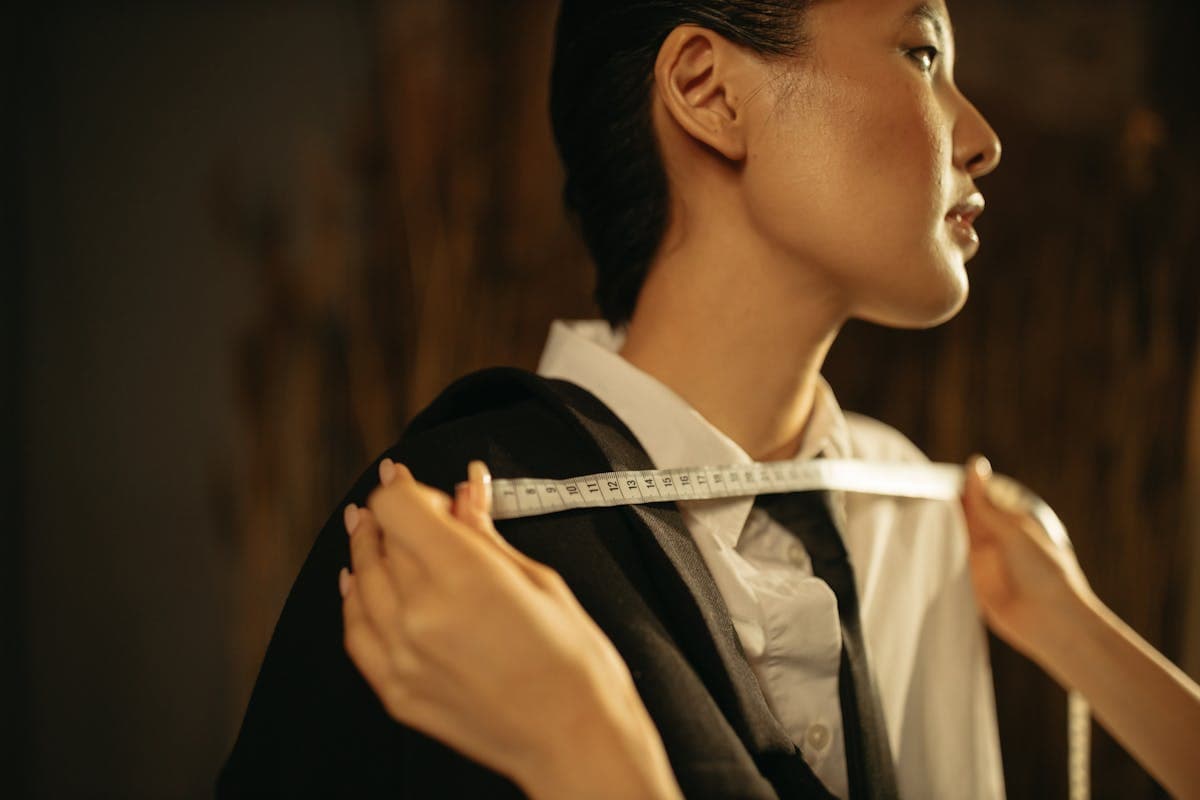
A custom suit is built to your exact measurements. The collar hugs. The shoulders end where yours do. The chest is clean. The lapels lie flat because they are shaped to your body, not to a mannequin. When you skip the tie in a custom suit, it looks like a choice. When you skip the tie in an off-the-rack suit, it looks like an oversight.
That is not a sales pitch. That is physics. And in 2026, when 80% of suit occasions are tieless, getting the fit right is not optional. It is the whole game.
Built for the No-Tie Era
At Nathan Tailors, we build suits specifically for how men actually wear them in 2026 -- which means tieless, with loafers, with knit polos and open collars and all the things this article covers. Our two-piece suits run $149 to $309 depending on fabric, and custom trousers start at $69. Every suit is cut to your exact measurements from a library of 200+ fabrics.
We are in Hoi An, Vietnam -- one of the last great tailoring towns on Earth. You can visit us in person or order remotely from anywhere in the world. Either way, you get a suit that makes going tieless look like the power move it is.
The tie had a good run. But the future of suiting is open-collar, perfectly fitted, and built for real life. Welcome to 2026.