The Fear That Stops 90% of First-Time Buyers
I know exactly what is going through your head. You have found a custom tailor online -- maybe us, maybe someone else -- and the prices look great, the reviews look solid, and part of you wants to pull the trigger. But there is this voice in the back of your mind saying: "What if it shows up and it does not fit? Then I am stuck with a $200 suit I cannot wear and no way to get my money back."
That fear is the single biggest reason people stick with off-the-rack suits that never quite fit right instead of trying custom. And I understand it completely. I lived in the West for over 10 years. I know how it feels to order something online, wait for it, open the box, and immediately think "this is not what I expected."
But here is what I have learned after 25+ years in the tailoring industry and thousands of remote orders: fit issues with custom suits are far less common than people think, and when they do happen, they are almost always fixable by a local tailor. The real question is not "will it fit perfectly?" -- it is "what happens if it does not, and how quickly can it be resolved?"
This article is going to answer that question in complete detail. I will be honest with you upfront: a custom garment is made for your body and cannot be resold, so it is non-refundable, and we do not offer free remakes. What we do instead is build every garment so that a local tailor can dial in the fit easily -- generous seam allowances plus a piece of the same fabric in the box -- and we stay reachable to help you diagnose any issue from photos. I will explain why fit issues happen, how rarely they happen, what we do to prevent them, and exactly what the resolution process looks like when something is off. I will also compare how the major brands handle fit so you can see where the industry stands.
How Often Do Custom Suits Actually Have Fit Problems?
Let me give you real numbers, not marketing fluff.
At Nathan Tailors, the overwhelming majority of remote orders fit right out of the box. That means approximately 97 out of every 100 remote orders arrive fitting correctly without any modification needed. Of the remaining 3%, the vast majority are minor issues -- a trouser hem that needs a quarter inch adjustment, a jacket sleeve that could be slightly shorter -- the kind of thing a local tailor handles in one visit. Issues serious enough that a local alteration cannot resolve them are rarer still, fewer than 1 in 100 orders.
How does that compare to in-person tailoring? Most brick-and-mortar tailors do not publish their fit rates, but industry data suggests that made-to-measure brands with physical showrooms have alteration rates of 15-25%. Indochino, for example, builds a $75 alteration credit into every order as standard policy. SuitSupply offers 30-day returns even on custom orders. These policies exist because fit issues are expected, not exceptional.
The point is not that our process is foolproof -- no tailoring process is. The point is that remote tailoring, done correctly, is not meaningfully less accurate than in-person measurement. And in some ways, it is more careful, because we know there is no second fitting, so we invest more time in the measurement verification stage.
Why Fit Issues Happen (And How We Prevent Most of Them)
Understanding the causes helps you understand the solutions. Here are the four most common reasons a custom suit might not fit perfectly, ranked from most to least common.
Cause 1: Measurement Error
The most common cause of fit issues in remote tailoring. A customer pulls the tape too tight on the chest, too loose on the waist, or measures the wrong point on the shoulder. Off by half an inch on a critical measurement, and you notice it in the finished garment.
How we prevent it: Every set of measurements goes through a verification process before we cut fabric. Our tailors compare your measurements against standard body proportion ratios. If your chest measurement is 42 inches but your waist says 28 inches, that is an unusual proportion and we will call you to re-measure before proceeding. We catch most errors at this stage. We also offer guided video measurement where our tailor watches you take each measurement in real time.
Cause 2: Posture and Body Asymmetry
Almost nobody has a perfectly symmetrical body. One shoulder is often slightly higher than the other. Many people have a slight forward lean or a rounded upper back. These are things a tailor can observe in person during a fitting but are harder to detect from measurements alone.
How we prevent it: We ask every remote customer to send photos in fitted clothing -- front, side, and back. Our experienced tailors can spot postural tendencies from these photos and adjust the pattern accordingly. A customer with forward-sloping shoulders, for instance, will get slightly more length in the front panel and less in the back. This is not guesswork -- it is pattern adjustment based on visible body characteristics, and our tailors do it hundreds of times a month.
Cause 3: Preference Misalignment
The suit technically fits your measurements correctly, but it does not fit the way you expected. Maybe you wanted a slim fit but the result is slimmer than you anticipated. Or you expected more room in the chest than what "standard comfort" provides. Fit is partly objective (measurements) and partly subjective (how you want the garment to drape and feel).
How we prevent it: During the consultation, we ask detailed questions about your fit preferences. Do you want to be able to button the jacket comfortably over a sweater? Do you prefer trousers with a break or no break? How snug do you want the shirt collar? We also ask about reference garments -- if you own a suit or jacket that fits the way you want, we can match that fit profile.
Cause 4: Production Error
The least common cause but the most straightforward to resolve. The tailor makes a cutting or sewing mistake. This is rare because our tailors handle a high volume of international orders and have refined their processes over decades. But it happens occasionally, as it does in any handcraft.
How we handle it: If there is a genuine workmanship defect that is clearly our error, we own it. We do not have a blanket "free remake" policy, but we will work it out with you case by case -- this is handled at our discretion based on the specific situation. In most instances the cleanest fix is still a local alteration using the generous seam allowances and matching fabric we ship with every garment, and we will help you figure out the right path.
The Seam Allowance: The Hidden Safety Net Most People Don't Know About
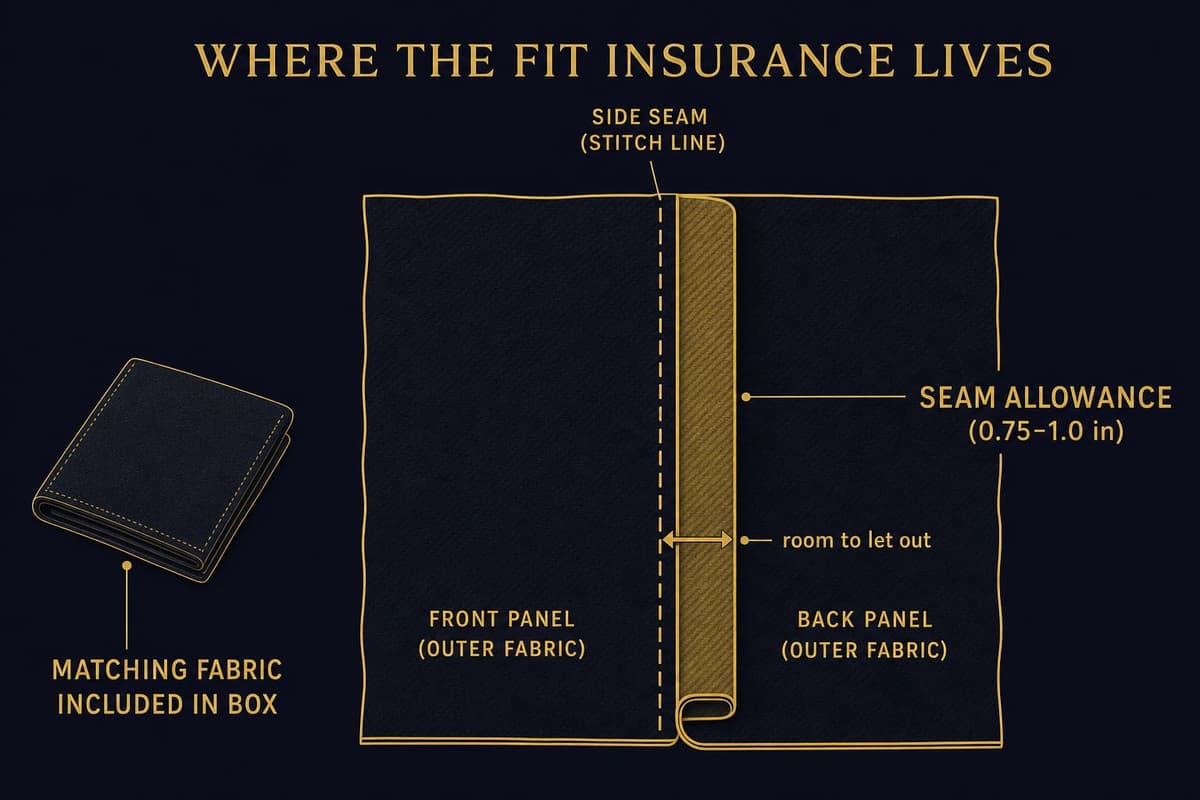
Here is something that separates thoughtful custom tailoring from factory-produced suits, and it is one of the most important things I can tell you about fit insurance.
Every Nathan Tailors garment is made with generous seam allowances -- extra fabric deliberately left inside the seams. This means that if a jacket needs to be let out by half an inch in the chest, or trousers need to be widened slightly at the hip, a local tailor can do it without any visible impact on the garment. On top of that, every order ships with a piece of the same fabric used to make your garment, so if a local tailor needs matching cloth for a more involved adjustment, it is already in the box. This is our primary remedy for fit issues, and it is by design: it puts a fast, affordable fix in your hands wherever you live, without shipping anything back to Vietnam.
Here is what our standard seam allowances look like versus what you get with off-the-rack and typical MTM brands:
| Garment Area | Off-the-Rack | Typical MTM (Indochino, etc.) | Nathan Tailors |
|---|---|---|---|
| Jacket Side Seams | 0.25 - 0.5 inches | 0.5 - 0.75 inches | 0.75 - 1.0 inches |
| Trouser Waist | 0.25 inches | 0.5 inches | 0.75 - 1.0 inches |
| Trouser Outseam | 1.0 inch (hem only) | 1.0 - 1.5 inches | 1.5 - 2.0 inches |
| Jacket Sleeve | 0.5 - 0.75 inches | 0.75 inches | 1.0 - 1.25 inches |
| Jacket Back Center | 0.25 inches | 0.5 inches | 0.75 inches |
Why does this matter? Because generous seam allowances mean that most minor fit adjustments can be handled by any local tailor in your city for $15-40, in a single visit. You do not need to ship the garment back to Vietnam. You do not need to wait weeks for a fix. You walk into a local alteration shop, they let out or take in the seam, and you are done.
Off-the-rack suits have minimal seam allowances because the factory is optimizing for fabric efficiency, not for your ability to alter the garment later. We optimize for your ability to get a perfect fit, even if it means using a bit more fabric per garment.
How We Handle a Fit Issue, Step by Step
When a customer receives a garment that does not fit perfectly, here is exactly what happens. No ambiguity, no fine print.
Step 1: Send Us Photos and Video
The moment something feels off, take clear photos -- and ideally a short video -- of the garment on your body, front, side, and back. Send them to us on WhatsApp. We will diagnose exactly what is going on (is it the shoulder, the back balance, the trouser rise?) and tell you whether it is a quick local fix or something more involved. This costs you nothing and usually takes one conversation.
Step 2: Local Alteration (the Primary Fix)
For the overwhelming majority of fit issues -- a trouser hem, a slight waist adjustment, a sleeve length tweak, taking in or letting out a seam -- the fastest and best fix is a local tailor in your own city. This is exactly what the generous seam allowances and the piece of matching fabric in your box are for. We tell you precisely what to ask the local tailor to do, in specific terms ("take in the jacket side seams by 0.5 inches from the natural waist to the hip"), so there is no guesswork on their end. This typically costs $15-40 and takes one visit. Most local tailors can do these adjustments in 1-3 days, and you never have to ship anything back to Vietnam.
Step 3: Genuine Workmanship Defects
If the problem is a clear workmanship defect on our part -- not a measurement or preference issue, but something we got wrong in cutting or sewing -- we will work it out with you case by case, at our discretion, based on the specifics of the situation. To be straight with you: this is not a blanket "free remake until you are satisfied" guarantee, and custom garments are non-refundable because they are made for your body and cannot be resold. What we commit to is staying reachable, diagnosing the issue honestly, and finding a fair resolution together. In practice, most situations are resolved at Step 2 with a local alteration.
How Fit Policies Compare: Nathan Tailors vs The Competition
Before you order from anyone, you should understand exactly what happens when something does not fit. Here is how the major custom suit brands handle it.
| Policy Detail | Nathan Tailors | Indochino | SuitSupply | Black Lapel |
|---|---|---|---|---|
| Cash Refund | No (custom product) | No (custom product) | Yes -- 30 days, tags on | No (custom product) |
| Alteration Credit | Guidance provided; most alterations $15-40 | $75 reimbursement per garment | In-store alterations (free at some locations) | $75 alteration reimbursement |
| Primary Fit Remedy | Seam allowances + matching cloth in the box; local alteration; case-by-case on our defects | At discretion; many customers report difficulty | Not standard; return and reorder instead | Yes -- "Perfect Fit Guarantee" remake |
| Who Does the Adjustment | Local tailor near you; we provide exact instructions | Customer may pay return shipping | In-store, or free return shipping on eligible returns | Brand remakes; free on first remake |
| Time Limit | Reach out anytime; sooner is better while we remember your order | 30 days from delivery | 30 days from purchase | Within 365 days of delivery |
| Typical Fix Turnaround | 1-3 days at a local tailor | 4-6 weeks | N/A (return/reorder process) | 3-4 weeks |
Credit where it is due: SuitSupply's 30-day return policy is the most consumer-friendly in the industry. If you are risk-averse and want the ability to return a custom suit for a full refund, SuitSupply is the only major brand that offers that. The trade-off is that you pay $499-$1,299 for the suit.
Black Lapel's 365-day window is also impressively generous. They are an online-only brand with no showrooms, so like us, they know their policy needs to build trust.
Our approach is different from both. We do not offer cash refunds or free remakes -- your suit is made specifically for your body and cannot be resold. Instead, we engineer the fix into the garment itself: generous seam allowances and a piece of matching fabric in every box mean a local tailor near you can perfect the fit quickly and cheaply, and we stay on the line to diagnose the issue and tell that tailor exactly what to do. For a genuine workmanship defect on our part, we work it out case by case. Our logic is simple: a happy customer leaves a five-star review, and giving you a fix you can complete locally in a couple of days is usually faster and better for you than shipping a garment across the world and back.
The Real Cost of a Fit Issue: An Honest Calculation
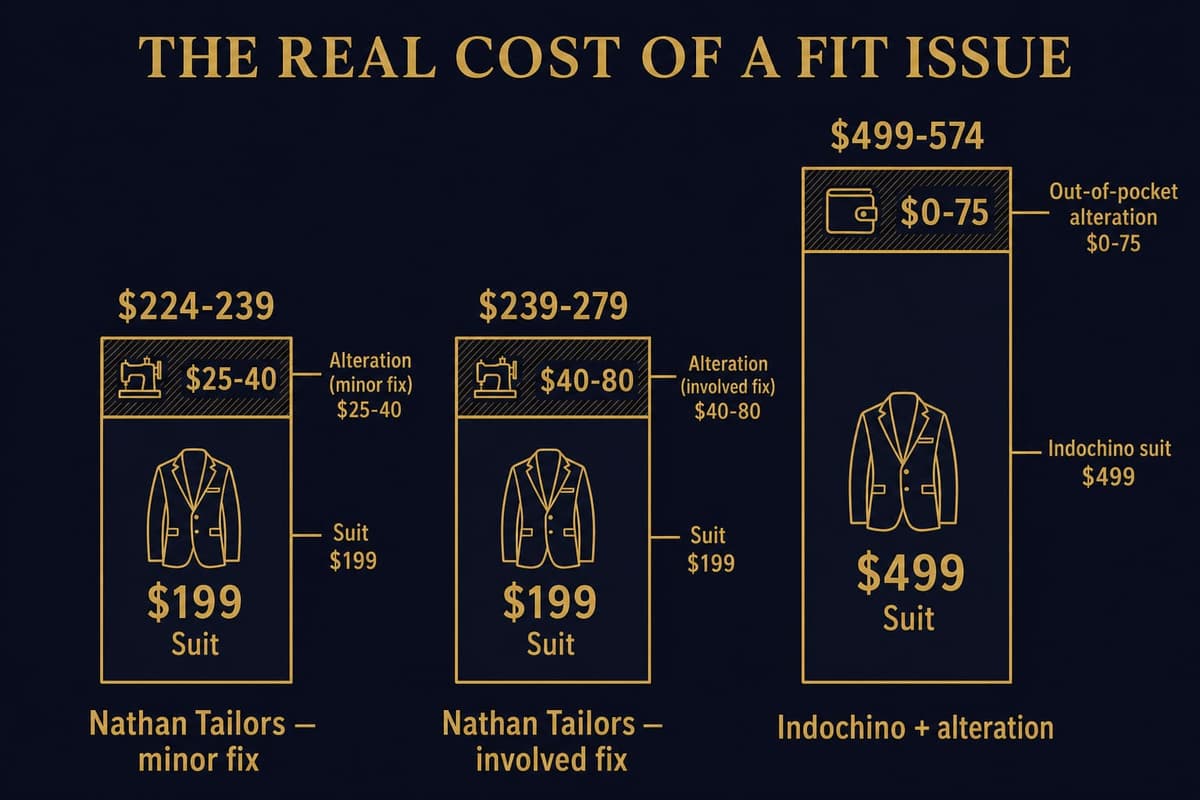
Let me put some numbers around this so you can assess the actual financial risk.
Scenario A: You order a $219 suit from Nathan Tailors and it needs minor alteration.
- Suit cost: $219
- Local alteration (trouser hem + waist adjustment): $25-40
- Total cost: $244-259
- Still less than a single Indochino suit at $399
Scenario B: You order a $219 suit from Nathan Tailors and it needs a more involved local alteration.
- Suit cost: $219
- Local alteration using the included matching fabric and seam allowances: $40-80
- Extra wait time: a few days at a local tailor
- Total cost: $259-299
Scenario C: You order a $499 suit from Indochino and it needs alteration.
- Suit cost: $499
- Alteration credit from Indochino: $75
- Actual alteration cost in a US city: $50-150
- Out-of-pocket alteration cost: $0-75 (depending on complexity)
- Total cost: $499-574
Even in this scenario -- a more involved local alteration -- your total cost with Nathan Tailors is still well under what you would pay for a single domestic MTM suit. And it is uncommon. Our 520+ five-star Google reviews are not from customers who all had perfect first deliveries. Many of them specifically mention how well we walked them through adjustments when something was slightly off. The service after delivery is part of what earns those reviews.
5 Things You Can Do to Maximize Fit Accuracy
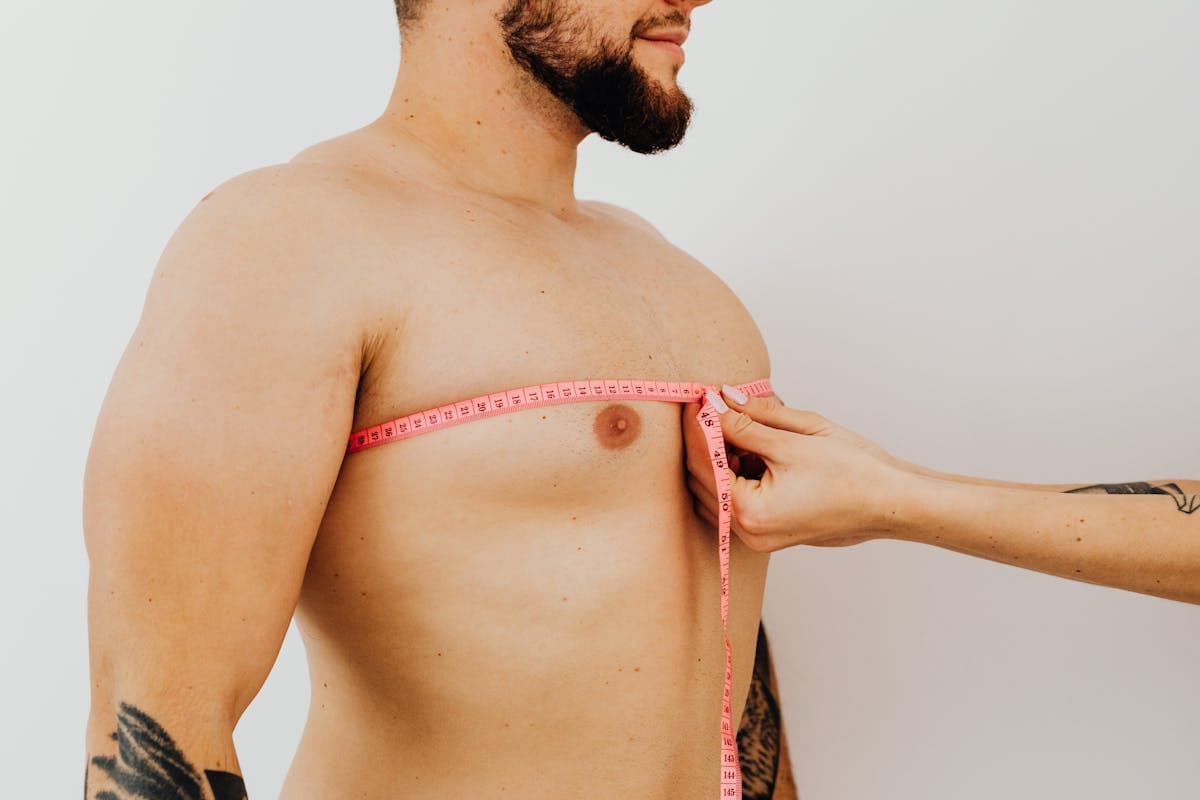
The more you invest in the measurement process upfront, the closer your first delivery will be to perfect. Here is how to set yourself up for success.
- Do the WhatsApp-guided measurement -- Do not just submit numbers on a form. Get on a video call with our tailor so they can watch you measure in real time and correct your technique immediately. This alone eliminates the majority of measurement errors. Book your free consultation here.
- Use a reference garment -- If you own a suit, jacket, or dress shirt that fits the way you want, measure that garment and send us those numbers alongside your body measurements. This gives our tailor two data points instead of one.
- Send photos in fitted clothing -- Front, side, and back. Our tailors can spot postural tendencies, shoulder slopes, and asymmetries from photos that no measurement alone can capture.
- Be specific about fit preferences -- "I want a slim fit" means different things to different people. Tell us what you mean in concrete terms: "I want the jacket to fit close to my body but still be able to button comfortably without pulling," for example.
- Measure twice -- Take each measurement at least twice and compare. If the two readings differ by more than half an inch, do it a third time. This takes an extra five minutes and can save you weeks of waiting for an adjustment.
The Bottom Line: Fit Risk Is Manageable
The fear of a custom suit not fitting is understandable but disproportionate to the actual risk. With a reputable tailor who uses guided measurement, proportion verification, progress photos, generous seam allowances, and a piece of matching fabric in every box so a local tailor can perfect the fit, the chance of ending up with a garment you cannot wear is extremely low.
And even in the rare case where something needs adjustment, the cost of that adjustment on a $149-$309 suit is a fraction of what you would have paid for a "safe" off-the-rack option. The math is on your side.
We have served 5,000+ clients worldwide, including 500+ wedding parties where every groomsman needed to match perfectly. If our measurement process did not work reliably, we would not have 520+ five-star Google reviews and 25+ years in business. Those numbers are the real fit guarantee.
Ready to get measured? Visit our interactive measurement guide or message us on WhatsApp. And if you are still doing research, browse our pricing page to see what is available.
Frequently Asked Questions
What is the most common fit issue with custom suits ordered online?
The most common issue is minor sleeve or trouser length adjustment -- typically needing a quarter to half inch change. These are quick fixes that any local tailor can handle in a single visit for $15-30. Significant structural fit problems (shoulder width, chest circumference) are rare with guided measurement and proportion verification.
Can a local tailor fix a custom suit that does not fit?
Yes, most minor adjustments can be handled locally. Because Nathan Tailors builds generous seam allowances into every garment, a local tailor has room to let out seams (make larger) or take them in (make smaller) without compromising the garment's appearance. We provide specific alteration instructions so your local tailor knows exactly what to adjust.
How does seam allowance affect whether a suit can be altered?
Seam allowance is the extra fabric inside the seams of a garment. More seam allowance means more room for a local tailor to let out the garment if it is too tight. Nathan Tailors leaves 0.75 to 1.25 inches of seam allowance on key areas (side seams, waist, sleeves), compared to 0.25 to 0.5 inches on typical off-the-rack suits. This means our suits can be adjusted up to an inch in either direction at most seam points.
Does Nathan Tailors offer refunds or free remakes on custom suits?
No. Because each garment is made specifically for your measurements and cannot be resold, it is non-refundable, and we do not offer free remakes. What we do instead is build the fix into the garment: every suit is cut with generous seam allowances and ships with a piece of the same fabric, so a local tailor can adjust the fit if anything needs tweaking. We also stay reachable to diagnose issues from your photos and tell your local tailor exactly what to do. For a genuine workmanship defect that is clearly our error, we work it out with you case by case at our discretion.
Can a custom suit be altered after it arrives?
Yes -- and this is the heart of how we handle fit. Our generous seam allowances (0.75 to 1.25 inches on key seams) plus the matching fabric we include in every box give any competent local tailor the room and the material to take in, let out, or adjust your suit. A typical local alteration costs $15-40 and takes 1-3 days, with no need to ship anything back to Vietnam.
What if I gain or lose weight after ordering?
If you experience a significant body change between ordering and delivery (or shortly after), let us know. Our generous seam allowances, combined with the matching fabric we include, mean that weight fluctuations of up to 10-15 pounds can often be accommodated by a local tailor. For larger changes, send us photos and we will help you figure out the best path forward.
How do I know if a fit issue is my fault or the tailor's fault?
Send us photos and we will tell you honestly what is going on. In most cases -- whatever the cause -- the cleanest resolution is a local alteration using the seam allowances and matching fabric that ship with your suit, and we will give your local tailor exact instructions. Common customer-side errors include measuring over thick clothing, pulling the tape too tight, or confusing body measurements with garment measurements; our verification process catches most of these before production. If a genuine workmanship defect is clearly on our side, we work it out with you case by case.
Is it better to order in person or remotely?
Both methods produce excellent results. In-person fitting in our Hoi An workshop has a slight edge on fit accuracy because our tailor can physically assess your posture, shoulder slope, and body shape. But our remote process -- guided video measurement, photo assessment, proportion verification, and generous seam allowances -- achieves an excellent first-time fit rate, comparable to the fit rates reported by brands with physical showrooms. If you are planning a trip to Vietnam, visiting us in Hoi An is a wonderful experience. If not, remote ordering works extremely well.