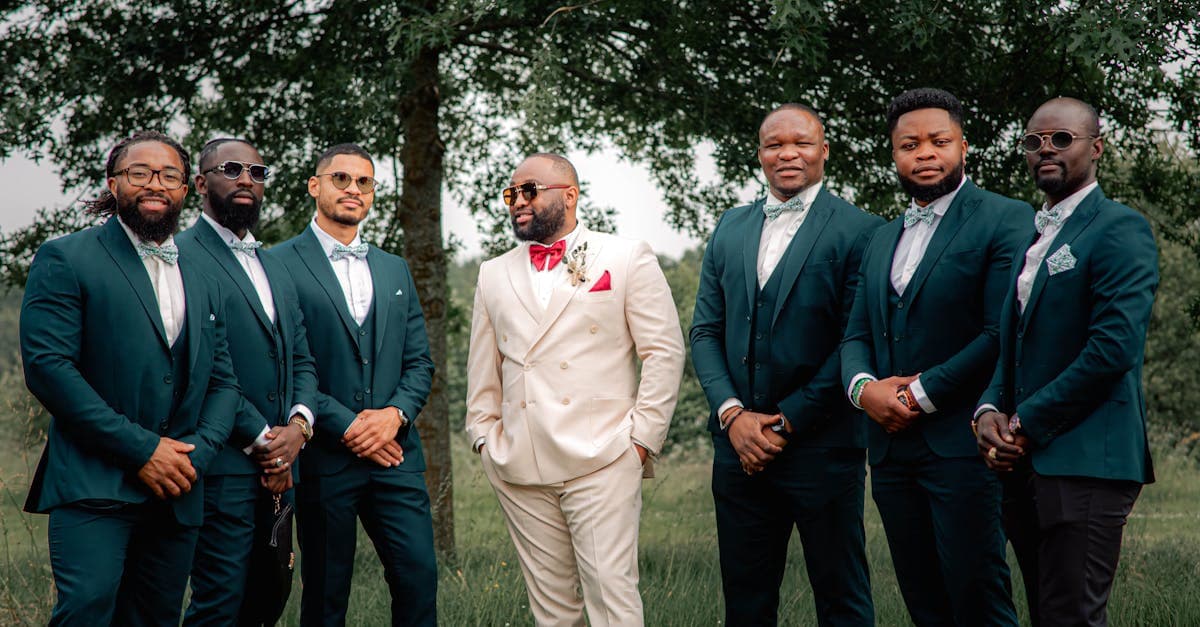
Almost every groom we have outfitted for a wedding has at some point said the same sentence: "I just told them to get charcoal." The result is rarely the photograph anyone hoped for. Five charcoals from five different shops walk down the aisle and what reads in the photo is five different greys — one with a blue cast, two with brown undertones, one verging on black, and one that turned out to be more "graphite."
Coordinating groomsmen is harder than it looks because cloth is harder than it looks. The same fabric name from the same parent mill in two different runs can finish to slightly different shades. The same suit on a 6'4" groomsman versus a 5'8" one drapes differently and catches light differently. And colour matching done by eye, in a shop on a Tuesday afternoon, will not survive a 4pm wedding photograph.
The good news: there are three ways to coordinate groomsmen, and all three work. The bad news: only one of them works the way most couples assume "matching" works. Here is how to choose, and how to make whichever you choose actually photograph.
The Three Approaches
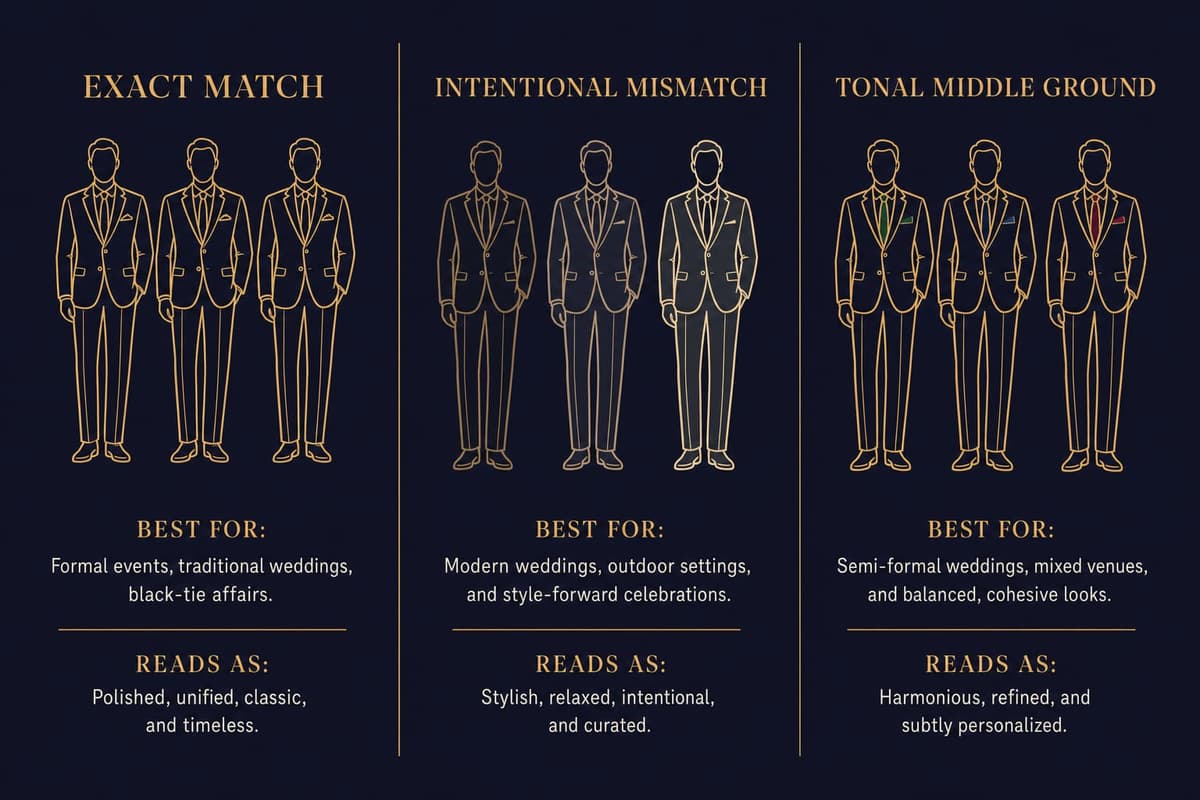
1. Exact Match
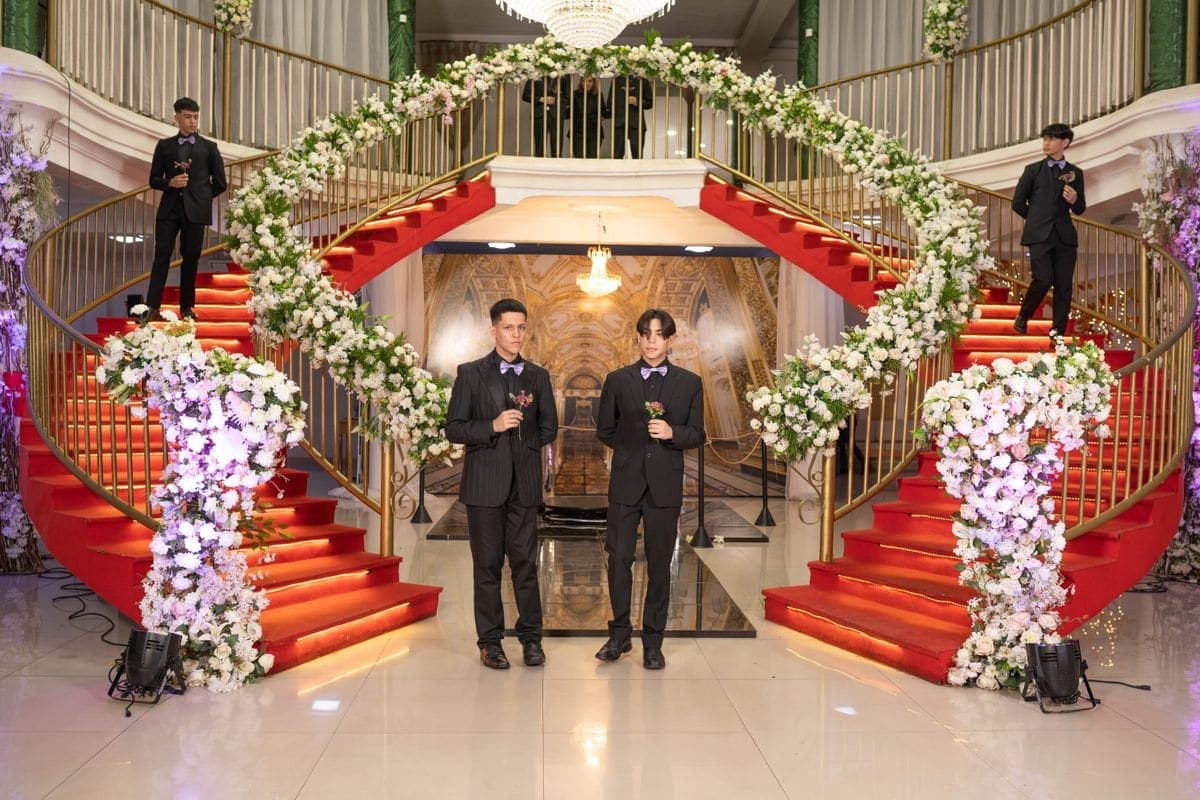
Every groomsman in the same suit. Same fabric, same colour, same construction, same buttons, same lapel. The groom is identified by his tie, pocket square, boutonniere, or lapel facing — never by his suit colour.
Best for: formal weddings, cathedrals, ballrooms, large parties (8+ groomsmen), couples who want a strongly unified visual statement.
Photographs as: a wall of identical men. Reads classic, traditional, formal. The eye goes to the groom because he is the only one with a different tie or boutonniere.
The catch: the only way to actually achieve exact match is for every suit to come from the same workshop, in the same dye lot, cut from the same bolt of cloth. Five groomsmen each ordering a "charcoal three-piece" from five different brands does not produce exact match. It produces five charcoals.
2. Intentional Mismatch
Every groomsman in a different colour from the same family. Three groomsmen in three different blues. Five groomsmen in five different earth tones. The party reads as a colour family rather than a colour uniform.
Best for: garden weddings, vineyard ceremonies, smaller parties (3–5 groomsmen), couples who want personality and individuality without chaos.
Photographs as: a coordinated spectrum. Reads modern, editorial, intentional. Particularly strong at golden hour where every shade has a chance to glow differently.
The catch: intentional mismatch is the hardest of the three to execute. If two of the shades are too close, it reads as a mistake. If two are too far apart, it reads as random. The shades have to be plotted in advance — usually with a swatch wall — and then made together.
3. Tonal Middle Ground
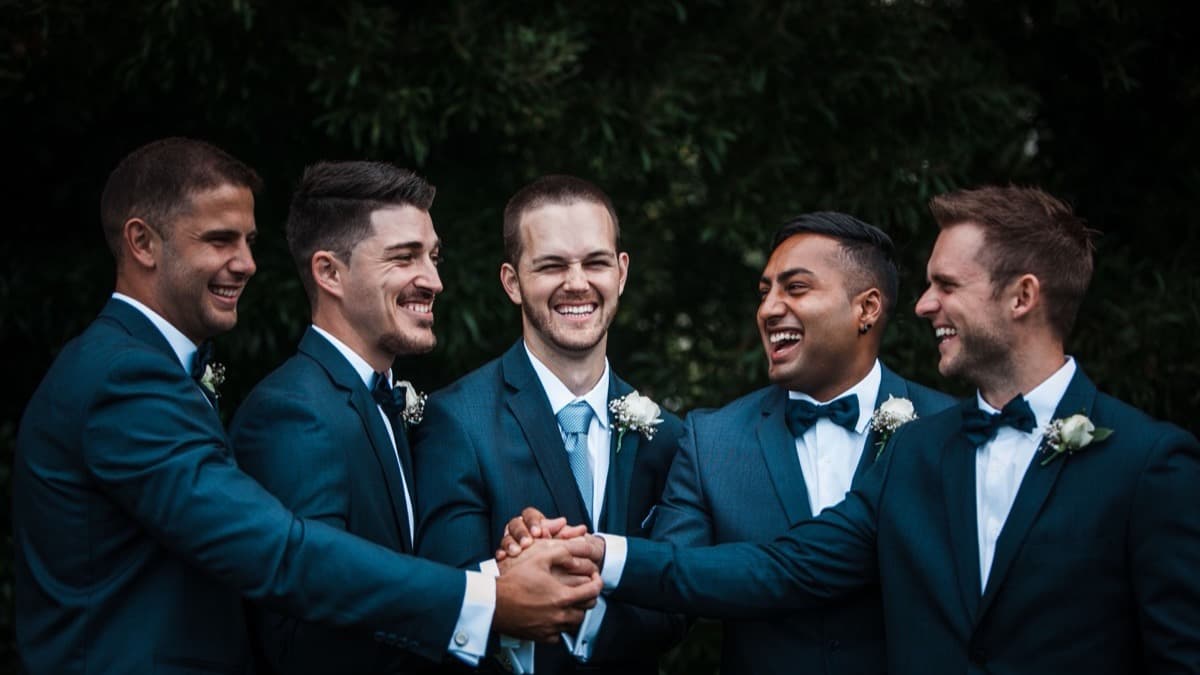
Same fabric, same suit colour, same workshop. Differentiation comes from accessories: ties, pocket squares, boutonnieres, sometimes shoes. This is the most-photographed approach in 2026 weddings and the one we render most often.
Best for: almost any wedding. Particularly strong for mid-formal weddings, mixed-venue weddings (ceremony in one place, reception in another), and parties of 4–7 groomsmen.
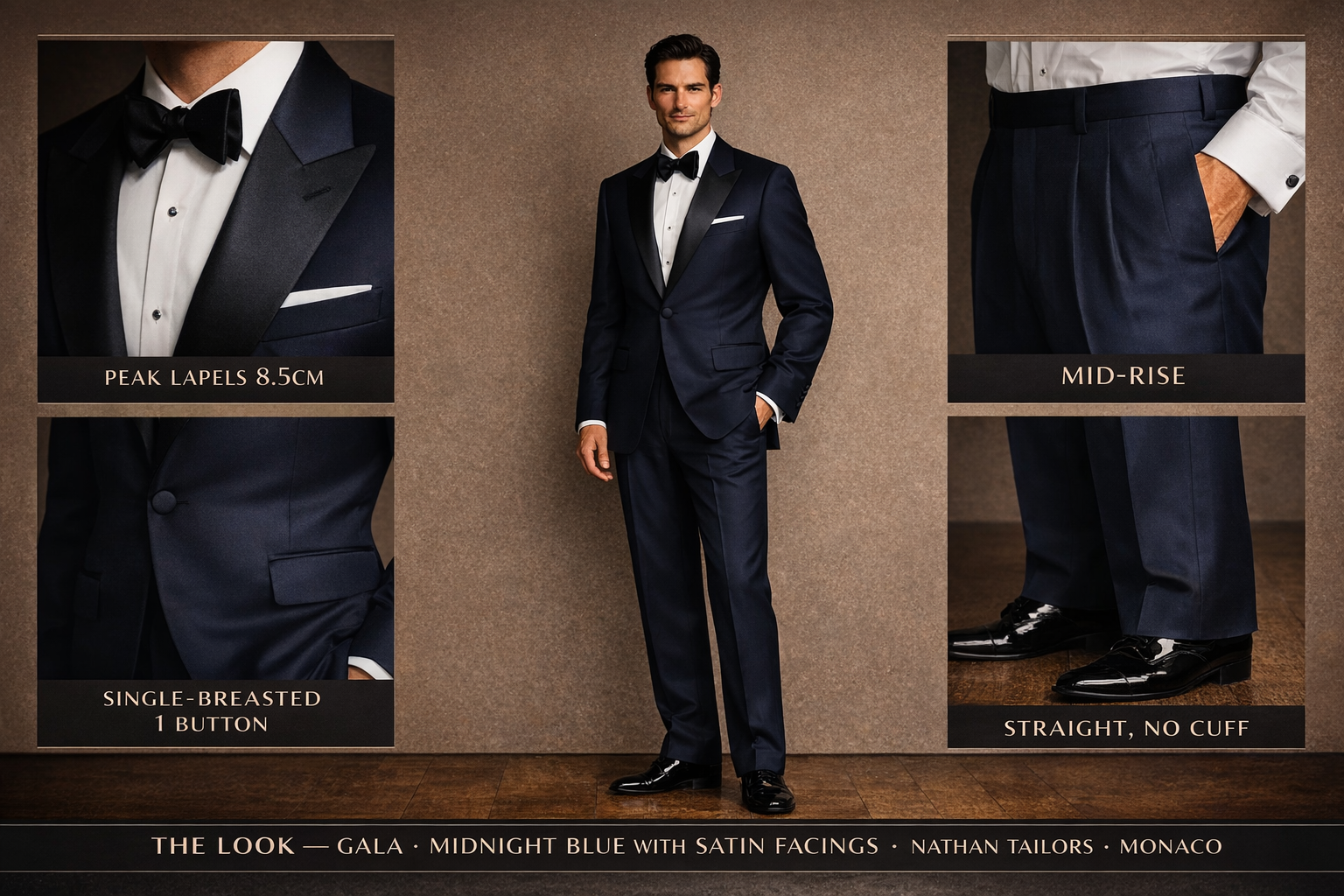
Photographs as: a unified party with subtle individual texture. Reads polished, considered, contemporary. The groom can still differentiate himself with a third-piece (waistcoat) or a peak lapel.
The catch: the accessories have to be coordinated as carefully as the suits would be. A random tie from each groomsman's closet defeats the purpose. The ties should come from the same palette family — different shades or different blooms, but visibly part of one story.
The "Just Get Charcoal" Problem
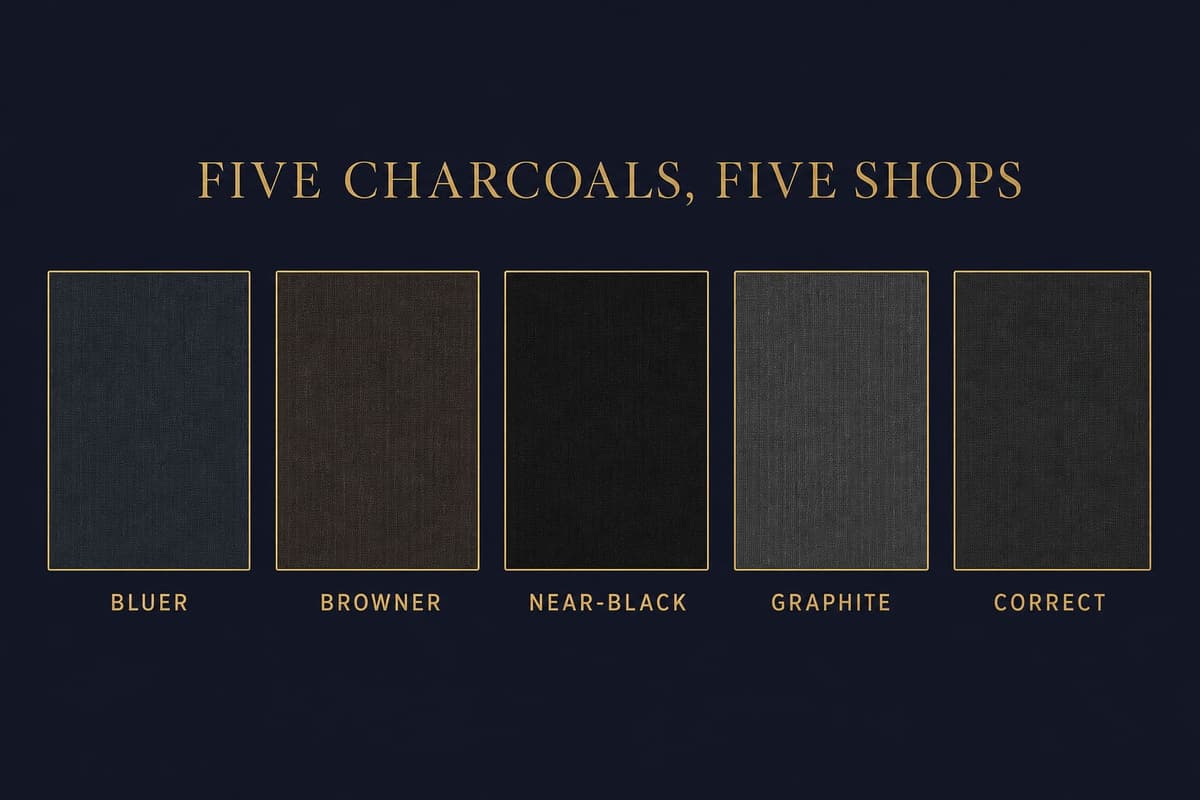
The single most common mistake in groomsmen coordination is the groom telling his groomsmen to "just get a charcoal suit." This is not coordination. This is five purchases that produce five different charcoals.
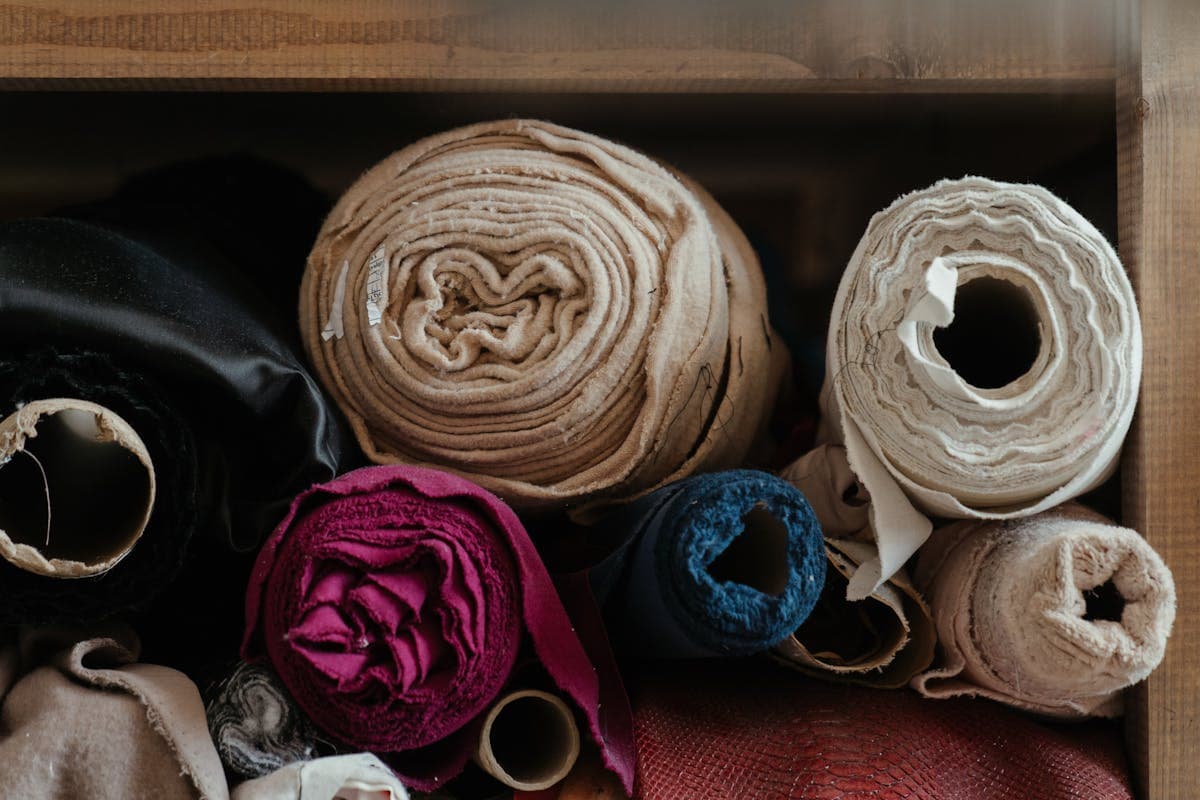
The reason it fails comes down to how cloth is dyed. A "charcoal" suit is dyed at the mill. Different mills have different proprietary dye recipes. Even within one mill, charcoal in a 320g worsted wool is not the same charcoal as in a 280g flannel — the fibre takes the dye differently. And then each suit gets pressed and finished by a different shop, which adds another small visual shift.
By the time five groomsmen show up on the morning of the wedding, the variation in their charcoals is roughly:
- One reads slightly bluer (a worsted with a cool finish).
- One reads slightly browner (a flannel with a warm finish).
- One reads almost black (a heavier wool, slightly darker dye recipe).
- One reads more graphite-grey (a lighter weight, lifted by the warmer indoor light).
- One reads correct — exactly the charcoal you imagined.
The wedding photographer can correct some of this in post. But not all of it. And the colour cast carries through the whole album.
The Solution: Same Workshop, Same Dye Lot
The fix is structural, not stylistic. If you want every groomsman to actually wear the same charcoal, every suit has to be cut from the same bolt of cloth, in the same dye lot, by the same workshop. This is not a luxury — this is just how cloth works. There is no consumer-side fix; there is only a supply-chain fix.
It also happens to be how we work. When a wedding party comes to us, we order the cloth as a single unit, cut from one bolt where possible, dyed in one lot, finished in one workshop, by the same construction team. The result is what an exact match is actually meant to look like in photographs.
This same logic applies to intentional mismatch. If you want three different shades of blue across three groomsmen, those three shades need to be plotted on a swatch wall together — in advance, at the same time, in the same lighting — and then ordered as a coordinated set, not as three independent purchases.
Render the Party Before You Order
Whatever approach you take, the cleanest sanity check is to render the full party in your palette before any cloth is cut. You see how each shade reads against every other shade, against the bride's dress, against the venue. Tonal middle ground? You see whether the ties read as coordinated or as random. Intentional mismatch? You see whether the spectrum reads as a family or as confusion.
Six Specific Palette + Approach Combinations
Combination 1: Charcoal exact match + groom in midnight blue, peak lapel, three-piece
Approach: exact match.
The look: all groomsmen in identical charcoal worsted wool, two-piece, notch lapel, knit ties in deep burgundy. Groom in midnight blue three-piece with peak lapel and a silk burgundy tie that visually echoes the groomsmen but in a richer texture.
Photographs at: cathedral, ballroom, hotel. Holds up under tungsten and candlelight.
Combination 2: Five shades of sage on five groomsmen, groom in charcoal
Approach: intentional mismatch.
The look: light sage, mid sage, deep sage, olive-sage, moss-sage — all from the same fabric house, plotted on a swatch wall in advance. Groom in charcoal three-piece, anchoring the spectrum without competing with it.
Photographs at: vineyard, garden, country house. Best at golden hour.
Combination 3: Beige linen exact match + colour-coded ties
Approach: tonal middle ground.
The look: all groomsmen in identical beige linen two-piece, notch lapel. Each groomsman wears a different tie in the wedding palette — sage, terracotta, mustard, dusty rose, copper. Groom wears a slightly deeper stone linen, three-piece, with the bride's matching tie.
Photographs at: beach, garden, terrace. Especially strong for parties where the groomsmen need individual personality.
Combination 4: Burgundy + black tuxedo party with groom in burgundy peak-lapel
Approach: tonal middle ground with a strong groom differential.
The look: all groomsmen in classic black tuxedos with shawl lapel. Groom in burgundy velvet jacket with peak lapel, black trousers, black bowtie. The groom is unmistakable; the rest of the party still reads as a unified black-tie phalanx.
Photographs at: ballroom, cathedral, hotel, winter wedding. Best in candlelight.
Combination 5: Three jewel tones across six groomsmen, groom in midnight charcoal
Approach: intentional mismatch.
The look: two groomsmen in sapphire, two in emerald, two in amethyst — all in the same suit construction, three-piece, peak lapel. Groom in midnight charcoal three-piece with peak lapel and a silver tie. Each jewel tone is matched to a bridesmaid; the photo reads as paired couples.
Photographs at: ballroom, cathedral, hotel, winter wedding. The most theatrical of the six combinations.
Combination 6: Stone wool-linen exact match + groom in cream three-piece
Approach: exact match with a groom shade differential.
The look: all groomsmen in identical stone wool-linen blend, two-piece, notch lapel, soft sage knit ties. Groom in a cream wool-linen three-piece, peak lapel, deeper sage silk tie.
Photographs at: garden, courtyard, vineyard, late-spring outdoor wedding. The cream-against-stone contrast reads strongly even in soft daylight.
How to Decide Which Approach
If you remember nothing else from this article, remember this set of three quick tests:
- If the wedding is formal and the venue is architectural (cathedral, ballroom, hotel), default to exact match with a groom differential. The setting carries enough visual weight; the party should read as a unified phalanx.
- If the wedding is mid-formal and outdoor (garden, vineyard, barn), default to tonal middle ground. The natural backdrop is doing visual work for you; let the party feel slightly more textured and human.
- If the wedding is small (under 50 guests, 3–4 groomsmen) and the couple is design-led, intentional mismatch is on the table. Below that party size and with the right palette, mismatch reads editorial. Above that size, it starts to read as chaos.
The Coordination Workflow
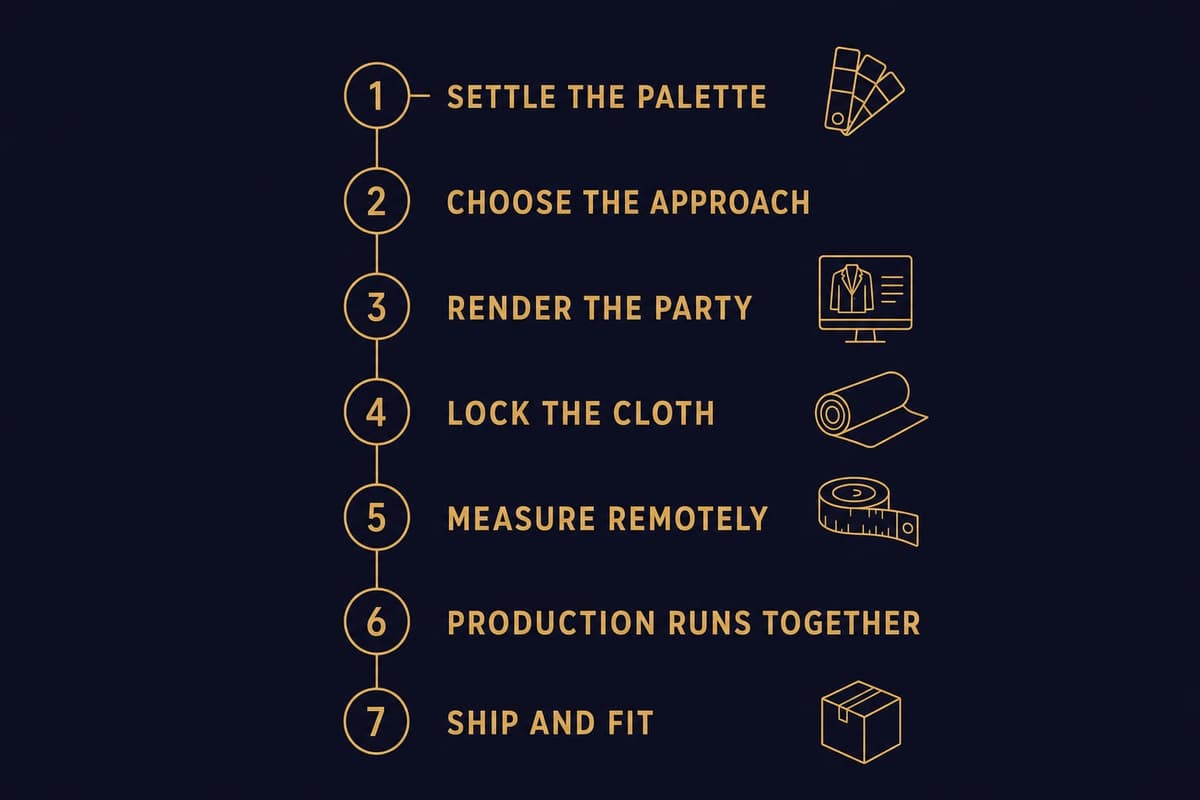
For couples coordinating a full party from different cities (or different countries — most of our wedding parties span at least three locations), the workflow looks like this:
- Settle the palette. One palette, locked, for the bride, groom, groomsmen, bridesmaids, and the parents of both.
- Choose the approach. Exact, intentional mismatch, or tonal middle ground. Different approaches change the cloth ordering process.
- Render the party. On a mood board, with the actual palette, with the actual approach. This is where most parties make their final adjustments.
- Lock the cloth. Once the render is approved, we order the cloth as a single unit. One bolt, one dye lot, one workshop.
- Take measurements remotely. Each groomsman submits measurements through a simple form or in person if local. We make recommendations on adjustments based on body type.
- Production runs together. All suits are made in parallel by the same construction team. This is where same-workshop matching happens — not at the dye stage, at the construction stage as well.
- Ship and fit. Suits ship to the wedding venue or to each groomsman individually. One fitting before the rehearsal dinner catches anything that needs adjusting.
The Cost Question
The honest answer is that custom groomsmen suits, made together in one workshop, cost roughly the same per suit as a mid-tier off-the-rack suit with alterations — and produce a dramatically more coordinated photograph. Our wedding-party pricing is structured so that as the party grows, the per-suit cost stays steady; the supply-chain savings come from cutting cloth as a single unit and running production in parallel rather than from charging less for fewer suits.
For groomsmen who are also handling tuxedos, formalwear for other events, or have more than one wedding in the year, our piece on coordinating groomsmen suits covers the wider economics in detail. The wedding suit is rarely a one-occasion purchase if it is built correctly.
Visualise Before You Commit
Whichever of the three approaches you take, the smartest thing you can do before ordering anything is render the full party. Drop your palette into our wedding mood board for the whole party, see the bride, the groom, the groomsmen, the parents, the ring bearer all in one frame. Adjust until it photographs the way you want it to. Then we make it.
For couples planning a wedding in Vietnam or coordinating remotely from elsewhere, our Nathan Tailors wedding collections page has the full party offering, and our destination wedding guide explains the remote-fitting workflow that has made coordinated party tailoring possible across continents.
FAQ
Can groomsmen wear different suits if they buy them separately?
Technically yes. Editorially, almost never well. The "let everyone choose their own charcoal" approach produces a photograph of five different charcoals walking down the aisle. If you genuinely want individual choice, commit to intentional mismatch — a coordinated spectrum across one fabric — and plan it together rather than letting each person decide alone.
How many shades is too many for intentional mismatch?
Three to five distinct shades, plotted in advance, reads as editorial. Six or more starts to read as random. The sweet spot is one shade per groomsman in parties of three to five; in larger parties, you typically pair shades — two groomsmen in shade A, two in shade B, two in shade C.
Should the groom always wear something different from the groomsmen?
Yes. In any of the three approaches, the groom needs at least one visible differential — a deeper shade, a peak lapel, a three-piece versus two-piece, a different boutonniere. The single most important rule is that anyone glancing at a group photo should be able to identify the groom in under a second.
How do you actually match colour across multiple groomsmen?
One workshop, one dye lot, one bolt of cloth where possible. There is no other reliable way. Colour matching by eye across multiple shops fails roughly half the time, and the failure shows up most clearly in photographs.
What if one groomsman is much taller or larger than the others?
The same fabric drapes the same way regardless of size, so the colour reads consistent. Construction adjustments — slightly different jacket length, different trouser break — happen at the measurement stage and do not affect how the suit photographs as part of a unified party.
How long does it take to make a coordinated set of groomsmen suits?
For our process, about 3 to 4 working days in production and roughly three weeks door-to-door including shipping. Even so, ordering well ahead of the wedding leaves comfortable room for a local tailor to fine-tune anything using the generous seam allowances we cut into every garment. Locking the order a couple of months before the wedding is the safest timeline.