Indochino is a real company making real suits. I want to say that at the top because the rest of this post is about where their self-measurement process gets hard, and I do not want you to read it as a hit piece. At $399-699 starting (often less with a sale, which is roughly always), Indochino gives you a legitimate made-to-measure suit in three weeks, a US retail presence, and a remake guarantee most of their competitors do not offer. For a first custom suit, a lot of people do worse.
But the number one reason Indochino suits need remakes -- and a meaningful chunk of them do -- is that the self-measure-at-home process asks you to take measurements nobody taught you how to take. Here is the honest guide to doing it right.
First: Know Which Path You Are On
Indochino has two ordering paths and they are very different experiences.
Path 1: In-store appointment. You book a showroom visit (they have stores in most major US cities -- New York, Chicago, Boston, LA, Dallas, Atlanta, Toronto, and more). A showroom associate takes all your measurements, you pick fabric in person, they send everything to the factory. This is the path with the highest first-fit success rate. If you can get to a store, take it.
Path 2: Self-measure at home. You follow Indochino's online guide, submit the numbers, hope for the best. This is the path most people reading this article are on. It is also the path where the remake rate is meaningfully higher. You can do it well, but you have to know where the traps are.
The Full List of Indochino Measurements
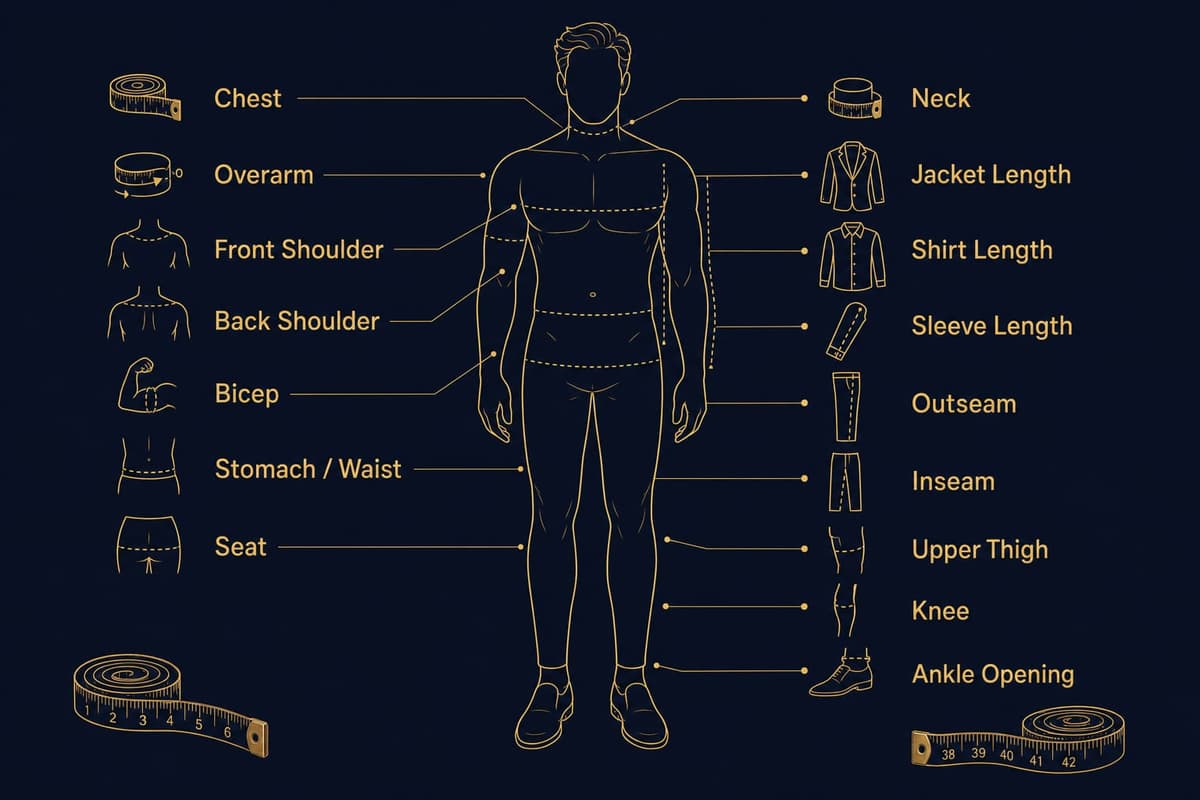
Indochino's self-measurement system asks for 15-20 numbers depending on whether you are ordering a suit, a shirt, or a combo. For a two-piece suit, expect roughly:
- Chest
- Stomach / Waist
- Seat
- Front shoulder
- Back shoulder
- Overarm
- Bicep
- Neck
- Shirt length
- Jacket length
- Sleeve length
- Outseam
- Inseam
- Upper thigh
- Knee
- Ankle / bottom opening
- Height and weight
That is more than twice what SuitSupply asks for, and roughly the same as what a real bespoke tailor on Savile Row takes. On paper that is a good thing. In practice, more measurements means more places for a self-measurer to make a small mistake that compounds into a real fit problem.
The Six Measurements That Trip Everyone Up
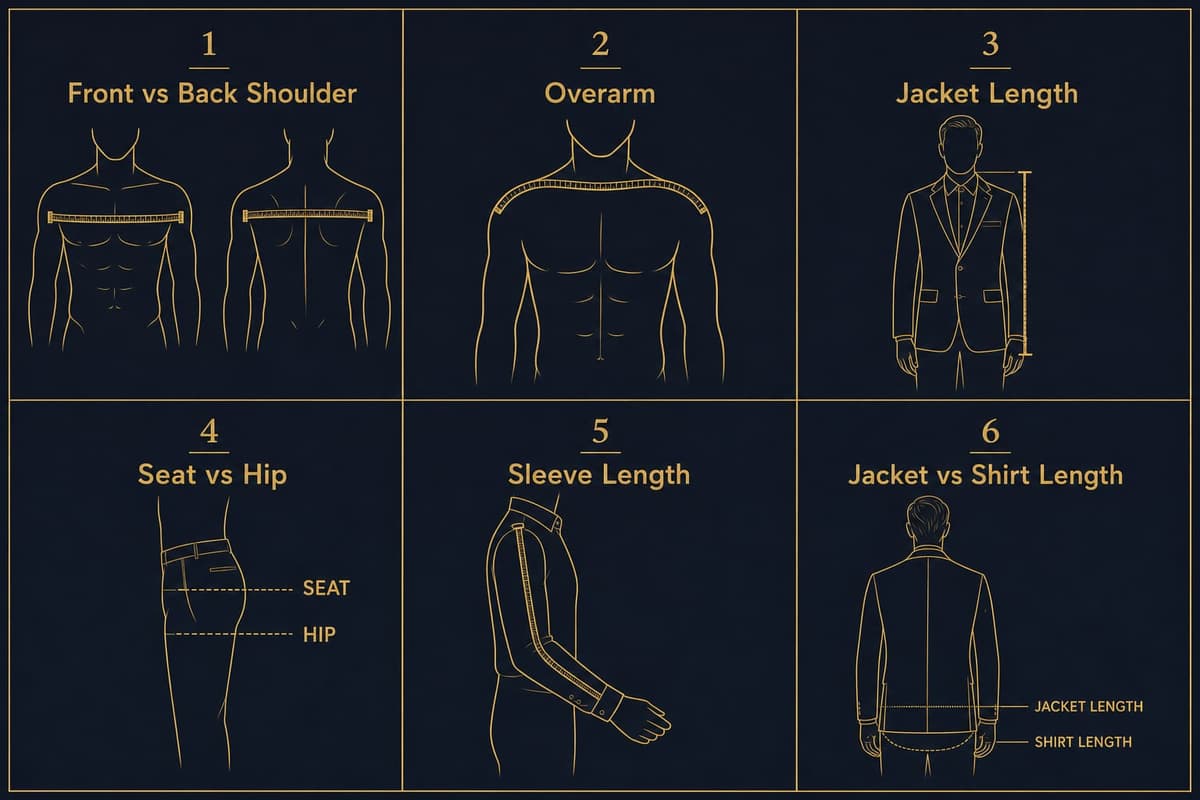
If you are going to obsess over any part of this process, obsess over these.
1. Front Shoulder vs Back Shoulder
These are not the same measurement. This is the single most confused pair on the whole list.
Front shoulder: With your arms hanging at your sides, measure from the outer bony point of one shoulder, across the front of your chest, to the outer bony point of the other shoulder. Tape passes across the collarbones.
Back shoulder: Same two bony points, but the tape now passes across the upper back, following the curve of the shoulder blades. This number is almost always larger than the front shoulder, because your back has more surface to cross.
If you accidentally give the same number for both, the pattern gets geometrically confused and the shoulder seam will not sit where it should. Use a mirror. Measure twice.
2. Overarm
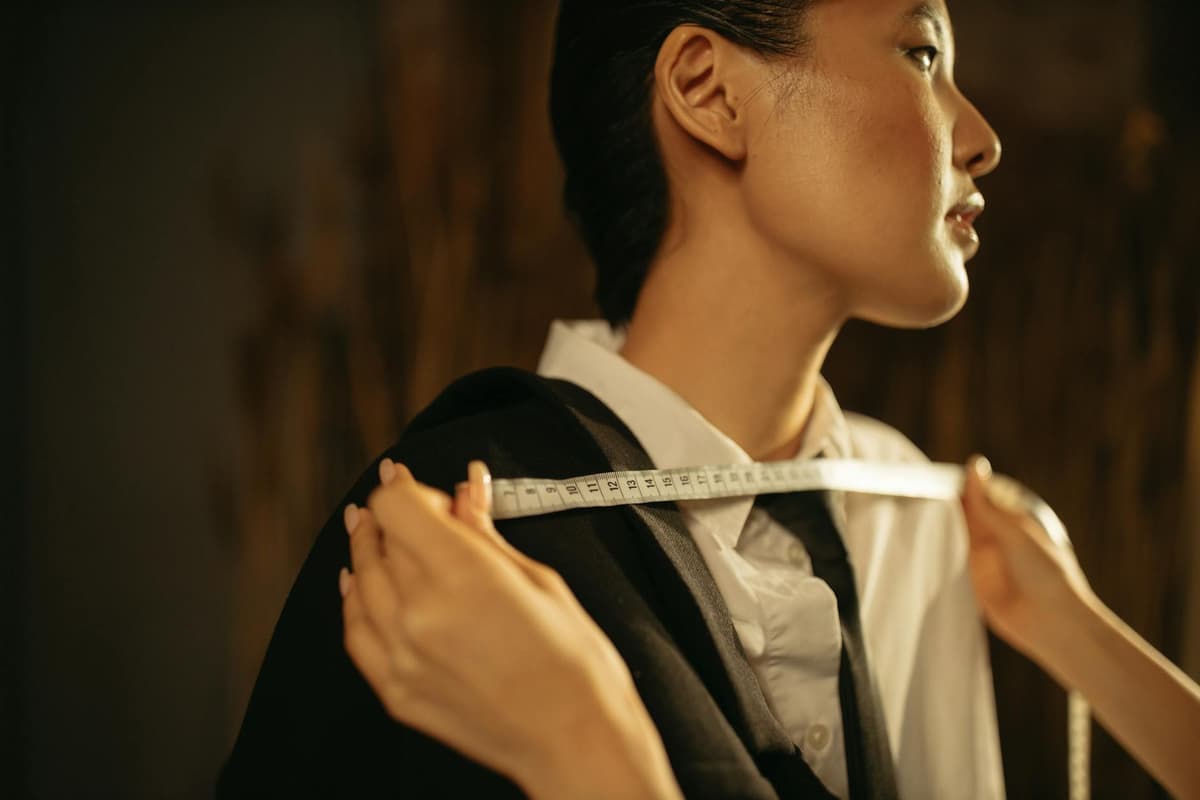
Overarm is a measurement almost nobody takes elsewhere. Tape goes around your torso at armpit height, over the fullest part of both shoulders and across the chest -- so the tape rides on top of the shoulder caps, not tucked underneath. This is Indochino's way of catching shoulder width + chest depth in one number, which is genuinely clever pattern-making. It is also impossible to do alone without a mirror. Get help.
3. Jacket Length
Indochino's guide says to measure from the base of your collar down to "where you want the jacket to end." That is not a measurement. That is a style decision dressed up as a measurement.
Default guidance: the jacket should end roughly where your fingers curl into your palm when your arms hang naturally. Shorter is more modern (2026 silhouette leans slightly longer than the 2020 super-cropped look). Longer reads more conservative. If you do not have a strong preference, go with the default.
4. Seat vs Hip
Seat is measured at the widest part of your buttocks -- usually 6-8 inches below your waist. Hip is a little higher, around the hip bone. Indochino typically asks for seat. Do not measure at your hip bone and call it a seat measurement. They are different numbers and the trouser pattern depends on it.
5. Sleeve Length
Measure from the outer shoulder bony point (same one you used for the shoulder measurement), down the slightly bent arm, to the wrist bone on the pinky side of your wrist. Sleeve should end roughly where the base of your thumb meets your wrist when your arm hangs naturally. If you measure with a straight arm, you will get a number that is a full inch too short.
6. Jacket vs Shirt Length
These are two separate numbers and they are not measured from the same reference point. Shirt length is usually from the base of the collar down the back to where you want the shirttail to hit. Jacket length is the same starting point but ending higher. Read Indochino's specific instructions for each; do not assume one number gives you the other.
What to Wear While Measuring
This sounds trivial but it is not. Wear:
- A thin, well-fitting undershirt -- not a dress shirt, not a hoodie.
- Briefs or thin athletic shorts -- not jeans. Jeans add a quarter to a half inch everywhere they touch, and that propagates through the trouser measurements.
- No shoes for inseam and outseam.
- Stand on a flat, hard surface. Not carpet.
Measure in the morning if you can. Your waist and seat are 0.5-1 inch smaller in the morning than after dinner. That is real. Pick one time of day and be consistent.
The Perfect Fit Guarantee (Read the Fine Print)
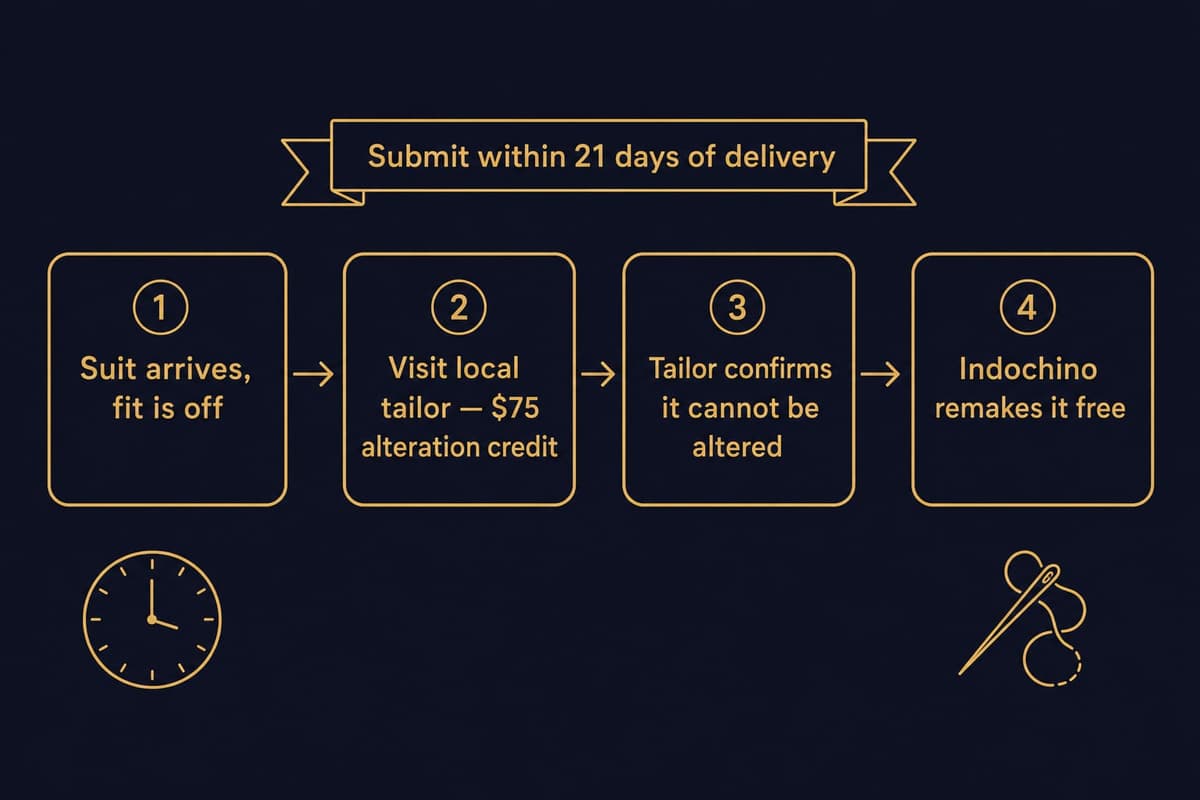
Indochino's Perfect Fit Guarantee is a genuine consumer protection and it is one of the main reasons to order from them over a no-name MTM site. But people misunderstand what it covers.
The rough terms, as of spring 2026: if your first suit does not fit, Indochino will remake it for free -- after you first take it to a local tailor for alterations using their $75 alteration credit. Only if the local tailor confirms it cannot be altered to fit will Indochino remake it. And you have to submit your remake request within 21 days of delivery.
That is fair policy. It also means: expect to make at least one trip to a local tailor even if everything goes well, and expect to wait another 4-6 weeks if a remake is needed. Plan your timeline accordingly -- especially for a wedding or work event.
The Honest Take on Indochino
Indochino's real strength is the retail footprint. If you can walk into a store in Manhattan or Lincoln Park or downtown Dallas and have a trained associate take all twenty of those measurements for you, your fit-success rate is very high. The brand's weakness is that most orders do not happen that way. They happen online, from a self-measurement form, at 11pm, on a Tuesday, in a bathroom mirror. And the remake rate for that cohort is meaningfully higher than the in-store cohort.
If you are in a city with an Indochino store -- go to the store. Do not self-measure for your first order. Use your first order to calibrate: get measured in person, then save those numbers, and your second and third orders can be online with confidence.
If You Want Fully-Remote With Live Guidance
Indochino's strength is the physical retail experience. Its weakness is that remote self-measurement leads to a significant chunk of first orders needing remakes or local alterations. If you want fully-remote custom tailoring with live WhatsApp guidance during the measurement step -- and generous seam allowances plus spare matching cloth in every parcel so a local tailor can adjust the fit -- that is what we do at Nathan Tailors.
Our Guided Measurement App walks you through 13 measurements in about 10 minutes, with reference photos at each step and 3 full-body photos submitted alongside. The submission goes straight to WhatsApp, where our master tailor (25+ years) reviews it before your suit is cut -- and if something looks off in the numbers, he messages you back before production starts. That pre-production review is the step Indochino's online flow does not have.
Pricing: two-piece custom suits from $149 (wool blend), $189 (wool-silk), $249 (premium wool blend), $309 (merino). Three weeks order to delivery (3-4 days production in Hoi An, plus about two weeks of tracked international shipping). 520+ five-star Google reviews. 5,000+ customers across 50+ countries, most of whom never came to Vietnam.
If you are weighing us against Indochino specifically, the deeper comparison lives here: Indochino vs SuitSupply vs Nathan Tailors. We are one of the three brands in that post, so read it knowing we have a perspective. The facts hold up regardless.
Whichever route you go, measure carefully. Measure twice. And if you are self-measuring for Indochino at 11pm on a Tuesday, maybe wait until Saturday morning.