How to Measure Arm Length:
And Why It's Different From Sleeve Length
Most online tailoring forms confuse arm length with sleeve length. They're different — and the difference is what gives a shirt or jacket sleeve that perfect 'half-inch of cuff' showing under the jacket sleeve.
What Is Arm Length?
Arm length is the distance from the shoulder point (where the shoulder bone ends and the arm begins) down to the wrist bone, measured along the outside of a slightly bent arm.
It is distinct from sleeve length, which is measured from the center back of the neck across the shoulder and down to the wrist (used for shirt sizing — typically 32-36 inches for adult men).
Arm length is a per-arm measurement and tailors record left and right separately. Asymmetry of 0.5-1.5 cm is common — your dominant arm is often slightly longer.
Why This Measurement Matters
- ✓Jacket sleeve length — jacket sleeves are cut from arm length, not sleeve length
- ✓Cuff exposure — the classic half-inch of shirt cuff under jacket sleeve depends on accurate arm length
- ✓Asymmetry handling — quality bespoke uses left and right separately; lower-end MTM uses one number for both
- ✓Athletic builds — well-developed biceps shorten the visible arm length when at rest; the tape needs to track the actual bone, not the muscle
Step-by-Step: How to Measure Arm Length
What You'll Need:
- Soft fabric measuring tape
- Helper (recommended)
- Slightly bent elbow during measurement
Stand with arm slightly bent
Stand naturally and bend your arm at about 30 degrees — hand resting on your hip is the standard position. Do not measure with the arm fully extended; arm length on a fully straight arm reads 1-2 cm shorter than functional length.
Find the shoulder point
The shoulder point is where the shoulder bone (acromion) ends and the arm begins. Run your finger along the top of the shoulder out to the edge — this is where jacket sleeve seams sit.
Measure to the wrist bone
Run the tape from the shoulder point, down along the outside of the arm, over the elbow, and to the prominent wrist bone (the styloid process at the outer wrist). Keep the tape on the outside of the arm — not over the top, not underneath.
Read at the wrist bone
Stop at the small bony bump at the side of your wrist (where a watch face sits). Record to the nearest 0.5 cm.
Repeat on the other arm
Asymmetry of 0.5-1.5 cm between arms is common. Record both numbers separately.
Average Adult Arm Length by Height (US Reference)
| Height | Arm Length (inches) | Arm Length (cm) |
|---|---|---|
| 5'4" – 5'6" | 23" – 24" | 58 – 61 cm |
| 5'7" – 5'9" | 24" – 25" | 61 – 63 cm |
| 5'10" – 6'0" | 25" – 26.5" | 63 – 67 cm |
| 6'1" – 6'3" | 26.5" – 28" | 67 – 71 cm |
Source & method
Data: ANSUR II — 2012 Anthropometric Survey of U.S. Army Personnel (NATICK/TR-15/007) · n = 4,082
Method: Shoulder point to wrist bone with the arm relaxed at the side, following the natural bend.
Limitation: Measured on U.S. service members, who tend to run leaner and more muscular than the general public — read this as an active-adult reference, not the "average American".
Last reviewed: April 27, 2026 · Full distribution and percentiles
Cite this page
Nathan Tailors, "How to Measure Arm Length" (2026). Data: ANSUR II — 2012 Anthropometric Survey of U.S. Army Personnel (NATICK/TR-15/007) (n=4,082). https://www.nathantailors.com/guides/how-to-measure-arm-length
Free to quote or reproduce with attribution and a link.
Common Mistakes
Measuring with the arm fully straight
A fully extended arm gives a shorter reading than a slightly bent one. Bent arm (30 degrees, hand on hip) is the tailor standard.
Measuring on the inside of the arm
Always on the outside (where the watch sits). The inside of the arm has different curvature and gives an unreliable reading.
Using one measurement for both arms
Left and right are different — sometimes by 1.5 cm. A jacket cut to one number will have one sleeve at the right length and the other slightly off.
Don't have a measuring tape?
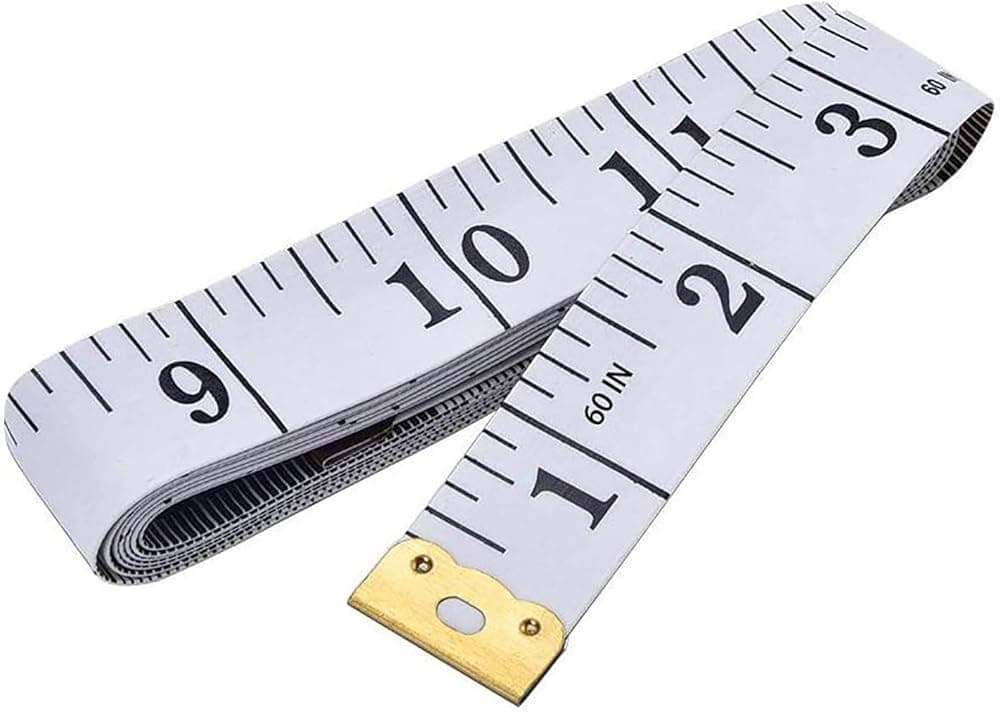
Soft Tailor’s Tape Measure — 60 in / 150 cm, dual scale
A flexible cloth body tape with both inches and centimetres — the exact kind we use in the workshop. Sixty inches covers any chest, waist, or hip. Grab two so you can hold one taut while you read the other.
As an Amazon Associate, Nathan Tailors earns from qualifying purchases — at no extra cost to you. Price is approximate; see Amazon for the current price.
Frequently Asked Questions
What is the difference between arm length and sleeve length?+
Arm length is shoulder point to wrist bone (typically 24-26 inches for adult men). Sleeve length is center back of neck to wrist, measured across the shoulder (typically 32-36 inches for adult men). Sleeve length is used for shirt sizing because shirts have a fixed back yoke. Arm length is used for jacket sleeves because jacket sleeves are cut separately from the body.
What is the average arm length for a man?+
The US adult male average arm length (shoulder to wrist) is approximately 25 inches (63 cm). It scales roughly linearly with height — about 1 inch of arm length per 3 inches of height. See the table above for height-based ranges.
How is arm length used to cut a jacket sleeve?+
The tailor takes the arm length, adds 1-1.5 cm of ease, and cuts the jacket sleeve from shoulder seam to cuff. The shirt sleeve is cut 1-1.5 cm longer than the jacket sleeve so half an inch of shirt cuff shows under the jacket — the classic finished-sleeve look.
Should both arms be measured separately?+
Yes, in true bespoke. Asymmetry of 0.5-1.5 cm is common (often the dominant arm is slightly longer). Lower-end MTM uses one number for both, which produces one sleeve at the right length and one slightly off — usually unnoticeable but visible in formal photographs.
How do I measure my own arm length without help?+
Tape the end of your measuring tape to your shoulder point with a piece of masking tape, bend your arm to 30 degrees, and run the tape down the outside of your arm to your wrist with your other hand. Read the value at the wrist. Self-measurement is workable for arm length within 0.5 cm — more reliable than self-measuring back width or shoulder.
Does arm length change with age?+
Bony arm length is essentially fixed in adulthood. What changes is functional arm length — how you hold the arm, posture, and the muscle bulk between shoulder and wrist. Most adults' tailoring arm-length measurement stays within 0.5 cm of itself across decades, unless trained muscle development is significant.
Eight tailoring traditions, one body
Every tradition lets the arm bend slightly. Arms work bent, not straight.
This guide was built from published primary sources in 8 tailoring traditions — every URL is cited inline and listed in the Sources block below. If any claim doesn't match the source it's tied to, email nathantailorshoian@gmail.com and we'll fix it the same day.
Arm length (distinct from sleeve length) is the body measurement from shoulder bone to wrist bone — Savile Row, Neapolitan, French, German, Japanese, and Vietnamese traditions all converge here. The single shared instruction across every tradition: don't measure the arm fully straight.
A slight bend at the elbow adds 1-2 cm to the reading and reflects the natural working position of the arm. Sleeves are cut for arms-in-use, not arms-at-rigid-attention. The Vietnamese áo dài tradition has carried this convention for centuries; the Müller pattern textbook calls it out explicitly; Italian and British tailors do it by reflex.
Watch out for one trap: some online "sleeve length" guides are actually arm-length guides under a different name, and vice versa. If the instruction says "shoulder point to wrist," that's arm length. If it says "center back to wrist," that's the American sleeve length convention.
🇻🇳Vietnamese
Áo dài tradition measures from the shoulder bone point down the arm to the wrist bone with a slight bend in the elbow. Vietnamese tailors also measure bicep diameter in the same pass.
🇬🇧British / Savile Row
Shoulder point (acromion bone) to wrist bone, arm relaxed and slightly bent at the elbow. Savile Row houses keep arm length distinct from sleeve length.
🇮🇹Italian
Same shoulder-point-to-wrist-bone landmark as British tradition. The Neapolitan finished sleeve is cut ~1-2 cm shorter so the shirt cuff peeks above the wrist — but the body number is taken the same way.
🇯🇵Japanese
Japanese protocol measures with the arm held at a 45° angle from vertical, tape running from the protruding bone in the neck (C7), over the shoulder bone, and down to the wrist bone — the kimono-derived yuki tradition. Modern Japanese tailoring derives arm length from yuki by subtracting the cross-shoulder portion.
🇰🇷Korean
Similar landmark to British (shoulder point to wrist), often paired with a separate bicep circumference taken with 5-10 cm of ease already added — a Korean industry convention.
🇩🇪German (Müller)
Müller's Armlänge is taken with the arm extended at ~15° from vertical, tape running from acromion to wrist bone. Müller also distinguishes "Vordere Armlänge" (front arm length) and "Hintere Armlänge" (back arm length) — three separate measurements where most traditions use one.
Most common self-measurement mistake
Self-measurers keep the arm fully straight, which under-reads by 1-2 cm. Every tradition that's ever cut a sleeve has accounted for the natural elbow bend — let your arm relax with a slight bend, and the number you read is the number the cutter wants.
Anatomical anchor
Average male arm length: 73-81 cm. The slight-bend convention is empirical across cultures — arms work bent, and every pattern system has been calibrated to that reality.
Sources: Wikipedia
Sources & references
Every claim above traces back to one of these
This guide was built from primary sources in 10 tailoring traditions — Vietnamese local convention first, then British, Italian, American, Japanese, Korean, French and German pattern systems, plus anthropometric standards (SizeUSA, SizeUK, JIS L4004). Click any to read the original.
🇻🇳 Vietnamese
- Custom tailor Hoi An — 24-hour professional processCustom Tailor Hoi AnHội An 24-48h workflow — pattern → fabric → measurements → try-on. Practical / finished-garment orientation.
- Quy trình đo may vest theo số đoThegioivestnamVietnamese-language vest measurement protocol — body shape adaptive convention.
- How to measure men's Áo DàiAlis CollectionÁo dài tradition: shoulder-bone to wrist-bone with slight elbow bend; bicep measured on the same pass.
🇬🇧 British / Savile Row
- Huntsman Savile Row — size guideHuntsman, Savile RowInseam: fork to "below the ankle bone." Anatomical anchor is the bone, not the floor.
- Bespoke trousers — all you need to knowApsley Tailors, Savile RowSavile Row trouser protocol; landmark-based measurement convention.
- The definitive guide to shirt sizing and measuringHarvie & Hudson, Jermyn StreetBritish shirtmaker sleeve convention — distinct from the American center-back method.
- What shirt size am I?Savile Row Co.British chest protocol — arms by sides, neutral breath, parallel to floor.
🇮🇹 Italian
- Neapolitan tailoringWikipediaOverview of the Neapolitan tradition (Rubinacci, Attolini, Kiton lineage) and house transmission of conventions.
- The history and anatomy of Neapolitan tailoringThe RakeNeapolitan finished cut conventions: shorter sleeve so shirt cuff peeks; spalla camicia construction.
- Come prendere le misureSartoria Rossi (Italian)Italian-language measurement protocol — landmark conventions identical to British, finished cut narrower in shoulders.
🇺🇸 American
- Brooks Brothers — suit measurementsBrooks BrothersCodified American measurement protocol; garment-derived more than body-derived.
- Brooks Brothers — dress shirt size guide (16/34 system)Brooks BrothersThe American dual-number sleeve sizing convention (neck/sleeve, e.g. "16/34") — the source of the cross-tradition confusion.
- How to measure neck size for dress shirtsThe Tie BarAmerican "two-finger" rule for neck collar measurement — ease built into measurement, not pattern.
- How to measure your body — bicepProper ClothAmerican bicep protocol — arm relaxed (NOT flexed) for tailoring; 1-2 fingers ease added.
- 3 steps — how to measure sleeve lengthNimble MadeAmerican sleeve protocol — center-back-neck through shoulder, elbow, to wrist.
🇯🇵 Japanese
- JIS L4004:2001 — adult men's clothing sizingJapan Industrial StandardsJapanese national standard. Chest, waist, and height are primary measurements. Based on ISO 3636:1977 with Japanese modifications.
- SOLIT! Japanese measurement guideSOLIT!Japanese precision-millimetre measurement convention — matagshita (inseam) treated as a primary measurement.
- Yukata / yuki measurement conventionWikipedia (cross-reference)Background on yuki — the kimono sleeve-length convention measured at 45° from C7 over shoulder to wrist. Foundational to modern Japanese yōfuku tailoring.
- Shoulder-width protocolY-Aoyama (Japanese suit chain)Japanese convention: tape passes through C7, not in a straight line — reads ~0.5-1cm larger than British convention for the same body.
🇰🇷 Korean
- Korean sleeve measurement (소매길이)GentlistKorean shops adopted American center-back-to-wrist for dress shirts post-1953 US military influence. Add 5-10cm ease at measurement (Korean industry convention).
- Uniqlo Korea — inseam (인심) protocolUniqlo KoreaKorean inseam = inner-leg seam measured on a reference garment laid flat. Body-only protocol mirrors Japanese tradition.
🇫🇷 French
- Normes et standards — prendre ses mesuresLa Bonne Taille (French)French inseam (longueur d'entrejambe): top of inner thigh to bottom of feet. Floor is the lower anchor, not the ankle bone.
- Choix de la taille homme — longueur d'entrejambeBioMidiFrench-language inseam protocol with string-substitute method.
🇩🇪 German (Müller)
- Fundamentals Menswear (textbook)Müller & Sohn, in publication since 1891The German pattern-construction tradition's reference textbook. Measurements sequenced as they enter pattern construction.
- Measurement charts for menswearMüller & SohnMüller pattern system measurement charts — codifies multiple decomposed measurements where most traditions use one.
- Konfektionsgrößen — German clothing sizesGermanwearGerman size convention: men's size = chest girth ÷ 2 (100cm chest → size 50). DOB for women: (chest − 12) ÷ 2.
📊 Anthropometric / Standards
- SizeUK survey overviewScienceDirectSizeUK (2001-2002): 5,500 men scanned in 3D, ~140 measurements per subject. Foundation of modern UK anthropometric data.
- SizeUSA — ethnicity and BMI body shape studyFashion and Textiles (Springer)SizeUSA scan data analyzed by ethnicity — chest, waist, and other regional variations.
- Human height — global dataOur World in DataAdult male average height by country (used to triangulate inseam and shoulder-width norms).
- Body proportionsWikipediaLeg-to-torso ratio differences by population — East Asian: shorter legs ratio; Sub-Saharan African: longer legs ratio.
🌍 Cross-tradition reference
- British, American, and Italian tailoring — a comprehensive guideWestwood HartCross-tradition synthesis of style and measurement convention differences.
- Types of measurementTailor WikiThe cross-back vs cross-shoulder distinction — different anatomical landmarks routinely conflated in English content.
Get Custom Tailored Clothes Built to Your Measurements
Save your measurements with Nathan Tailors and order bespoke and custom tailored suits, dresses, and shirts — hand-cut in Hoi An, shipped worldwide. From $169.
Related Measurement Guides
How to Measure Inseam
Perfect pants length from crotch to ankle
How to Measure Chest
Chest circumference for jackets and shirts
How to Measure Waist
Natural waist for trousers
How to Measure Shoulder Width
The most important jacket fit measurement
How to Measure Sleeve Length
Center back to wrist sleeve sizing
How to Measure Neck Size
Collar measurement for dress shirts