I am not here to sugar-coat this. If your closet is full of suits you bought between 2015 and 2022, you look dated. Not bad. Not embarrassing. Just... obviously behind. Like a guy still wearing square-toed shoes in 2018. Nobody is going to say it to your face, but everyone notices.
The skinny suit is dead. It has been dying slowly since about 2020, and Fashion Week Spring/Summer 2026 was the funeral. Every major house -- from Zegna to Tom Ford to Brioni -- showed the same thing: wider shoulders, relaxed drape, fuller trousers, longer jackets. The shrunken, body-hugging, too-short-in-the-jacket silhouette that dominated menswear for a decade is finished.
And here is the part that should matter to you if you are a 27-to-35-year-old professional in New York City: your off-the-rack options have not caught up yet. Walk into SuitSupply tomorrow. The Lazio is still cut slim. The Havana is closer, but still follows patterns designed 3-4 years ago. Indochino is still selling the same silhouette they launched with. The RTW supply chain needs 18 months to update patterns, source new fabrics, produce new inventory, and ship to stores. That means the suit you buy off the rack today in February 2026 was designed in mid-2024.
Custom tailoring does not have that problem. You tell us what you want. We cut it in two weeks. We are already making the 2026 silhouette because we have been making it since clients started asking for it. That is the advantage of cutting one suit at a time instead of 50,000.
This article will walk you through exactly what changed, why it changed, what the new measurements look like, and how to update your wardrobe without spending $3,000 at Zegna. Let us get into it.
What Exactly Changed: The Old Silhouette vs. The New
Before we talk about why this shift happened, let me show you what it actually looks like in numbers. Menswear is ultimately a game of proportions, and proportions come down to measurements. Here is a side-by-side comparison of the skinny-era suit versus the 2026 silhouette, based on a standard size 40R.
| Measurement | Skinny Era (2014-2022) | 2026 Silhouette | What It Means |
|---|---|---|---|
| Lapel Width | 2.25" - 2.75" | 3.25" - 3.75" | Wider lapels frame the face, add visual weight to the chest, balance broader trouser leg |
| Trouser Leg Opening | 13.5" - 14.5" | 16.5" - 18" | Fuller trouser drapes over the shoe instead of clinging to the ankle -- more elegant, more movement |
| Shoulder Construction | Thin pad (1/4"), narrow shoulder line | Natural or lightly structured (3/8"), slightly extended | Shoulders follow your actual body shape instead of compressing it |
| Jacket Length | Cropped -- barely covers belt | Standard -- fully covers seat, ~31" for 40R | Longer jacket creates a cleaner, more proportional line from shoulder to hem |
| Chest/Waist Suppression | Very aggressive darting, hugs body | Moderate -- follows body with 1-2" ease | You can sit, move, and breathe without the jacket pulling into an X shape |
| Trouser Rise | Low rise, 9" - 9.5" | Mid rise, 10.5" - 11.5" | Sits at natural waist, elongates the leg, eliminates the "plumber" effect when sitting |
| Trouser Pleats | Flat front only -- pleats considered "old man" | Single or double forward pleats | Pleats add drape and room in the thigh without adding waist bulk |
| Button Stance | High, right at natural waist | Slightly lower, more open chest | Shows more shirt and tie, creates a V-shaped opening that flatters the torso |
Look at that table and tell me you cannot see the difference. The skinny suit made you look like you were vacuum-sealed into your clothes. The 2026 silhouette makes you look like the clothes were built around you -- which, if you go custom, they literally were.
Why the Silhouette Shifted: Three Forces That Killed the Skinny Suit
Fashion does not change randomly. There are always economic, cultural, and practical forces at work. The death of the skinny suit was driven by three things, and understanding them will help you make better wardrobe decisions for the next decade -- not just the next season.
1. The Post-Pandemic Comfort Reset
This is the most obvious one, but it goes deeper than "we all wore sweatpants for two years." What COVID actually did to menswear was expose the absurdity of being uncomfortable for no reason. You spent 2020 and 2021 on WhatsApp video calls in joggers and quarter-zips, and your work did not suffer. Your clients did not care. Your deals still closed.
When offices reopened, men came back with a fundamentally different relationship with their clothes. They wanted to look professional, but they were done pretending that a suit had to be uncomfortable to be sharp. The idea that "fit" means "tight" was a lie that only survived because nobody had the alternative experience. Once they did, they could not unsee it.
The relaxed silhouette is not sloppy. It is not baggy. It is what tailoring looked like for the hundred years before the skinny suit arrived in the mid-2000s. It is a return to a proportion system that actually works with the human body -- broader chest, natural shoulder, room in the thigh, fabric that moves with you instead of restricting you. The post-pandemic man did not reject tailoring. He rejected the specific version of tailoring that treated discomfort as a feature.
2. Italian Tailoring Reasserted Itself
The skinny suit was not Italian. I know people think of Italy and think of tight suits, but that is a misconception created by fast fashion brands borrowing the worst elements of Milanese runway looks. Actual Italian tailoring -- Neapolitan, Florentine, Roman -- has always been about drape, soft construction, and natural shoulders. Think of the classic Kiton, Cesare Attolini, or Isaia jacket: unstructured, soft, rolling lapel, natural shoulder line.
What happened in the 2010s was that mass-market brands like Zara, H&M, and Topman took the most extreme runway looks -- ultra-slim, cropped, minimal padding -- and mass-produced them. The look spread from Instagram influencers to Wall Street analysts to wedding parties. Everyone was wearing the same shrunken silhouette, and nobody questioned it because it was everywhere.
By 2023, the Italian houses started pushing back hard. Zegna's Creative Director Alessandro Sartori has been showing relaxed, wider silhouettes since his appointment. Brunello Cucinelli never stopped making soft, drapey tailoring. The Spring/Summer 2026 collections were the culmination: wider trousers, softer shoulders, longer jackets, peak lapels, double-breasted options. The runway message was clear -- the skinny experiment is over, and classic proportion has won.
3. The Instagram Aesthetic Burned Itself Out
Here is the cultural argument, and it is the most interesting one. The skinny suit was the perfect Instagram outfit. It was form-fitting, which photographs well. It had a clear "before and after" quality -- put a guy in a skinny suit and he immediately looked "transformed." It was easy to sell. You did not need to understand proportions or drape or fabric. Just get the tightest fit possible and add a patterned pocket square.
That aesthetic dominated social media menswear from about 2014 to 2022. Every menswear influencer was wearing the same thing: cropped pants with no socks, slim jacket, tie bar, pocket square, Instagram pose. It became a uniform. And like all uniforms, it eventually became boring.
The quiet luxury movement -- which I wrote about in detail in my NYC quiet luxury guide -- was partly a reaction to this. Men stopped wanting to look like they were trying to look good. They wanted to look like they naturally looked good. And the relaxed silhouette, with its effortless drape and natural lines, does exactly that. It is harder to photograph because its beauty is in the movement and the drape, not the tightness. But in person, in a boardroom, at a restaurant, walking down Madison Avenue -- it is unmistakably superior.
The RTW Problem: Why Your Off-the-Rack Options Are Stuck in 2024
This is where the economics matter, and this is where custom tailoring has an unfair advantage.
If you walk into SuitSupply on Broadway right now, in February 2026, and try on a Lazio, you are trying on a pattern that was designed in mid-2024 at the latest. Here is why:
- Design and pattern development: 6-8 months before production. The creative team decides on fits, fabrics, and details.
- Fabric sourcing: Orders placed with mills 4-6 months ahead. Italian and English wool mills have their own lead times.
- Production: 3-4 months for cutting, sewing, and quality control across their factories in China, Vietnam, Italy, and Portugal.
- Shipping and distribution: 2-3 months to ship to warehouses, then to 150+ retail locations worldwide.
- Sell-through: Current inventory needs to sell before new patterns can replace them. Nobody destroys $500 suits.
Add that up: 18-24 months from design decision to retail floor. That means the earliest SuitSupply could have a genuinely new 2026 silhouette in stores is late 2026 or early 2027 -- if they started redesigning in early 2025. And they did not. Their current lineup still leads with slim and tailored fits.
The same is true for Indochino, which uses a made-to-measure model but still relies on pre-set pattern blocks. Those blocks were designed years ago. When you "customize" an Indochino suit, you are adjusting an existing slim pattern, not designing from scratch. The underlying silhouette is baked in.
| Brand | Current Silhouette | Estimated Time to 2026 Update | Why |
|---|---|---|---|
| SuitSupply | Slim (Lazio) / Soft slim (Havana) | Late 2026 - Early 2027 | 150+ stores of current inventory to sell through, 18-month design cycle |
| Indochino | Slim-modern pattern blocks | Late 2026+ | Pattern blocks designed 2019-2021, slow to update core templates |
| Brooks Brothers | Mix of classic and slim | Mid-2027 | Post-bankruptcy restructuring, slow innovation, massive legacy inventory |
| Bonobos | Slim / athletic slim | 2027+ | Owned by WHP Global/Express, mass-market production cycles, slim is their identity |
| Nathan Tailors | Whatever you want -- right now | Already available | No inventory, no pattern lag. We cut every suit from scratch to your specs in 2 weeks. |
This is not a knock on those brands. This is just how supply chains work. When you produce 50,000 units of a single fit, you cannot pivot on a dime. When you produce one suit at a time, you can cut whatever silhouette the client asks for -- today.
What the 2026 Silhouette Actually Looks Like on a Real Person
Let me translate all of this from runway language into what it means for a 29-year-old in Midtown who needs to look sharp at work and at the three weddings he has this summer.
The Jacket
Shoulders: Natural or lightly padded. Not the structured, pronounced shoulder of the 1980s power suit. Not the completely unstructured shoulder of the Neapolitan spalla camicia (unless you are specifically into that). Something in between -- a shoulder that follows the shape of your actual shoulder with just enough structure to create a clean line. Think 3/8" pad at most. Your jacket shoulder should end right at the edge of your shoulder bone, not an inch past it (that is the 80s) and not an inch before it (that is the skinny era).
Chest: Room. Real room. Not billowing, not structured with heavy canvas, just 1-2 inches of ease so the jacket drapes around your torso instead of gripping it. When you button the jacket, there should be no X-shaped pull lines from the button. When you raise your arm to shake someone's hand, the jacket should not ride up three inches.
Length: The jacket covers your entire seat. Period. The cropped jacket trend -- where the hem barely reached your belt -- was the most unflattering aspect of the skinny era. A proper jacket length creates a balanced proportion between your upper and lower body. For most guys, that is around 30-31 inches for a 40R.
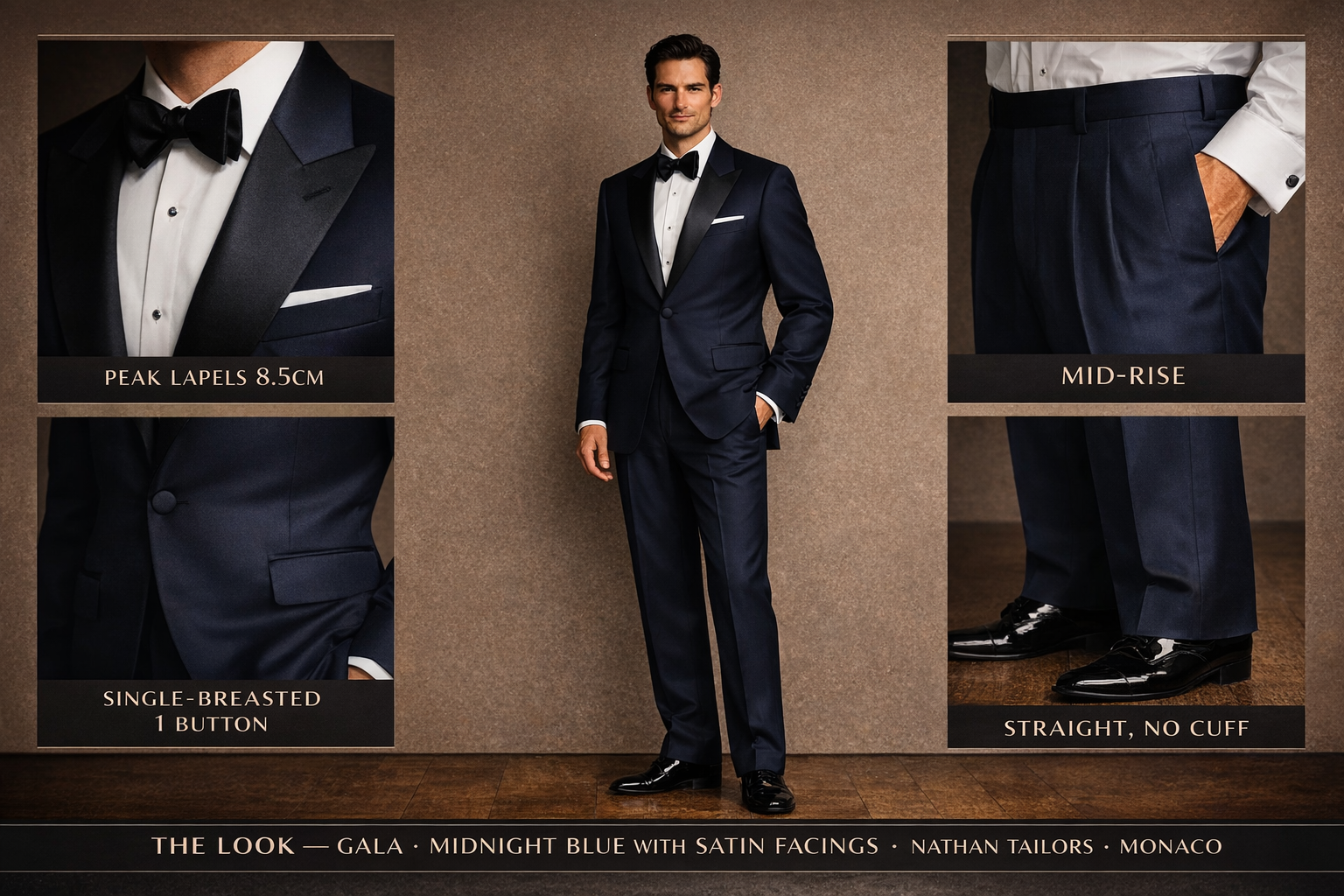
Lapels: 3.25-3.75 inches wide, notch or peak. If your current suits have lapels narrower than 3 inches, they will read as skinny era. The wider lapel is not a style choice anymore -- it is just correct proportion. Wider lapels balance the wider trousers and create visual harmony from top to bottom. I go into fabric and proportion details in our suit fabric guide.
The Trousers
This is where the biggest change is, and it is where most men are most behind.
Rise: Mid-rise, 10.5-11.5 inches. Your trousers should sit at or near your natural waist, which is a few inches above where your jeans probably sit. This elongates your legs, creates a cleaner tuck, and eliminates the uncomfortable feeling of low-rise trousers pulling down when you sit. If you have been wearing 9-inch rise trousers, this will feel strange for two days and then you will never go back.
Thigh: Room for your actual thigh. Single or double forward pleats are back, and for good reason -- they add fabric volume in the thigh where most athletic guys need it without adding bulk at the waist. If you have been squeezing your quads into flat-front slim trousers, pleated trousers will change your life.
Leg opening: 16.5-18 inches for most guys, depending on height and shoe size. For reference, skinny-era trousers typically had a 13.5-14.5 inch opening. The wider opening lets the trouser drape over the shoe with a clean break instead of bunching up at the ankle like leggings. This is the single measurement that makes the most visual difference.
Taper: Gentle. The trouser narrows slightly from knee to hem, but not dramatically. The goal is a clean line, not a stovepipe and not a carrot. Think of it as a straight leg with a slight narrowing -- maybe half an inch from knee to hem on each side.
The Full Picture
When you put it all together -- natural shoulder, moderate chest ease, proper jacket length, wider lapels, mid-rise pleated trousers with a 17-inch leg opening -- you get something that looks completely different from the skinny suit, but not remotely costume-y. You look like you belong in 2026. You look comfortable. You look intentional. You look like the clothes were made for you, because if you go custom, they literally were.
The Closet Audit: What to Keep, What to Retire
I am not telling you to throw everything away. I am telling you to be honest about what still works and what does not.
Keep
- Navy and charcoal suits with moderate lapels (3"+) that are not aggressively slim. If you can pinch more than an inch of fabric at the chest when buttoned, the jacket has reasonable ease and may still work.
- Solid dress shirts in white and light blue. These never go out of style. The collar might be too small (slim-era spread collars ran narrow), but the shirt itself is fine.
- Quality leather shoes. Cap-toe Oxfords, penny loafers, and monk straps are timeless. What sits above them changes. What is on your feet mostly does not.
- Overcoats. Unless your overcoat is cropped, it is probably fine. Topcoats and overcoats have not changed as dramatically as suits.
Retire
- Any suit with a jacket that does not cover your belt. The cropped jacket is the most dated element of the skinny era. There is no way to make it work in 2026.
- Trousers with leg openings under 15 inches. They will read immediately as 2017. Even if the jacket still fits, the trousers will date the entire outfit.
- Anything with a lapel under 2.5 inches. Ultra-skinny lapels are the menswear equivalent of a soul patch -- they had their moment and that moment is over.
- Low-rise trousers that show your belt buckle above the jacket button. This proportion is dead. The jacket and trouser should overlap, with the trouser waistband hidden beneath the jacket's button.
- Super-short sleeve lengths showing 2+ inches of shirt cuff. The skinny era had guys showing excessive cuff. Half an inch of visible shirt cuff is ideal -- clean and understated.
The Cost of Updating Your Wardrobe: RTW vs. Custom
Here is where economics meets wardrobe planning. Let us say you need to replace two suits and three pairs of trousers to bring your closet into 2026. What does that actually cost?
| Item | SuitSupply | Indochino | Nathan Tailors |
|---|---|---|---|
| 2 Suits (2026 silhouette) | $998 - $1,598 (still slim-cut) | $798 - $1,198 (slim pattern blocks) | $298 - $618 |
| 3 Pairs Trousers (wider leg, mid-rise, pleated) | $447 - $597 (limited options) | $357 - $537 | $207 - $327 |
| Alterations Needed? | Probably -- $75-$150/suit | Often -- $75 credit per suit | No -- cut to your measurements |
| Can You Get 2026 Silhouette? | Not yet -- current patterns are slim | Limited -- pattern blocks lag | Yes -- every suit cut from scratch |
| Total | $1,595 - $2,495 | $1,230 - $1,810 | $505 - $945 |
Read that bottom row again. You can update your entire wardrobe to the 2026 silhouette for less than the cost of a single SuitSupply suit that is still cut in the old silhouette. That is not marketing spin. That is math. And I am happy to walk you through exactly how this pricing works.
Why Nathan Tailors Can Cut Any Silhouette, Immediately
This is the part where I get to explain the economics, and if you have read my other posts, you know this is my favorite part. Because the economics explain everything.
Here is what it costs to make a suit. Any suit. Anywhere in the world. The core components are the same:
- Fabric: The raw material. A good worsted wool costs $15-$25 per meter at wholesale, and you need about 3 meters for a suit. That is $45-$75 in fabric cost -- the same whether the suit is cut in Hoi An or New York.
- Labor: This is where the divergence happens. A skilled tailor in Manhattan charges $150-$300 per hour. A skilled tailor in Hoi An -- equally experienced, often more experienced because of volume -- earns a very good local wage at a fraction of that cost. Our tailors make more than doctors and lawyers in Vietnam. They are compensated well. The cost difference is purchasing power parity, not exploitation.
- Overhead: SuitSupply pays $200-$400/sqft annual rent for Madison Avenue. We pay a fraction of that for our workshop on Tran Hung Dao Street in Hoi An. SuitSupply has 150+ store managers, corporate marketing teams, supply chain logistics for global distribution. We have a workshop and a WhatsApp number.
- Margin: Retail brands operate on 60-70% gross margins. That $499 SuitSupply suit? About $150-$180 in fabric and labor. The rest is margin, overhead, and marketing. We operate on transparent margins because we do not have $400/sqft rent to cover.
The silhouette costs nothing extra. Whether we cut a slim suit or a relaxed 2026 silhouette, the fabric cost is the same. The labor time is the same. The only thing that changes is the pattern -- and our tailors are not using pre-made pattern blocks from 2021. They draft patterns based on your measurements and your style preferences, every single time. Want wider lapels? Done. Want a 17-inch leg opening with single forward pleats? Done. Want a natural shoulder with a soft roll to the lapel? Done. Same price. Same timeline. Two weeks.
This is why custom tailoring has a structural advantage during periods of silhouette change. RTW brands are prisoners of their own supply chain. We are not.
The Measurement Conversation: Exactly What to Ask For
If you are going to order a custom suit in the 2026 silhouette, you need to know what to ask for. Here are the specific measurements and style details you should request. You can use these whether you order from us or anyone else -- this is just good information.
Jacket Specs
- Shoulder: Natural, lightly padded (3/8" max). Shoulder seam should land at the edge of your shoulder bone.
- Chest: 1.5-2 inches of ease beyond your chest measurement. If your chest is 40", ask for 41.5-42" in the jacket.
- Lapel width: 3.25-3.5" for notch lapel. 3.5-3.75" if you are going peak lapel.
- Button stance: Slightly lower than standard -- ask for the button to sit about 1" below natural waist.
- Jacket length: Fully covers seat. Should be roughly equal to half the measurement from collar seam to floor.
- Gorge: Medium -- not the super-high gorge of the skinny era, not the low gorge of the 1970s.
- Vents: Double vents. This is non-negotiable for the relaxed look -- single vents and no-vent options restrict movement and look stiffer.
Trouser Specs
- Rise: Mid-rise, 10.5-11.5 inches. Sits at natural waist.
- Pleats: Single forward pleat or double forward pleat. If you are under 175 lbs, single pleat is plenty. Over 175 lbs or with bigger thighs, double pleat gives better drape.
- Leg opening: 16.5-18 inches depending on your height and shoe. If you are under 5'10", aim for 16.5-17". Over 5'10", you can go 17-18".
- Break: Medium break -- the trouser rests on the shoe with one clean fold. Not the "no break showing ankle" of the skinny era, not the "full break pooling on the shoe" of the 1990s.
- Cuff: Optional. A 1.5-1.75" cuff adds visual weight to the bottom of the trouser and is a classic touch that complements the wider leg. Totally personal preference.
If those specifications feel overwhelming, do not worry. Our measurement guide walks you through everything visually, step by step. And we offer free WhatsApp video calls where our team walks you through exactly what to measure and what style details to choose.
Fabric Matters More in a Relaxed Silhouette
Here is something nobody tells you: fabric choice matters significantly more in a relaxed silhouette than in a slim one. When a suit is tight against your body, the fabric has no room to move -- so the drape of the fabric is almost irrelevant. The body provides the shape. When a suit is relaxed, the fabric has to do more work. It has to drape, it has to fall cleanly, it has to hold its shape without being stretched over your torso like a drumhead.
This is why the best relaxed suits use fabrics with good body and drape:
- Wool gabardine: The workhorse. Smooth finish, excellent drape, holds a crease, resists wrinkles. This is what Italian tailors have used for relaxed silhouettes for decades.
- Wool-cashmere blend: Softer hand, beautiful drape, a little more luxurious. The cashmere adds softness without sacrificing structure.
- Wool-silk blend: Slight sheen, elegant drape. Perfect for warm-weather suits where you want the fabric to flow rather than cling.
- Linen-cotton blend (summer): Relaxed texture, breathable, casual elegance. Embraces wrinkles as character rather than a defect.
- Heavier wool (280-320 gsm): For fall and winter. More weight means better drape. The fabric hangs and moves beautifully with wider trousers and soft shoulders.
What you want to avoid in a relaxed silhouette: thin, cheap polyester-blend fabrics that have no body. When the suit is not tight on your body, flimsy fabric looks limp and shapeless. You need fabric with structure and weight. This is why quality matters more as silhouettes relax -- and it is another reason why cheap RTW brands will struggle with the transition. Their low-cost poly-blend fabrics worked fine when stretched over a body. They do not work when asked to drape.
For a deep dive into fabrics, read our complete fabric guide. We work with premium worsted wool from established fabric brokers. We won't claim it is identical to luxury house cloth, but for our prices you get a real custom suit with real fabric and a half-canvas chest. The markup is what's different.
Common Objections (And Why They Are Wrong)
"Relaxed fits will make me look sloppy."
Only if the suit does not fit. A relaxed silhouette with proper proportions -- shoulder seam at the right point, correct chest ease, trouser sitting at natural waist -- looks clean and intentional. What looks sloppy is a suit that is too big. The 2026 silhouette is not "oversized." It is properly sized with intentional ease. There is a massive difference.
"Wider trousers will make me look short."
The opposite is true. Mid-rise trousers that sit at your natural waist elongate your legs by raising the visual starting point. Combined with a clean break at the shoe, wider trousers actually create a longer leg line than the low-rise, cropped trousers of the skinny era that exposed your ankle and made your legs look like they ended two inches too soon.
"Pleats are for old men."
Pleats were for old men in 2015. In 2026, single forward pleats are on every runway and every best-dressed list. Pleats add volume in the thigh -- which is where most athletic men need it -- without adding waist bulk. They create beautiful movement when you walk. And they are significantly more comfortable sitting at a desk for 10 hours. The "flat front only" rule was a skinny-era invention that made no sense for anyone with thighs bigger than a bicycle seat.
"I just spent $1,500 on suits and I am not replacing them already."
I understand that. And you do not have to replace everything at once. Start with one suit and one pair of trousers in the new silhouette. Wear them next to your existing suits for a week. You will see the difference immediately, and you will understand why the old ones feel wrong. At our prices -- suits from $149, trousers from $69 -- the cost of testing the new silhouette is less than dinner for two in Manhattan. Check our full pricing menu.
The NYC Specifics: What This Looks Like on the Street
New York is always the first city to adopt a new menswear direction in the US. Walk through different neighborhoods and you can already see the shift happening in real time:
- Tribeca/SoHo: The creative professional crowd was early on this. Wide-leg trousers with unstructured blazers have been the move here since 2024. These guys shop Auralee, Lemaire, and The Row.
- Midtown/Financial District: Slower to change because of the conservative dress code, but you can see it happening. The more style-aware analysts and associates are showing up in softer shoulders and wider legs. The MDs still do not care, and they never will. Give it 12-18 months and the relaxed suit will be standard even in banking.
- West Village/Brooklyn: The art world and media crowd have been wearing relaxed tailoring forever. Double-breasted, wider trouser, loafers with no socks -- this is their territory and always has been.
- Upper East Side: Old money does not follow trends because old money was already dressing this way. If you want to see what the 2026 silhouette looks like on someone who has been wearing it for 30 years, go to The Carlyle on a Friday evening.
The point is that the shift is real, it is visible, and it is accelerating. Every month, more guys on the subway look like they got the memo. If you have not gotten it yet, this is your memo.
How to Order the 2026 Silhouette from Nathan Tailors
Here is the step-by-step process. The whole thing takes about three weeks from first message to delivery.
- Message us on WhatsApp. Tell us what you want -- two suits, three trousers, whatever. Send photos of silhouettes you like. We speak fluent menswear and can translate any reference image into specifications.
- Get your measurements. Open our free Guided Measurement App -- it walks you through every measurement step-by-step with photos. We also offer free WhatsApp video calls to walk you through it. Our first-time fit record on remote orders is not luck -- it is process.
- Choose your fabric. We send you photos and descriptions. If you want, we ship you physical swatches. We carry premium worsted wool, linens, cottons, and blends across a wide range of weights and patterns.
- Confirm your style details. Lapel width, lapel style, button count, trouser rise, pleat style, leg opening, vents, lining, buttons -- everything is yours to decide. Want the exact 2026 specs from this article? Just say so. We will build it.
- We cut and ship. Production takes 3-4 working days. Door-to-door delivery to anywhere in the US is typically about three weeks, faster with express shipping.
If the suit does not fit to your satisfaction, we have a seam allowance built into every garment that allows any local tailor to make minor adjustments -- though in practice most clients do not need them. We also ship a piece of the same fabric in every box so a local tailor has matching cloth to work with, and we stay reachable to help you figure out the right fix. Our 520+ five-star Google reviews are not from people who received mediocre-fitting suits.
The Bottom Line
The skinny suit had a good run. About 10 years. It is over. The menswear world has moved to wider lapels, relaxed shoulders, fuller trousers, and longer jackets -- a silhouette that is more comfortable, more flattering, and more timeless than the shrunken suits of the Instagram era.
If you buy off the rack right now, you are buying a silhouette that was designed in 2024. The brands have not caught up yet. They will, eventually -- in 18 months, maybe two years. By then the trend will be fully established and you will have spent two years looking dated.
Or you can skip the lag. Tell us what you want. We cut it from scratch, to your measurements. Suits from $149. Trousers from $69. Real wool from established mill suppliers. No inventory to sell through. No 18-month design cycle. No pattern blocks from 2021. Just your body, your specifications, and a team that has been making clothes to order for 25+ years.
The silhouette shifted. Your closet can too.
Ready to update your silhouette? Message us on WhatsApp with photos of what you are going for, and we will put together a plan and pricing within 24 hours. No pressure, no upsells -- just straight talk about what your wardrobe needs and what it will cost. We have dressed 5,000+ clients worldwide. We know what the 2026 silhouette looks like, because we are already making it.