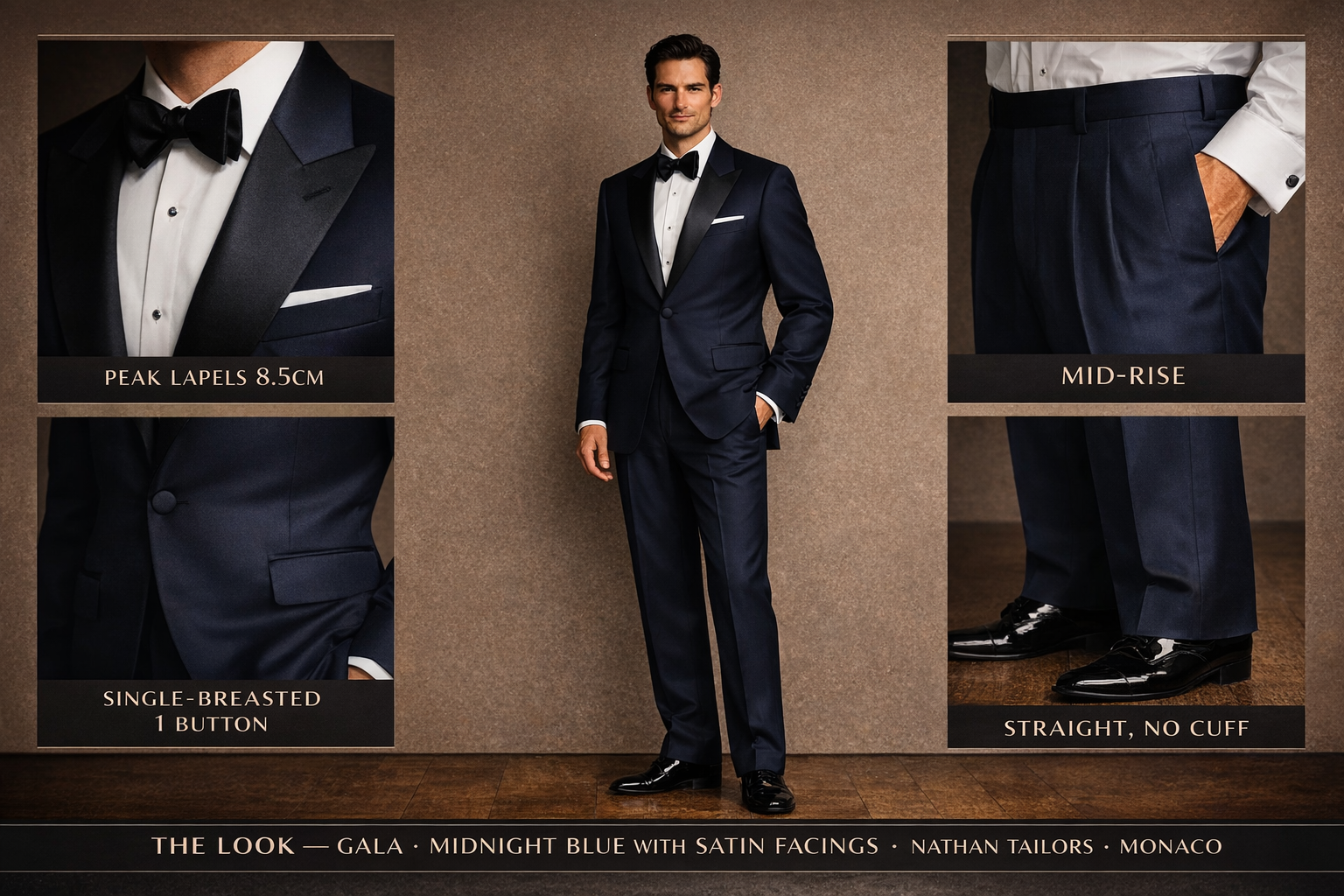
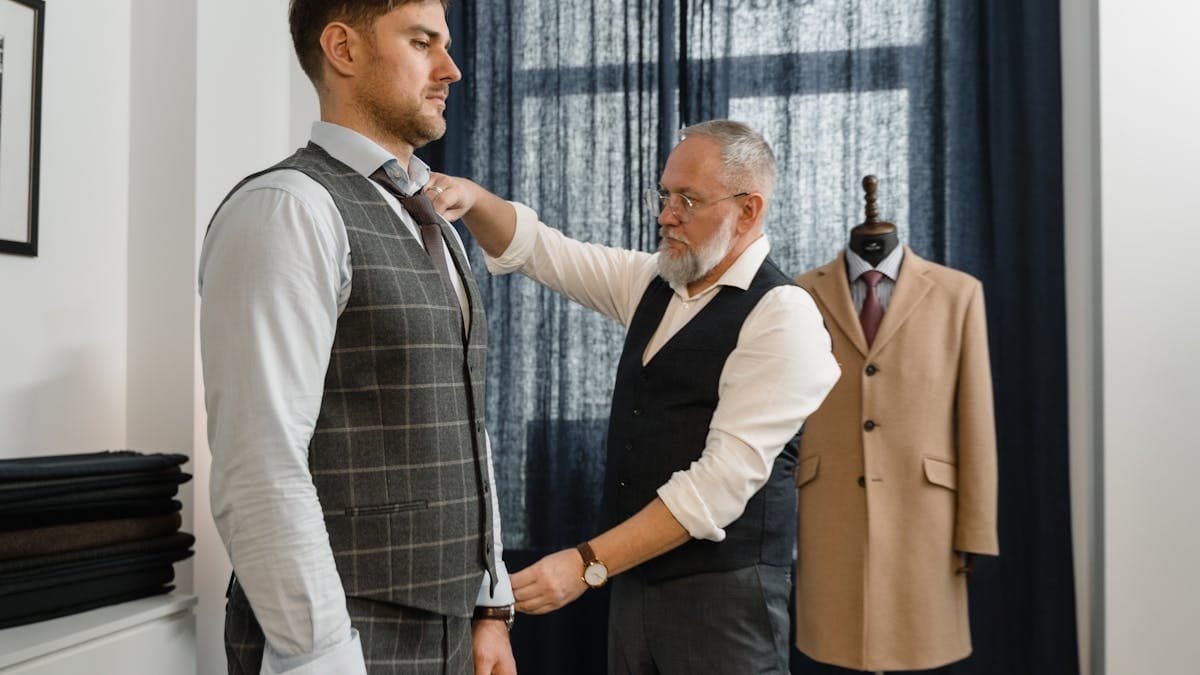
New: this article now has a living, data-driven companion -- our Destination Tailoring Engine compares every suit destination on current prices, construction reality and scam risk, with head-to-heads like Vietnam vs Thailand, Hoi An vs Bangkok and Hoi An vs Hong Kong -- and it can research your city live.
I Live in One of These Cities. Let Me Tell You About All Three.
Every few days, someone messages our WhatsApp asking a version of the same question: "I am planning a trip to Asia and I want to get custom suits made. Should I go to Hong Kong, Bangkok, or Hoi An?"
These are usually NYC professionals -- guys in finance, tech, consulting, law -- who have heard that you can get incredible custom clothing in Asia for a fraction of what it costs back home. They have read the same travel blogs. They have seen the same Reddit threads. And they are confused because the advice they are getting is all over the map.
Here is what makes my perspective different from the standard travel blog comparison: I actually live here. I spent over 10 years in the West. I have visited Hong Kong tailors as a customer and as a competitor doing market research. I have clients who have gotten suits made in all three cities and told me exactly what went right and what went wrong. I run a tailor shop at 127 Tran Hung Dao Street in Hoi An with 25+ years of operation, 520+ five-star Google reviews, and 5,000+ clients worldwide.
I am obviously biased. I chose Hoi An for a reason. But I am going to be brutally honest about where each city is genuinely better -- and where the reputation does not match reality anymore. If Hong Kong is the right choice for you, I would rather tell you that straight up than have you come to us with the wrong expectations.
Let's break this down.
The Quick Answer: Price Comparison Table
Before we get into the nuances, here is the raw pricing across all three cities and the Savile Row gold standard for reference. These are 2026 prices based on actual market research, not numbers I am pulling from the air.
| Item | Hoi An (Nathan Tailors) | Bangkok (Mid-Range) | Hong Kong (Mid-Range) | Savile Row (London) |
|---|---|---|---|---|
| Two-Piece Suit (Wool Blend) | $149 - $209 | $165 - $350 | $350 - $800 | $4,500 - $6,500+ |
| Two-Piece Suit (Premium Wool / Italian Fabric) | $209 - $309 | $360 - $850 | $800 - $1,500 | $6,500 - $10,000+ |
| Custom Dress Shirt | $39 - $49 | $40 - $80 | $60 - $150 | $250 - $450 |
| Custom Trousers | $69 - $109 | $60 - $140 | $120 - $300 | $800 - $1,500 |
| Overcoat / Topcoat | $109 - $169 | $200 - $500 | $500 - $1,200 | $5,000 - $8,000+ |
| Three-Piece Suit (Premium) | $219 - $349 | $400 - $900 | $900 - $2,000 | $7,000 - $12,000+ |
| Cashmere-Blend Suit (2-Piece) | $219 | $500 - $1,200 | $1,200 - $2,500 | $8,000 - $15,000+ |
Look at those numbers. The Bangkok-to-Hoi-An difference is significant, but it is not as dramatic as the Hoi-An-to-Hong-Kong gap. And the Savile Row column exists to remind you that the same fundamental product -- a suit cut from Italian wool to your measurements -- can swing from $149 to $10,000 depending entirely on geography, brand, and overhead.
But price alone tells you nothing about what you are actually getting. So let's go city by city.
Hong Kong: The Reputation King
The Good (And It Is Real)
I am going to say this upfront: Hong Kong's tailoring heritage is legitimate. The city's custom tailoring tradition stretches back over 100 years, rooted in Shanghai's pre-revolution tailoring community. When the Communist revolution hit in 1949, many of China's finest tailors -- especially those trained in the Shanghai tradition of adapting Western suit construction -- fled to Hong Kong. They brought their skills, their pattern-making knowledge, and their apprenticeship traditions with them.
The top-tier Hong Kong tailors today are the descendants -- literally and figuratively -- of that migration. Some of them trained under Savile Row-educated cutters. Some of them trained in Savile Row itself. The very best Hong Kong tailor shops produce garments that are indistinguishable from a $6,000 Savile Row commission at a fraction of the price. That is not marketing. That is just true.
If you are looking for a true bespoke suit -- meaning a suit where the pattern is hand-drafted from scratch on brown paper to your exact body, where the canvas is hand-shaped over many hours, where you get three or four fittings over several weeks, and where every stitch in the lapels and buttonholes is done by hand -- the best Hong Kong shops are still the gold standard in Asia. Nobody else comes close on that specific tier of construction.
The Bad (And Nobody Talks About This)
Here is the problem: the Hong Kong you read about in Esquire articles from 2005 is not the Hong Kong you will experience as a first-time visitor in 2026.
The legendary tailors -- the ones with the genuine heritage -- charge $800 to $1,500+ for a suit. That is still less than Savile Row, but it is dramatically more than Bangkok or Hoi An. And those prices are for the legitimate operations. For that money, you are getting real quality. No argument from me.
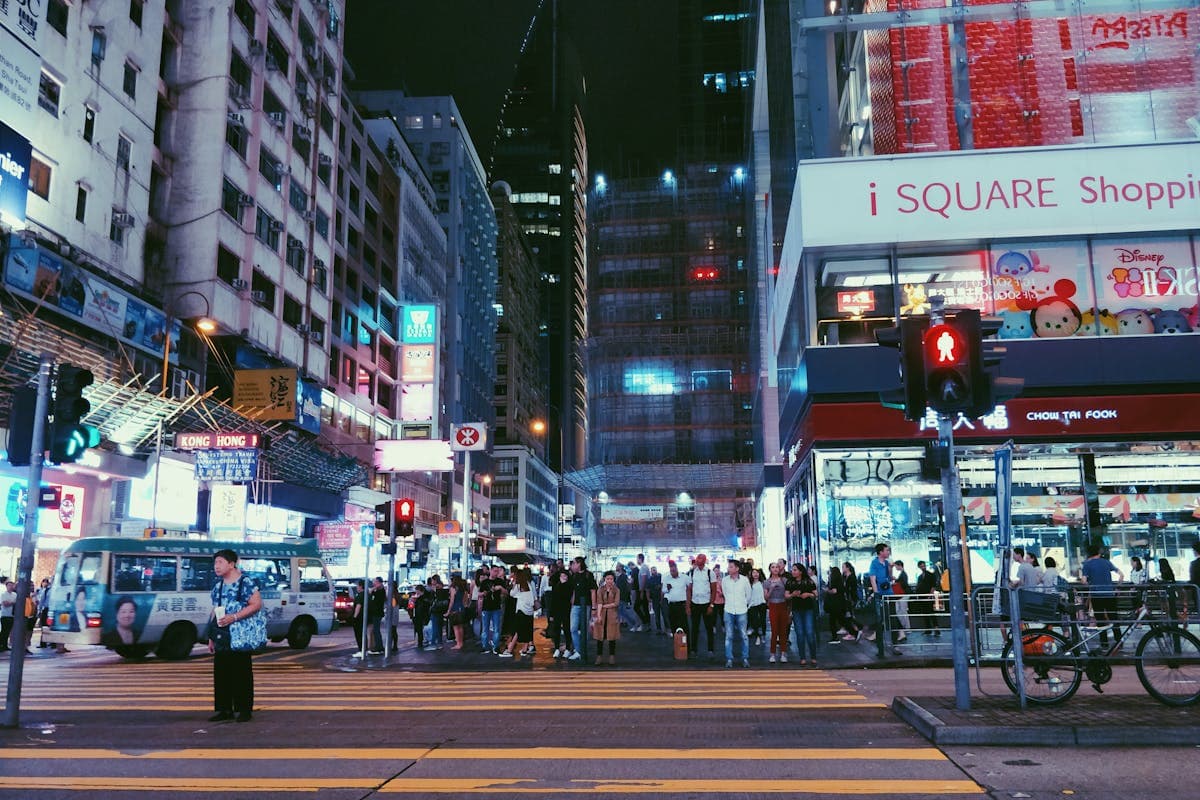
But the vast majority of visitors to Hong Kong do not end up at those tailors. They end up at the tourist operations. The ones clustered around Tsim Sha Tsui, Nathan Road, and the Star Ferry terminal. The ones with touts standing outside who will grab your arm and promise you "one suit, two shirts, and a tie for $250." These shops are industrial-scale operations that cater to tourists on a 48-hour stopover. They are the equivalent of Times Square restaurants -- occupying premium real estate in a world-class city while serving a product that has nothing to do with that city's actual culinary (or in this case, tailoring) tradition.
The tourist-trap Hong Kong tailors have well-documented problems:
- Fabric substitution. You pick a fabric from the bolt. The suit that arrives is made from a different, cheaper fabric. This is so common that forums are full of stories about it.
- Fused construction marketed as "bespoke." A fused suit -- where the canvas is glued to the fabric instead of hand-stitched -- is not bespoke. It is not even proper made-to-measure. But calling it bespoke lets them charge bespoke prices.
- The 24-hour suit. Some Hong Kong shops promise a custom suit in 24 hours. Think about that. A proper suit takes 20-40 hours of skilled labor. A "24-hour suit" is a pre-made suit hastily altered to your measurements. It is off-the-rack with extra steps.
- Aggressive upselling. You walk in for one suit and walk out having agreed to four suits, six shirts, and two overcoats because the salesperson made you feel like the deal was too good to pass up. Then you get home and realize two of those suits have bubbling on the chest (a telltale sign of a fused interlining starting to delaminate).
- No recourse. You are 8,000 miles away. The suit does not fit. Now what? Most tourist-oriented Hong Kong shops do not have a robust remote alteration or remake process because their business model depends on one-time transactions with people passing through.
The other factor nobody mentions is cost of living. Hong Kong is one of the most expensive cities on Earth. A mid-range hotel room runs $200-$400/night. Meals, transport, entertainment -- you are spending $300-$500/day just existing in Hong Kong. Add flights from the US ($800-$1,400) and your "cheap custom suit" trip actually cost you $2,000-$4,000 all-in for a three-day trip where you also got two suits made. That is $1,000-$2,000 per suit when you factor in travel costs -- which suddenly puts you in Savile Row territory.
The Verdict on Hong Kong
If you already have a relationship with a top-tier Hong Kong tailor and you are visiting for business anyway, absolutely get suits made there. The heritage shops are world-class. But if you are planning a trip specifically for tailoring, Hong Kong's cost of living makes it a poor value proposition compared to Southeast Asia. And if you are a first-time visitor without a specific tailor recommendation, the odds of landing at a tourist trap are uncomfortably high.
Bangkok: The Volume Play
The Good
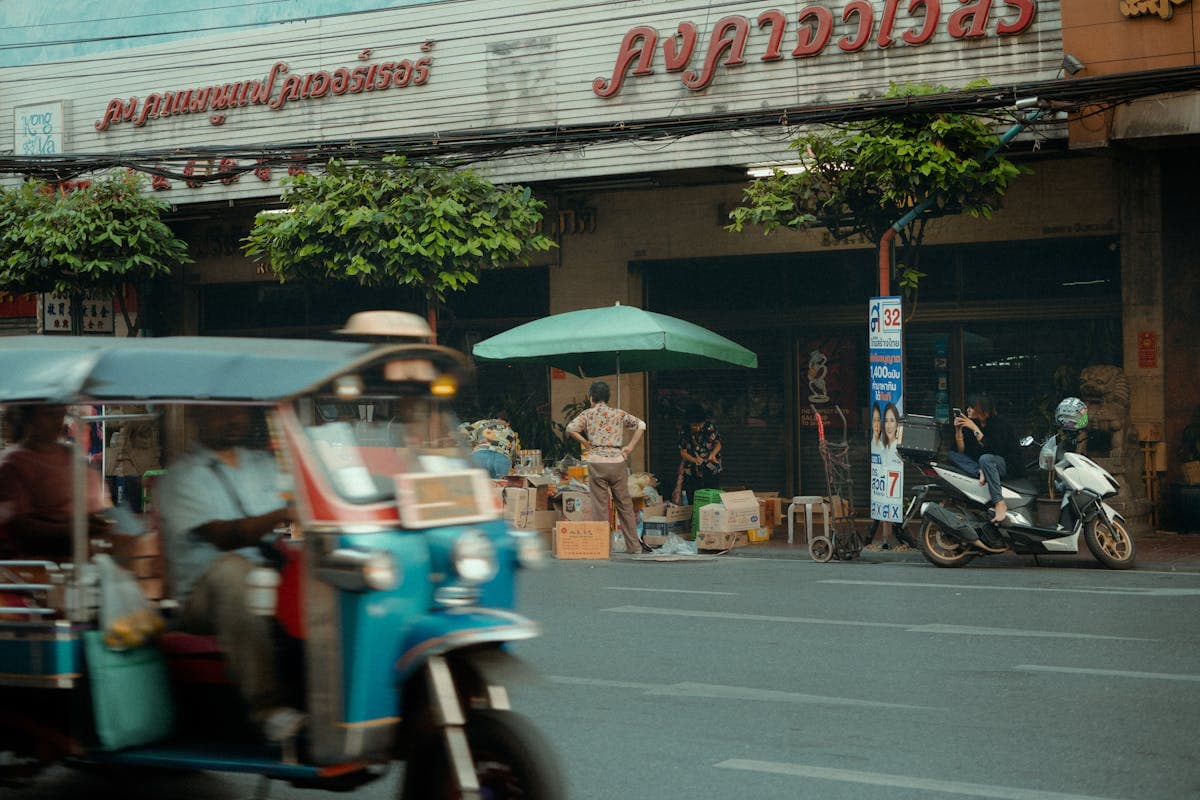
Bangkok has a massive, well-established custom tailoring industry. The Sukhumvit Road corridor alone has dozens of tailor shops, and the industry is deeply integrated into the tourist experience. Hotel concierges recommend tailors. Tuk-tuk drivers take you to tailors. The infrastructure is built around serving a high volume of international visitors.
Prices are legitimately low. You can get a basic custom suit made in Bangkok for $165-$250, with mid-range options at $300-$500 using decent wool blends. The turnaround is fast -- many shops promise and deliver suits in 24-48 hours, with a fitting in between. If you are in Bangkok for a week, you can easily get multiple garments made with time for adjustments.
The best Bangkok tailors -- and there are genuinely excellent ones -- have been operating for decades. Many are Indian-origin families who brought tailoring traditions from the subcontinent. They know what Western clients want, they have systems for handling high volume, and they can produce a solid suit quickly.
The Bad
Bangkok's tailoring scene has the highest tourist trap density of any city in Asia. And I say that as someone who lives in Hoi An, which also has its share. The difference is scale and aggressiveness.
The Bangkok tourist tailor machine works like this:
- The tuk-tuk hustle. A driver offers you a "free tour" of Bangkok. The tour includes mandatory stops at a jewelry shop, a leather goods shop, and -- of course -- a tailor. The driver gets a commission from each stop. The tailor has already built that commission into the price you will pay.
- The "deal" that is not a deal. "Two suits, five shirts, and two pairs of trousers for $299!" This is a real offer you will see in Bangkok. Think about the math. Two suits, five shirts, and two trousers for $299 means each garment averages about $33. At that price, the fabric is almost certainly polyester or a low-grade polyester-wool blend, the construction is fully fused, and the "custom" aspect is limited to basic length and width adjustments on a pre-made template.
- The Khao San Road special. Backpacker-area tailors cater to budget travelers who want the Instagram photo of getting a suit made in Asia. These suits often fall apart within a few wears. They use synthetic fabrics that do not breathe and wrinkle badly.
- Rapid turnaround as a selling point (that is actually a red flag). A proper suit needs time. When a Bangkok shop promises a suit in 24 hours, they are usually cutting from a pre-made block pattern and making minimal adjustments. True made-to-measure requires individual pattern work, which takes longer.
The legitimate mid-range and upper-tier Bangkok tailors do exist, and they charge accordingly -- $350-$850 for a proper suit in decent fabric. At that price point, they are doing real work. But these shops are harder to find because they do not need to advertise with tuk-tuk drivers and Khao San Road flyers. They rely on word of mouth and repeat clients. If you do not already know which Bangkok tailors are legitimate, your odds of stumbling into a great one as a first-time visitor are probably 30/70.
The Fabric Question
This is where Bangkok starts to lose ground. The best Bangkok tailors offer legitimate Italian and English fabrics from named heritage mills. But these are the shops charging $500+. The majority of mid-range and budget Bangkok tailors use locally sourced fabrics from Thai textile mills or low-grade imports from China. These are not bad fabrics, necessarily, but they are not at the quality level of what a reputable Hong Kong or Hoi An shop will offer at comparable prices.
One thing I have noticed from clients who come to us after trying Bangkok: they often describe their Bangkok suits as feeling "stiff" or "heavy" compared to what they expected. This is usually a fabric issue. Lower-grade wool blends tend to have a heavier hand and less drape than the fine worsted wool you will find in a quality operation. For more on how fabric weight and content actually affect how a suit feels on your body, see our complete fabric guide.
The Verdict on Bangkok
Bangkok is a legitimate custom tailoring destination if you do your homework, go to a recommended mid-range or high-end shop, and are realistic about what you are getting at each price point. It is not the right choice if you are walking in blind, if you are lured in by a tuk-tuk driver, or if you are seduced by a "10 garments for $299" deal. At the mid-to-upper tier where Bangkok tailors do their best work, prices start overlapping with what you would pay at Nathan Tailors for our premium tier -- and at that point, the value equation shifts.
Hoi An: The Value Play (Where I Chose to Build My Business)
Brutal Honesty First
I need to acknowledge something before I make the case for Hoi An: this town has a tourist trap problem too.
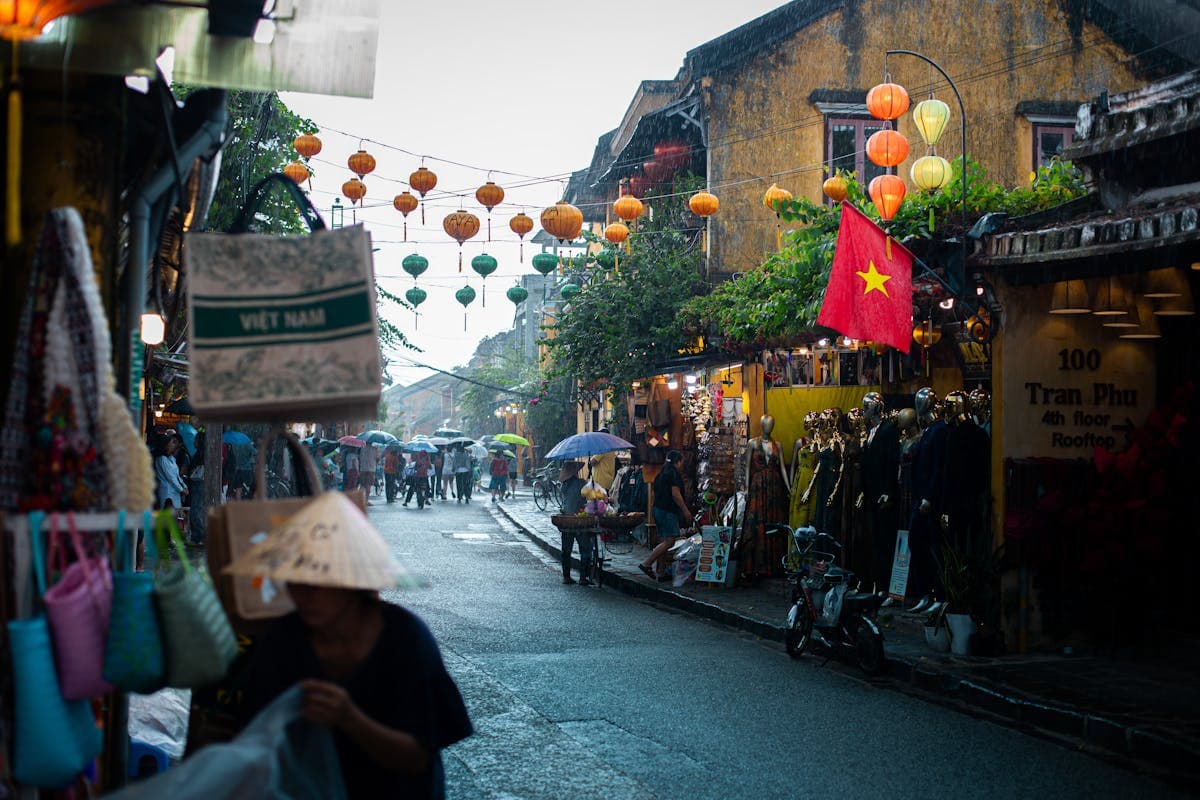
There are an estimated 500+ tailor shops in Hoi An, a city of roughly 120,000 people. That is approximately one tailor shop for every 240 residents. Many of these shops are not staffed by experienced tailors -- they are tourist-facing storefronts that take your order, take your money, and send the work out to whoever is cheapest. The fabric is often synthetic dressed up as silk or wool. The fitting is a tape measure around your chest and a nod. The suit shows up at your hotel the next morning, and by the time you realize it does not fit properly, you are on a plane.
I know this because I live here. I see it every day. I watch tourists walk into shops with no online presence, no reviews, and no accountability, and I know exactly what they are going to get. It is the same dynamic as Bangkok and Hong Kong, just at a smaller, more intimate scale.
So why did I choose Hoi An?
The Real Advantages
1. The tailoring tradition is deeper than people realize.
Hoi An has been a tailoring center for over 300 years. It is not a tourist invention. The city was a major trading port on the maritime silk road, and its textile and garment-making traditions predate French colonialism. Many of the family-run operations here have skills that have been passed down through three, four, five generations. This is not "a town that learned to sew because tourists showed up in the 2000s." This is a town where tailoring is woven into the cultural identity.
2. The cost structure is genuinely, structurally lower.
This is the economics part, and it is the main reason our prices are what they are. Let me break it down simply:
- Rent: A shop on Tran Hung Dao Street in Hoi An costs a tiny fraction of what a shop on Nathan Road in Hong Kong or Sukhumvit Road in Bangkok costs. Our overhead is so low that it barely registers in the price of a suit.
- Labor: Our tailors are highly skilled craftspeople who earn a strong wage by Vietnamese standards -- well above the national average. But the cost of living in Hoi An means that a strong wage here would not cover a studio apartment in Hong Kong or a meal in Central London. This is not exploitation. This is economics. Our tailors own homes, send their kids to school, and live well. They just live in a place where a satisfying life does not cost $4,000 a month.
- Volume: Nathan Tailors processes 30-50 customers per day during peak season. A mid-range tailor in NYC or London might see 5-15 customers per week. This volume means two things: our tailors get exponentially more practice (a Nathan tailor does more fittings in a month than most Western tailors do in a year), and our per-unit costs are spread across a much larger base.
- No middlemen: When you order from Indochino or Black Lapel, your suit is made in Asia by Asian tailors using Asian labor costs. Then you pay a 300-500% markup for the privilege of a Western brand name on the label. When you order from us, you are ordering directly from the people who make the garment. There is no brand markup. There is no showroom lease in SoHo. There is no VC-backed marketing budget baked into your suit price. You are just paying for fabric, skilled labor, and shipping. For a deeper dive into why this price gap exists across the industry, read our complete custom suit cost breakdown.
3. We work with real fabric -- including cashmere blends.
An honest note here, because this is where most Vietnam tailor marketing falls apart: we are not going to name-drop specific Italian mills the way bigger brands do. For a Hoi An workshop, those claims are usually fiction even when our peers play that game. What we will tell you plainly is that our cloth comes from established mill suppliers, that the fiber content is what we say it is (real wool, real cashmere when we sell cashmere), and that you can touch the bolt your suit is being cut from before we make a single stitch.
This applies to our cashmere blends too. A wool-cashmere suit at Nathan Tailors costs $219. A real cashmere-blend bespoke suit on Savile Row would run $8,000+. We are not pretending it is the same cloth -- it is not, at those prices it could not be. What we are saying is that it is a genuine wool-cashmere blend, custom-cut, in a price tier the Western suit market does not offer. In Bangkok, most mid-range shops do not stock cashmere at all because it requires direct supplier relationships to source reliably. That sourcing depth is one of Hoi An's genuine advantages.
We source directly through our own supplier network -- not through a distributor in Hong Kong, not through a middleman in Singapore. This is another reason our prices are what they are: a shorter supply chain.
4. The fitting process is personal, not transactional.
Because Hoi An is a small town and we are a family-run operation, the fitting experience is fundamentally different from a high-volume Bangkok shop or a tourist-oriented Hong Kong tailor. You are not a ticket number. You sit down with us. We talk about what you need the suit for. We discuss fabric. We measure. We do a first fitting the next day. We do a second fitting the day after. If something is not right, we fix it before you leave.
For remote customers -- and a growing percentage of our 5,000+ worldwide clients order remotely -- we do the same thing via WhatsApp, guided self-measurement with our interactive measurement tool, and WhatsApp communication throughout the process. Read about how that process works in detail in our guide to ordering custom clothes online.
5. Travel costs are dramatically lower.
Vietnam is one of the most affordable countries in Southeast Asia for visitors. A quality hotel in Hoi An runs $30-$80/night. Meals are $3-$15. A domestic flight from Ho Chi Minh City or Hanoi to Da Nang (the nearest airport to Hoi An) is $30-$60. If you are combining a tailoring trip with a Vietnam vacation -- which many of our clients do -- the total travel cost is a fraction of what you would spend in Hong Kong.
The Full Comparison: Quality, Process, and Experience
Pricing only tells part of the story. Here is a comprehensive comparison across every factor that actually matters when choosing where to get custom clothing made.
| Factor | Hoi An (Nathan Tailors) | Bangkok (Mid-Range) | Hong Kong (Heritage Tier) | Savile Row |
|---|---|---|---|---|
| Construction | Half-canvas standard; full canvas on request | Fused to half-canvas depending on shop | Half-canvas to full-canvas; hand-padded lapels at heritage shops | Full bespoke: hand-cut pattern, hand-padded canvas, hand-stitched throughout |
| Fabric Origin | Wool blends to premium worsted wool from established mill suppliers | Mix: Thai domestic, Chinese imports, Italian at higher tiers | Italian, English, Japanese -- full range at heritage shops | Full named heritage mill range; customer's choice |
| Turnaround Time | 3-5 days in person; 2-4 weeks for remote/shipping | 24-48 hours (budget); 3-7 days (quality shops) | 3-7 days (MTM); 4-8 weeks (true bespoke) | 8-12 weeks minimum; often 16+ weeks |
| Number of Fittings | 2-3 fittings in person; 1 virtual + photos for remote | 1-2 fittings typical | 2-4 fittings at heritage shops; 1-2 at tourist shops | 3-4 fittings minimum over multiple visits |
| Tourist Trap Risk | High (500+ shops, quality varies wildly) -- research required | Very high (tuk-tuk commissions, Khao San Road specials) | High (Tsim Sha Tsui tourist tailors, fabric substitution) | Low (prices are transparent; you get what you pay for) |
| Remote Ordering | Yes -- WhatsApp consultations, online Guided Measurement App at /measurement/new, WhatsApp support, DHL/FedEx shipping to 50+ countries | Limited -- most shops are walk-in only | Some heritage shops offer trunk shows in NYC/London; limited remote | Some houses do trunk shows in major cities; otherwise in-person only |
| Post-Purchase Support | Seam allowances + extra cloth for local alterations; WhatsApp support indefinitely; alteration guidance | Minimal -- most shops have no post-departure support | Heritage shops honor adjustments; tourist shops -- good luck | Excellent -- ongoing relationship with your cutter |
| Google Review Score | 5.0 stars (520+ reviews) | Varies: 3.5 - 4.8 depending on shop | Varies: 3.0 - 4.7 (tourist shops often 3.0 - 3.5) | Generally 4.5+ (smaller client base, higher satisfaction) |
| Best For | Best value: premium fabric + quality construction at lowest price; remote clients worldwide | Budget travelers already in Bangkok who want a quick suit | True bespoke enthusiasts willing to pay $800+ and who have a specific tailor relationship | The absolute pinnacle of bespoke craft, if money is no object |
Savile Row: The Gold Standard (And Why You Are Not Getting It for $500 Anywhere)
I want to address the elephant in the room: Savile Row. Because every conversation about custom suits in Asia eventually includes the phrase "but it is not Savile Row."
Correct. It is not. Nothing in Asia is Savile Row, and anyone telling you otherwise is lying.
A true Savile Row bespoke suit involves a master cutter who has spent 10-15 years learning their craft. They draft a unique paper pattern for your body from scratch. The suit is constructed over 60-80 hours of hand labor. The canvas is hand-shaped using an iron and a wet rag to mold it to the contours of your specific chest. The buttonholes are hand-stitched. The lapels are hand-padded. You have three to four fittings over two to four months.
This process starts at $4,500-$6,500 at the entry-level Savile Row houses and goes to $10,000-$15,000+ at Huntsman, Anderson and Sheppard, or Henry Poole. At Jeff Banks Savile Row, bespoke three-piece suits start from around $4,200.
That is the gold standard. I respect it deeply. And I am not going to insult your intelligence by pretending that a $209 suit from Hoi An is the same thing. It is not.
But here is the question most NYC professionals should actually be asking: Do you need a Savile Row suit, or do you need a suit that fits well, looks sharp, is made from good fabric, and does not cost a month's rent?
Because for 95% of working professionals -- including the finance guys, the lawyers, the tech founders I used to work alongside on Wall Street -- the answer is the latter. You need a well-fitting suit in real wool with half-canvas construction, clean lines, and a modern silhouette. That is a Nathan Tailors suit. And it costs $149-$309 instead of $5,000.
The difference between a $200 half-canvas made-to-measure suit and a $5,000 full bespoke suit is real. But it is in the details -- the way the lapel rolls, the precision of the hand-stitching, the fact that the pattern was drafted for your body versus adapted from a base pattern. These are differences that maybe 2% of the population can spot, and even fewer can feel.
If you are in that 2% and those details matter to you, Savile Row is your destination. You have my genuine respect. For everyone else, read on.
"But I Heard Hong Kong Is the Best for Suits in Asia"
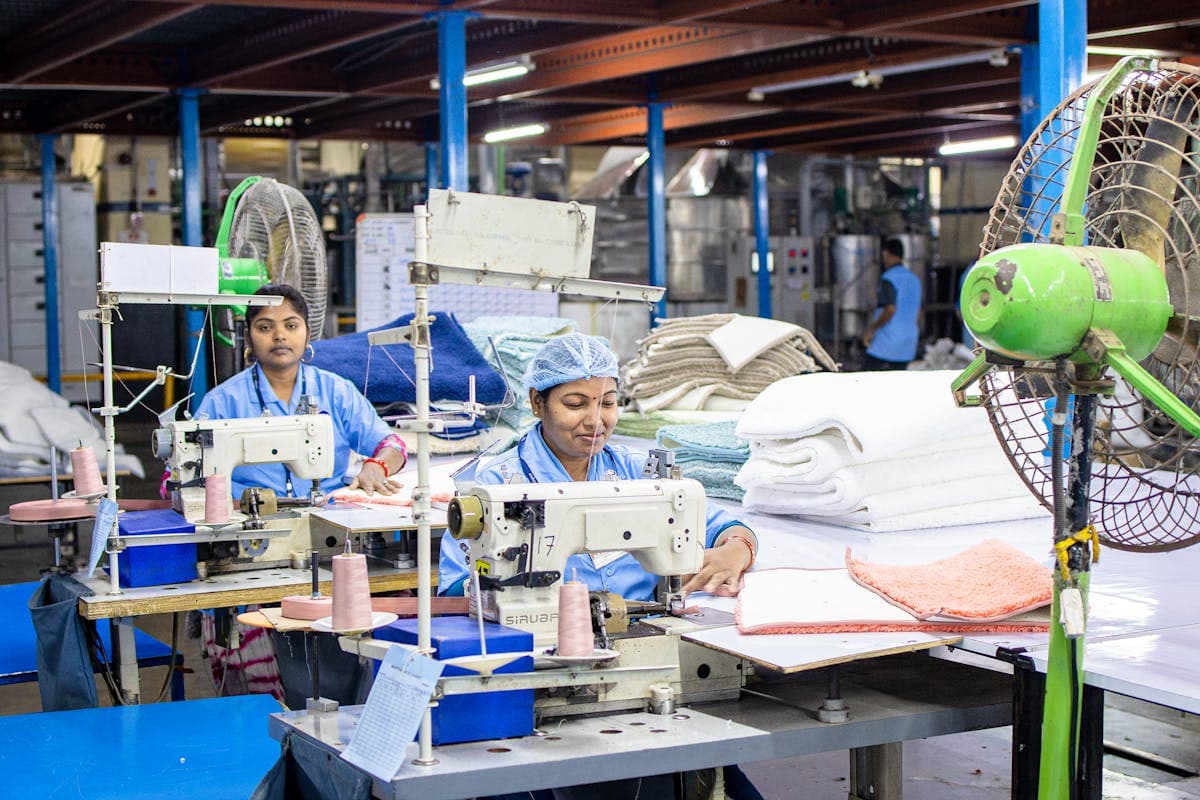
This reputation was earned. It was earned by a specific generation of tailors, most of whom started working in the 1950s through the 1980s, when Hong Kong was the undisputed center of Western-style tailoring in Asia. Many of those tailors -- the absolute legends -- have retired or passed away. Their shops continue under the next generation, and some of those successors are very good. But many shops are now running on the name recognition built by their predecessors while the actual craft has been outsourced to workshops in Shenzhen.
There is a dirty open secret in the Hong Kong tailoring industry: a significant number of "Hong Kong" suits are actually made across the border in mainland China. You get measured in the air-conditioned showroom in Tsim Sha Tsui. Your measurements and fabric choice are sent to a factory in Shenzhen or Dongguan. The suit is made there -- often by workers who are less experienced than the craftspeople in Hoi An or Bangkok -- and shipped back to Hong Kong for your final fitting. You pay Hong Kong prices for mainland Chinese production costs.
This is not unique to Hong Kong. The same dynamic exists with Western online MTM brands -- your Indochino suit is made in a factory somewhere in Asia, but you are paying for the brand, the showroom in SoHo, and the marketing budget. Hong Kong's premium shops do still make in-house, and that work is excellent. But the mid-range Hong Kong experience in 2026 is often "Chinese factory suit with a Hong Kong fitting fee."
For context, at Nathan Tailors, every garment is made by our own team of tailors in Hoi An. Not outsourced. Not sent to a factory in another city. Made in-house, under our direct supervision, by tailors who work with us full-time and whose work we see every single day.
"Bangkok Is Cheaper Though, Right?"
At the absolute bottom end, yes. You can get a suit made in Bangkok for $100-$165 that you cannot get in Hoi An at that price.
But I would seriously question whether you should.
A $100 Bangkok suit is made from synthetic or heavily blended fabric. It is fully fused. The pattern work is minimal. The fitting is a quick measure and a prayer. These suits look passable in photos and start falling apart within a few months. The chest canvas bubbles. The seams pull. The fabric pills. You have spent $100 on a garment that gives you maybe 10-15 wears before it looks like something you would not wear to your own apartment.
At the legitimate mid-range -- $300-$500 for a proper Bangkok suit in decent fabric -- the price difference with Nathan Tailors shrinks dramatically, and in many cases we are cheaper. Our suits start at $149 and our premium range tops out at $309 for our top-tier wool and wool-cashmere blends. A comparable Bangkok suit in similar fabric costs $400-$600. The gap comes mostly from Bangkok tailors' higher overhead -- higher rent, higher wages, and a tourist economy that supports higher prices.
The bottom line: Bangkok is cheaper if you want a cheap suit. It is not cheaper if you want a good suit.
The Shipping Question: What Happens When You Are 8,000 Miles Away
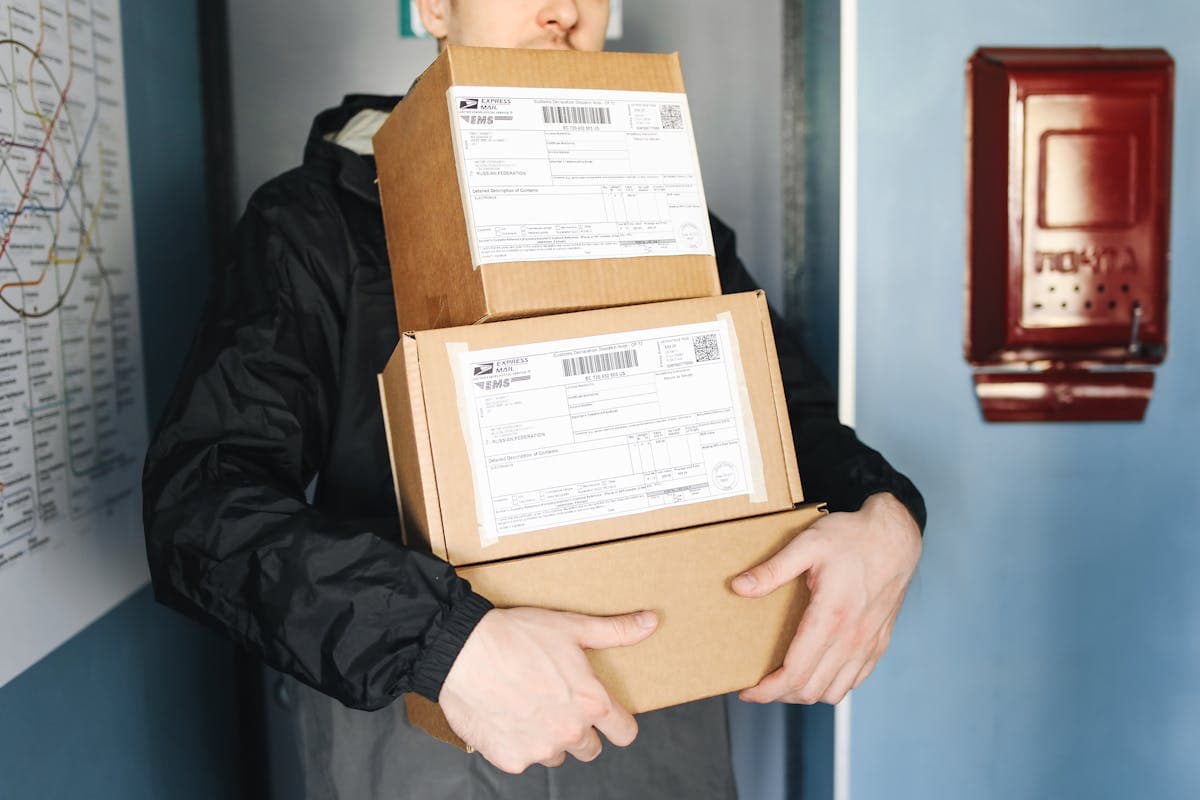
This is where Hoi An has a structural advantage that neither Hong Kong nor Bangkok can match, because we were built for remote clients from day one.
Most Hong Kong and Bangkok tailors are designed around the walk-in experience. Their business model assumes you are physically present for fittings. When you leave the city, the relationship effectively ends. If the suit does not fit when you try it on back in Brooklyn, your options are: fly back, pay a local tailor to fix it, or live with it.
Nathan Tailors ships to 50+ countries via DHL and FedEx. We have a full remote ordering process -- WhatsApp consultation, guided self-measurement, fabric selection via swatches, WhatsApp communication throughout production. We have been doing this for years. It is not an afterthought bolted onto an in-person business. It is a core part of how we operate.
And if something does not fit? We work with you on WhatsApp. Send photos when it arrives and we walk through what needs adjusting -- sometimes a quick local alteration on your end is the right call (cheaper and faster for you), sometimes a piece needs to come back. We figure out the right step together rather than promising blanket remakes we then have to walk back.
For the full process breakdown, see our guide to ordering custom clothes online.
The Real Risk Matrix: What Can Actually Go Wrong
Let me be honest about the risks of each option, because every choice carries some.
Hoi An Risks
- Choosing the wrong shop. With 500+ tailors in town, there is no shortage of mediocre operations. Many have fake reviews, aggressive touts, and no accountability. This is real. The mitigation: do your research. Check Google reviews (not Facebook or TripAdvisor, which are easier to game). Look for shops with hundreds of reviews and a consistent track record over years, not months.
- Fabric bait-and-switch. Some Hoi An shops show you Italian fabric swatches and use cheaper Vietnamese or Chinese fabric for the actual suit. Nathan Tailors lets you inspect the bolt your suit is being cut from. We also send fabric swatches to remote clients before production begins.
- Rush jobs. Tourists often want a suit made in 24 hours because they are leaving town. Reputable tailors will push back on this and ask for 3-5 days. If a shop promises overnight delivery on a custom suit, they are cutting corners. We ask for at least 2 days for in-person orders -- measurements on day one, fitting and pickup on day two -- to ensure proper construction and fittings.
Bangkok Risks
- Tuk-tuk commission scams. Widely documented. Never go to a tailor recommended by a tuk-tuk driver.
- Package deal traps. "5 suits for $500" -- the math does not work, and neither will the suits.
- No post-departure support. Most Bangkok tailors have no infrastructure for handling issues after you leave the country.
- Synthetic fabric marketed as wool. More common at the budget tier than people realize.
Hong Kong Risks
- Price premium for the name. You may be paying Hong Kong prices for Shenzhen production.
- 24-hour suit traps. Any shop promising a bespoke suit in 24 hours is selling you an altered off-the-rack garment.
- High travel cost. Even if the suit is great, the all-in cost including flights and hotel makes the per-suit price comparable to Western alternatives.
- Aggressive upselling. Walking out of a Hong Kong tourist tailor with only what you planned to buy requires genuine willpower.
Three Scenarios: Which City Is Right for You
Scenario 1: You Are Planning an Asia Trip and Want Suits Made
If your trip includes Vietnam, stop in Hoi An. Give yourself at least 3-4 days. Get measured, get fitted, get your suits. Budget $300-$600 total for 2 suits and a few shirts at Nathan Tailors. Enjoy Hoi An -- the food, the old town, the lanterns, the beach. It is one of the most beautiful small cities in Asia and the cost of being there is almost nothing.
If your trip only includes Thailand, go to a recommended mid-range Bangkok tailor. Budget $400-$700 for 2 suits. Do your research beforehand. Do not follow tuk-tuk drivers.
If your trip only includes Hong Kong, and you have a specific heritage tailor in mind and a budget of $800+ per suit, go for it. Otherwise, skip the tailoring and enjoy Hong Kong for its other merits.
Scenario 2: You Are Not Traveling Anywhere -- You Just Want Custom Suits
This is where Nathan Tailors genuinely has no competition from Bangkok or Hong Kong. We are built for remote clients. Bangkok and Hong Kong tailors are not. You can order from us from your apartment in Brooklyn without leaving your couch. Message us on WhatsApp, message us on WhatsApp, use our measurement guide, and have your suit delivered to your door via DHL in 2-4 weeks. See our full pricing menu for every garment we offer.
Scenario 3: Money Is No Object and You Want the Absolute Best
Go to Savile Row. Seriously. If budget is not a factor and you want the pinnacle of bespoke tailoring as an art form, nothing in Asia competes with the top London houses. That is an honest answer from someone who runs a value-focused tailor shop. There is a reason Savile Row has survived for 200+ years.
The Economics -- Why This Pricing Gap Exists (And Why It Is Not Closing)
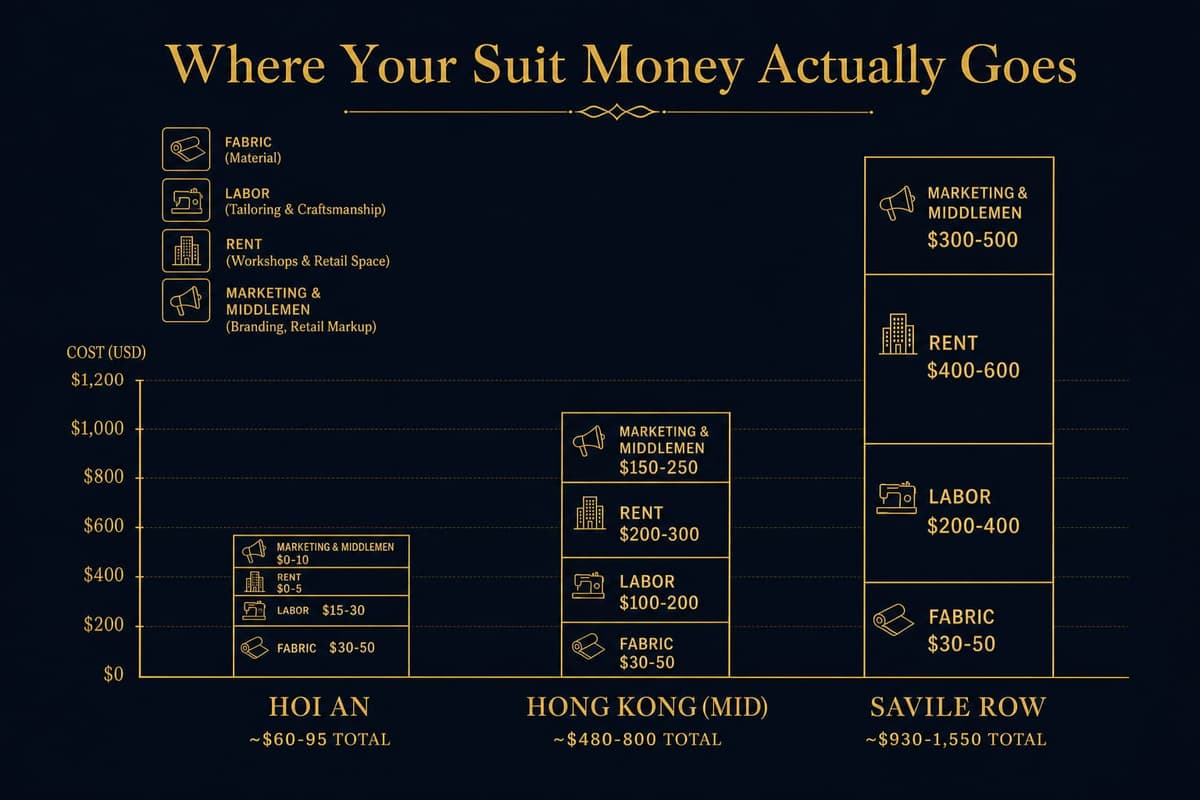
If you have read this far, you might be wondering: why is there a 5-10x price difference between essentially the same product made in different locations?
The answer is not quality. It is not fabric. It is not skill. It is overhead, labor arbitrage, and brand markup.
Here is a simplified cost breakdown for the same suit -- a two-piece in mid-range Italian wool -- made in different locations:
- Fabric cost: Roughly comparable across locations buying from similar mill tiers. About $30-$50 per suit length for mid-range Italian wool purchased in bulk. Savile Row tailors pay more through their distributor network -- often $80-$200+ for a higher-grade cloth.
- Labor cost: A skilled tailor in Hoi An earns a strong local wage. A Savile Row cutter earns $50,000-$80,000/year in one of the world's most expensive cities. A Hong Kong tailor falls somewhere in between. The labor cost per suit in Hoi An is roughly $15-$30. In London, it is $200-$400.
- Rent: Our shop in Hoi An costs a fraction of what any retail space in Hong Kong, London, or New York would cost. A Savile Row address costs $100,000-$200,000/year. A Hong Kong showroom on Nathan Road is similarly expensive. This rent gets divided across every suit made and sold in that space.
- Marketing and brand: Savile Row houses do not need to advertise -- their name is the advertisement. Online MTM brands like Indochino and Black Lapel spend millions on digital marketing, and that spend is baked into every suit price. We spend almost nothing on marketing. Our 520+ Google reviews and word of mouth do the work for us.
- Middlemen: Every time a suit passes through an intermediary -- a brand, a distributor, a showroom, a sales consultant on commission -- the price goes up 30-100%. A suit that costs $80 to produce in a Vietnamese workshop might retail for $499 with a Black Lapel label, or $149-$209 sold directly from the workshop to you.
This is not a temporary arbitrage. It is a structural economic reality that will persist as long as the cost of living in Vietnam remains a fraction of the cost of living in Hong Kong, London, or New York. And there is no indication that gap is closing anytime soon.
What Our Clients Say (The Ones Who Have Tried All Three)
I am not going to write fictional testimonials. But I can tell you the patterns I hear from the clients who have tried Hong Kong, Bangkok, and Hoi An -- because we get a lot of them.
From former Hong Kong clients: "The suit was good but I paid $900 and I could not tell the difference from what you made me for $219." Or: "I went to [famous name] and the experience was great, but when I came back for a second order they had raised prices 30% and the cutter I worked with had left." Or, less charitably: "I got absolutely ripped off at a shop near the Star Ferry and I am never making that mistake again."
From former Bangkok clients: "My first Bangkok suit was terrible -- I went to a tuk-tuk recommendation. My second was better because I did research. But it was still $450 and the fabric was not as nice as what you use." Or: "The turnaround was fast but I only got one fitting and the shoulders are off."
From repeat Nathan Tailors clients: The number that matters here is our repeat customer rate. A significant portion of our 5,000+ worldwide clients are repeat buyers. They come back for a second suit, then shirts, then trousers, then a wedding party order for their groomsmen. That does not happen if the first suit was disappointing.
Frequently Asked Questions
Can I order from Nathan Tailors without visiting Hoi An?
Yes. A large and growing percentage of our clients order entirely remotely. The process involves a WhatsApp consultation, guided self-measurement using our interactive measurement tool, fabric selection via swatches sent to your address, and regular WhatsApp updates during production. Your suit ships via DHL or FedEx with tracking and arrives in 3-5 business days after dispatch.
What if my remote order does not fit?
We work with you on WhatsApp. Send photos when the piece arrives and we walk through what needs adjusting. Sometimes the right answer is a quick local alteration on your end (cheaper and faster for you), sometimes the piece needs to come back to us. We figure out the right step together.
Is it safe to use a tailor in Hoi An I found on TripAdvisor?
Be cautious. TripAdvisor reviews in Hoi An are notoriously unreliable for tailors. Commission-based reviews, fake profiles, and shops that pay guides to leave ratings are well-documented problems. Google reviews are harder to game and more reliable. Look for shops with 100+ reviews, a consistent score over many years, and detailed reviews from verifiable accounts.
How does Nathan Tailors compare to Yaly Couture or A Dong Silk?
Yaly and A Dong are well-known Hoi An shops with good reputations. They tend to be more tourist-oriented and charge higher prices. Our prices are lower because we run a leaner operation and focus on value rather than showroom ambiance. The quality of tailoring is comparable. We recommend doing your own comparison by reading Google reviews across all three.
Do Hong Kong tailors do trunk shows in New York?
Some heritage Hong Kong tailors do periodic trunk shows in NYC, London, and other major cities. This is a great option if you want the Hong Kong tailoring experience without the travel cost. However, you will typically pay the full Hong Kong heritage price ($800-$1,500 per suit), and the fitting process is compressed into one session rather than multiple fittings.
What fabric should I choose for my first custom suit?
For most NYC professionals, a navy or charcoal suit in a fine worsted wool is the right starting point. This weight works year-round with a good lining, drapes well, and is durable enough for regular wear. We stock real wool in this range across our cloth library. For a deeper dive into fabric types, weights, and when to use each one, read our complete fabric guide.
Can I bring my own fabric?
No. We cut only from our own cloth library. It is the one way we can vouch for the fibre content, the weight and the way a cloth behaves on the table, and it keeps every order moving at the same pace. If a specific cloth from an outside mill or merchant is the whole point of your project, some other Hoi An tailors do take customer-supplied fabric, and that would be the better fit for that order.
How long should I plan to stay in Hoi An for tailoring?
We recommend a minimum of 3-4 days for in-person orders. This allows time for initial consultation and measurement (Day 1), first fitting (Day 2-3), and final adjustments and pickup (Day 3-4). If you are ordering multiple garments -- say 2 suits, shirts, and trousers -- plan for 4-5 days to ensure everything gets proper attention. Hoi An is beautiful enough that most visitors wish they had planned to stay longer anyway.
The Bottom Line
Every city has its lane:
- Savile Row is for bespoke purists with deep pockets and patience. It is the pinnacle and it earns its price. No argument.
- Hong Kong is for people with a specific heritage tailor relationship and a budget of $800+ per suit. The glory days of Hong Kong as a value destination for tailoring are fading as costs rise and many mid-range shops outsource across the border.
- Bangkok is for budget travelers who do their homework and avoid the tuk-tuk funnel. At the mid-range tier where Bangkok tailors do good work, prices overlap with premium Hoi An prices -- and you are getting comparable or lesser fabric quality.
- Hoi An (Nathan Tailors) is for people who want the best value in custom tailoring anywhere on Earth. Real fabrics from established mill suppliers, half-canvas construction (full canvas on request), 25+ years of experience, 520+ five-star reviews, full remote ordering capability, and garments cut with generous seam allowances plus a piece of the same fabric so a local tailor can adjust the fit -- all at $149-$309 per suit. There is no rational economic argument against it.
I chose to build my business here because the economics are simply irrefutable. After 10 years in the West, watching people overpay for suits that were secretly being made in Asia anyway, the idea of cutting out every middleman and selling directly to the customer at honest prices was not just a business opportunity -- it felt like the only thing that made sense.
If you are ready to see what that looks like, message us on WhatsApp. Send us your measurements, tell us what you need, and we will give you an honest quote in under 24 hours. No pressure. No upsell. Just the price, the fabric, and the timeline.
Or browse our full pricing menu and see for yourself why 5,000+ clients worldwide keep coming back.