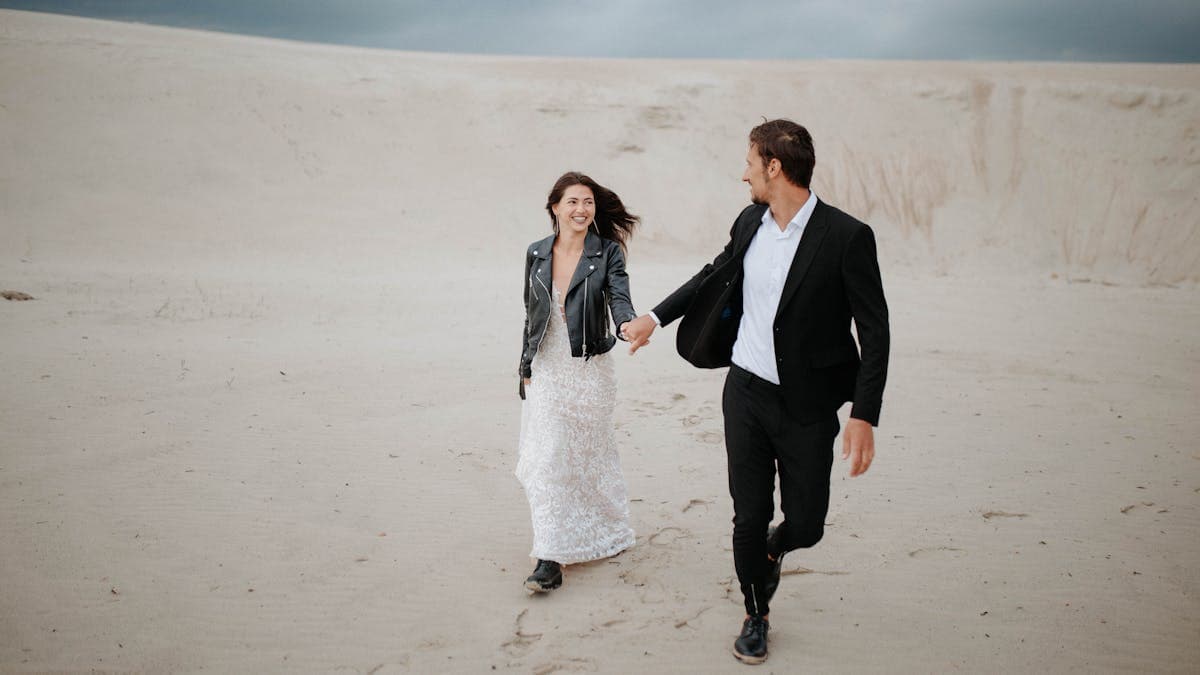
Coachella Weekend 2 is happening as I write this. Weekend 1 ended six days ago. The photo dumps, the TikTok recaps, the "best dressed" roundups -- they are still rolling through every feed I open. And while the fashion press is mostly focused on what the women wore on the main stage, something quieter is happening in the men's photos: 2016 festival fashion is back, but grown up. Linen shirts unbuttoned to the sternum. Cowboy hats that look earned instead of ironic. Bolo ties. Oversized Western belts. Turquoise. Earth tones. The skinny black jean is dead and the wide-leg cream linen trouser has replaced it.
Here is the part the Coachella recaps are missing: the same men who are photographing like this at the festival are the men getting married in Palm Springs, Joshua Tree, Sedona, and Marfa this year. And 2026 is -- by every destination wedding data point I have seen -- peak desert wedding season. The festival look and the desert-wedding look are converging. What works under string lights at a Joshua Tree ceremony is the same vocabulary that works in the Polo Fields at 4pm. That convergence is the single most useful thing I can tell you if you are a groom, a groomsman, or a guest headed west in the next six months.
I am Jay. I have spent 10 years in the US -- Pennsylvania, New York, Houston -- and I now help run Nathan Tailors in Hoi An, Vietnam. We have made wedding suits for 25+ years, we have 520+ five-star Google reviews, and we have shipped a surprising number of linen suits to zip codes that end in California, Arizona, New Mexico, and West Texas. Let me tell you what is actually working for desert weddings in 2026, what it should cost, and how to order it without ending up in a costume.
What the Desert Wedding Actually Is in 2026
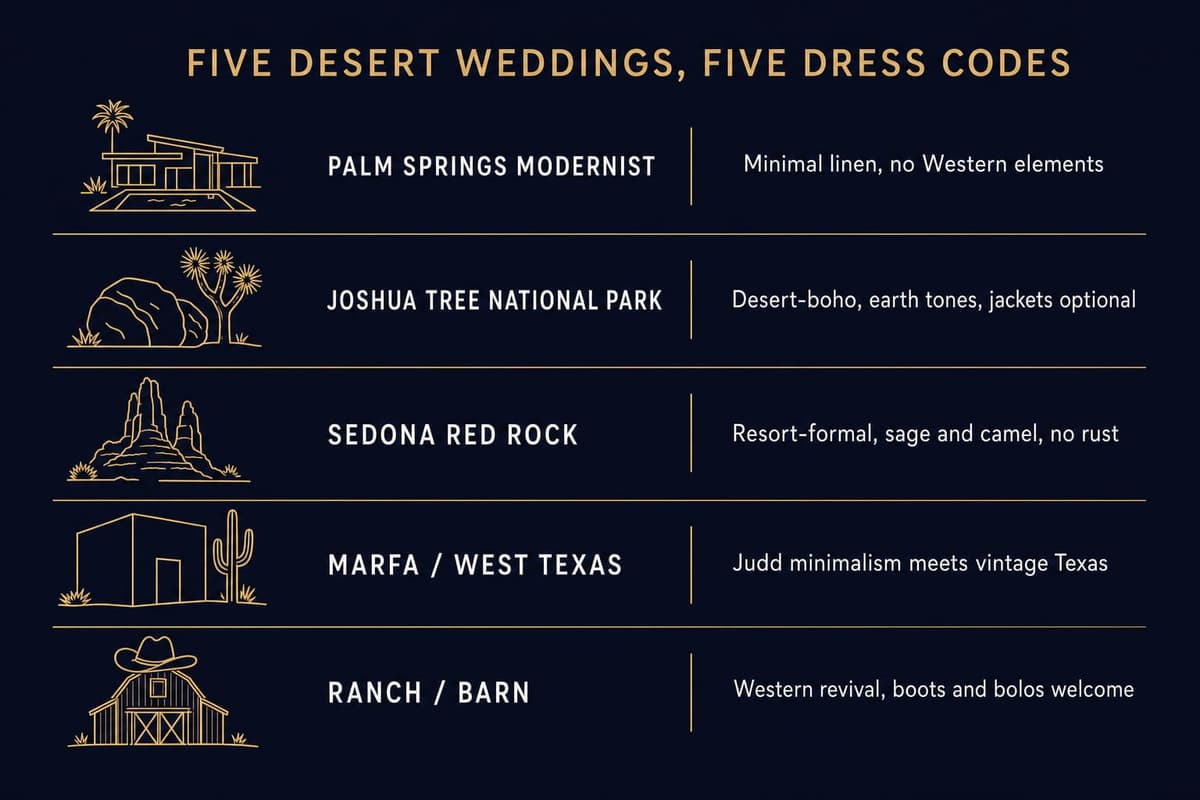
"Destination desert wedding" is not one thing. It is at least five different aesthetics sharing a climate. If you are reading this because you have an invitation in your hand, the first thing you need to figure out is which kind of desert wedding you are attending. The venue type dictates 80% of your outfit decision.
The Palm Springs Modernist Wedding
Mid-century modern houses, clean architectural lines, pool-deck ceremonies, Parker Palm Springs, Korakia Pensione, the Ace Hotel. This is a design-forward crowd. Most weddings here happen between October and May because summer temperatures hit 110 degrees Fahrenheit regularly. The vibe is "Slim Aarons meets Acne Studios." Minimal. Crisp. Intentionally undone. The aesthetic punishes anything that feels costume-y -- no bolo ties, no cowboy hats, no Western embellishment. The uniform is linen or linen-blend in sand, cream, sage, or pale terracotta.
The Joshua Tree National Park Wedding
This one is regulated. You need a Special Use Permit from the National Park Service, weddings are capped at small group sizes in designated areas, and the ceremony is usually at sunrise or sunset to avoid the heat. The boulders, the yucca, the cholla -- the landscape does all the decorating. The aesthetic here leans harder into desert-boho. Natural fibers. Earth tones. Slightly more Western energy than Palm Springs but still restrained. Jackets are often optional for the groom party. Couples are barefoot. Photographers love the golden hour light.
The Sedona Red Rock Wedding
L'Auberge, Tlaquepaque, the amphitheater at Poco Diablo, or a private ranch with the Bell Rock view. Sedona skews slightly more traditional than Joshua Tree -- there are more resort-style weddings, more formal setups, more families flying in from the Midwest. The red rock backdrop means colors need to be chosen carefully. Rust, terracotta, and orange tones clash with the landscape. Sage, cream, camel, and dusty blue photograph beautifully against red sandstone.
The Marfa / West Texas Art-Scene Wedding
Hotel Saint George, El Cosmico, the Paisano, private ranches outside town. Marfa is the most specific aesthetic of all of them -- equal parts Donald Judd minimalism and vintage Texas. The dress code is rarely formal. You will see grooms in cream linen suits next to grooms in Wrangler jeans and sport coats. Boots are welcome. Turquoise is welcome. A bolo tie at a Marfa wedding reads as correct, not costume. The photography aesthetic is sun-bleached, wide-format, and the clothes need to hold up in that visual language.
The Texas / Arizona / New Mexico Ranch or Barn Wedding
The largest category by volume. Hill Country ranches outside Austin. Fredericksburg wineries. Tucson private estates. Santa Fe adobe venues. The aesthetic leans fully into Western revival in a way the other four do not. Cowboy boots are standard. Cowboy hats appear on at least 30% of guests. Bolo ties are common. Buckles matter. The 2026 version of this wedding pulls from Beyonce's Cowboy Carter aesthetic and the Yellowstone halo effect more than from old-school country formal.
Knowing which of these five you are walking into is the whole ball game. A Palm Springs modernist suit at a Hill Country ranch will read as "guy who flew in from Los Angeles." A cowboy-hat-and-bolo setup at Parker Palm Springs will read as "guy who did not read the invitation." Get the context right first. Everything else follows.
The 2026 Desert Wedding Dress Code: Fabric, Color, and Construction
If there is one sentence to remember about dressing for any desert wedding in 2026, it is this: soft tailoring in natural fibers, earth-tone colors, minimal structure. That sentence unpacks into three decisions.
The Fabric Decision
Forget wool. Forget wool blends above 240 grams per square meter. A proper desert wedding suit lives in the 180-240 gsm range, and it is made of one of these four fabrics:
- 100% linen. The default. Breathable, forgiving of heat, and carries the exact visual texture the desert-wedding aesthetic rewards. Wrinkles are a feature, not a bug -- as I wrote in our linen suit deep dive, clean wrinkles on a well-fitted linen suit read as "relaxed sophistication." Buy a linen suit that actually fits and the wrinkle problem solves itself.
- Linen-cotton blend (60/40 or 70/30). My top recommendation for guests and groomsmen. Roughly 40% less wrinkling than pure linen, almost the same breathability, and holds shape better when you are sitting through a long ceremony or dancing into the night. This is also the fabric I would pick for a Sedona or Marfa wedding where you might move between indoor and outdoor settings three or four times.
- Raw silk (or silk-linen blend). The sleeper pick. Raw silk has an uneven, slubby texture that photographs incredibly well in golden-hour desert light. It has more sheen than linen and more drape than cotton. Slightly more formal -- think Palm Springs modernist wedding where you want "intentional" to read through the photos. Runs about $40 more than linen in our pricing.
- Open-weave tropical wool (fine worsted, under 200 gsm). The right answer when the ceremony is at 10am in 95-degree heat and you need structure to hold up through a long day. Tropical wool does not wrinkle like linen and breathes better than most men think. Under 200 gsm is the non-negotiable threshold.
The Color Decision
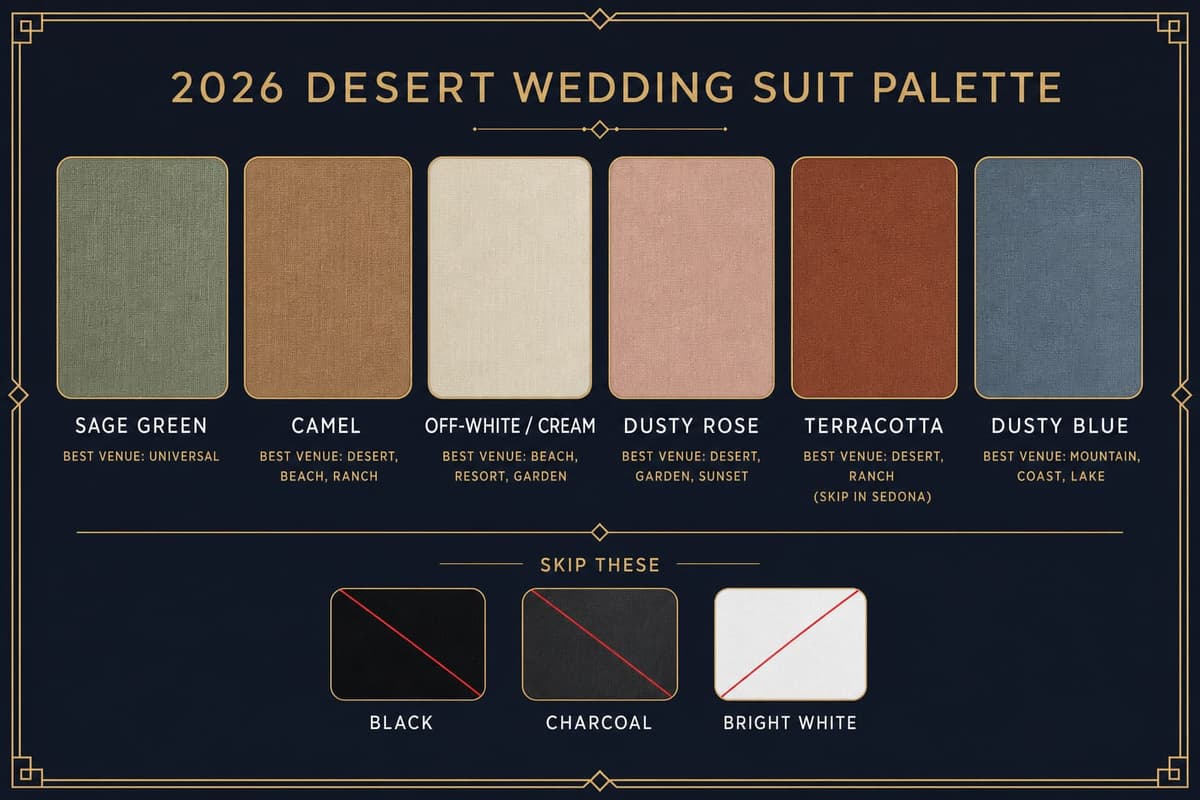
The desert tells you what colors work. You just have to listen to it.
- Sage green. The breakout color of SS26 runways, the breakout color of destination wedding Pinterest boards, and the single most-requested color at our shop this spring. Works against red rock (Sedona), against desert scrub (Joshua Tree), and against modernist architecture (Palm Springs). Universally flattering across skin tones.
- Camel / warm tan. The classic. Reads old-money in Palm Springs, reads Western at a Texas ranch, reads natural in Joshua Tree. A camel linen suit is the most versatile desert-wedding purchase you can make.
- Off-white / cream. Big risk, big reward. Requires confidence and a venue that rewards restraint (Palm Springs, Marfa). Do not wear cream if the bride has asked guests to avoid white -- that conversation supersedes any style tip.
- Dusty rose / blush. The 2026 pastel that does not read as feminine on men when the fabric is right. Works especially well in linen-silk blend. Photographs beautifully at sunset.
- Terracotta / rust. The bold move. Works perfectly in Palm Springs and Joshua Tree. Clashes with the red rock in Sedona, so skip it there. Ideal for a late-afternoon wedding when the sun is turning everything amber anyway.
- Dusty blue / slate. The other direction. If you do not want to wear an earth tone, a soft muted blue is the only color-away-from-desert-tones that still reads as correct. Avoid royal blue, navy, and anything saturated.
Colors to skip: black (reads funeral in bright sun), charcoal (same problem), bright white (too formal for the aesthetic), and anything neon, saturated, or shiny.
The Construction Decision
This is the part off-the-rack suits almost always get wrong. A desert wedding suit needs:
- Natural shoulder. No pads. No roping. No structured "Milanese" shoulder. The jacket should follow the shoulder line without adding to it. This is the single biggest construction difference between a Brooks Brothers suit and a desert-appropriate suit -- and almost no ready-to-wear brand in the US cuts a proper natural shoulder at anything under $800.
- Unlined or half-lined. A fully lined jacket in 95-degree heat is a mistake. Unlined jackets let air move through the back. Half-lined (just the upper back and sleeves) is a good compromise if you want the jacket to hold shape through a long day. Never order a desert wedding suit with a full satin lining. You will regret it at the ceremony and hate it at the reception.
- Patch pockets instead of flap pockets. Patch pockets are the casual signal. They soften the jacket visually, they read correct for outdoor ceremonies, and they photograph better than flap pockets under hard desert sun. Flap pockets are business-formal. Patch pockets are resort-formal. Know the difference.
- Soft roll lapel. A natural, slightly curled lapel edge instead of a pressed-flat lapel. This is an Italian tailoring detail that reads immediately as "custom" and "considered" instead of "rented." Ask for it specifically when you order.
- Trouser break: quarter-break or no-break. Trousers that barely touch the top of the shoe. No stack of fabric at the ankle. This is especially important with linen -- excess fabric at the hem creates accordion wrinkles that are impossible to recover from.
The Bolo Tie Question
The bolo tie is the single most charged accessory decision in the 2026 desert wedding vocabulary. It works beautifully in the right context and looks like a Halloween costume in the wrong one. Here is the honest breakdown:
- Works: Marfa weddings, Texas Hill Country ranch weddings, Arizona private estate weddings, New Mexico adobe weddings, any venue where the invitation itself leaned Western.
- Does not work: Palm Springs modernist weddings, Sedona resort weddings, any Joshua Tree ceremony where the couple is going for a minimalist desert-boho aesthetic rather than a Western one.
- The quality matters. A $20 Amazon bolo with a plastic "turquoise" slide reads as costume instantly. A $80-$150 bolo with a real silver slide and genuine stone -- Arizona turquoise, Navajo-made, or modern minimalist with a matte silver or bone slide -- reads as considered. If you cannot spend the money on a real one, skip the bolo entirely and wear an open collar.
- The shirt matters. A bolo works over a white or cream Western-cut shirt with pearl snaps, or over a linen shirt with a one-piece spread collar. It does not work over a standard business dress shirt with a stiff collar.
Four Desert Wedding Looks, With Prices
Let me get specific. Here are four concrete outfits I would build for four different desert wedding scenarios, with full pricing from our menu. To see any of these palettes rendered across the full wedding party — groom, bride, groomsmen, bridesmaids, the Joshua Tree backdrop and the fabric swatches — try our free desert wedding attire mood board; pick "desert" as the venue and "terracotta & sand" as the palette and the rest is automatic.
Look 1: The Palm Springs Modernist Groom -- $228
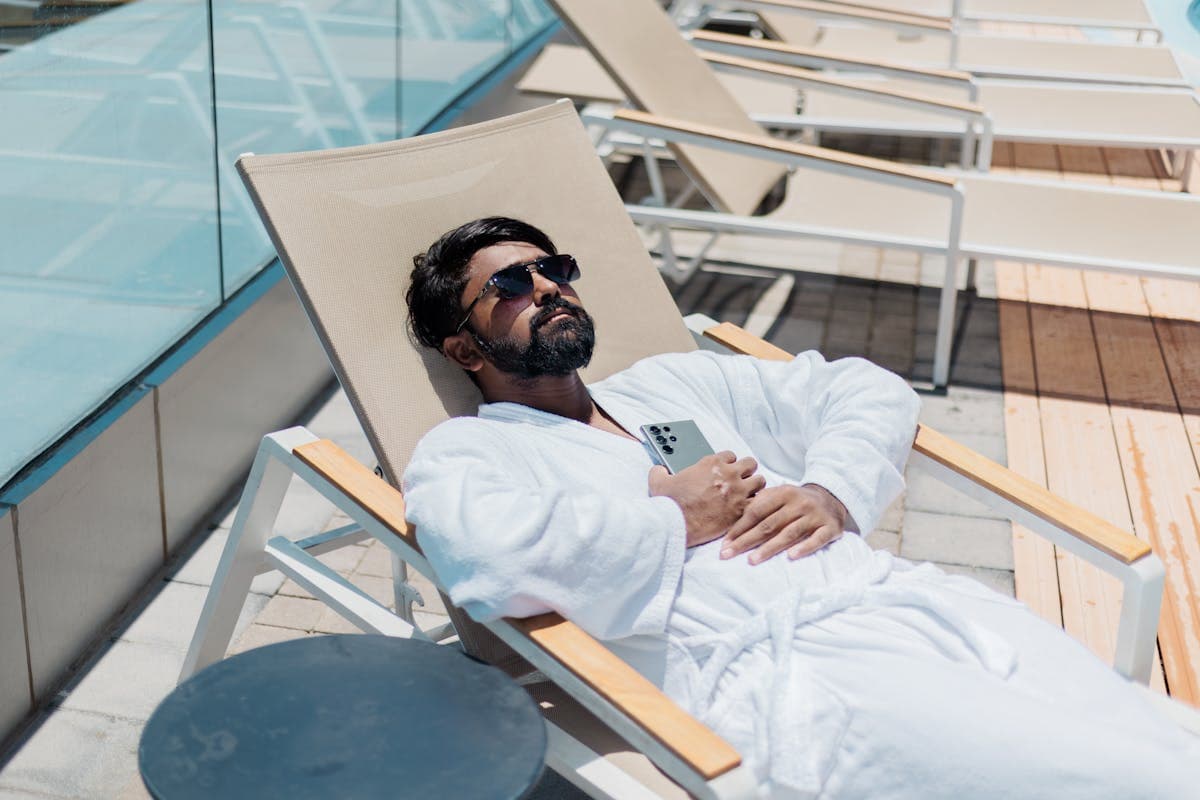
A Parker Palm Springs ceremony at 5pm, reception by the pool, black-tie optional but the couple has clearly signaled a relaxed interpretation. You are the groom. You want to photograph like you belong in the architectural frame.
- Sage green linen-silk suit, two-piece. Single-breasted, two-button, natural shoulder, unlined, patch pockets, soft roll lapel. The silk in the blend adds a subtle sheen that reads well in sunset photos. $189.
- White linen dress shirt, spread collar, French cuff. Not the business-spread. A softer, slightly longer point collar that works with and without a tie. $39.
- Accessories to bring: Simple tan suede loafers (own-them already, not part of our pricing). No tie -- open collar with a single button undone. Optional pocket square in cream or blush silk.
- Trouser-only alternative for groomsmen: Matching sage linen trousers + cream shirt, no jacket. $108.
- What this replaces: A SuitSupply Havana linen-blend in a comparable color runs $798 off-the-rack plus $150+ in alterations to get the fit right. The Brunello Cucinelli sage green linen suit that populates the Palm Springs Pinterest boards is $4,800.
Look 2: The Joshua Tree Officiant -- $208
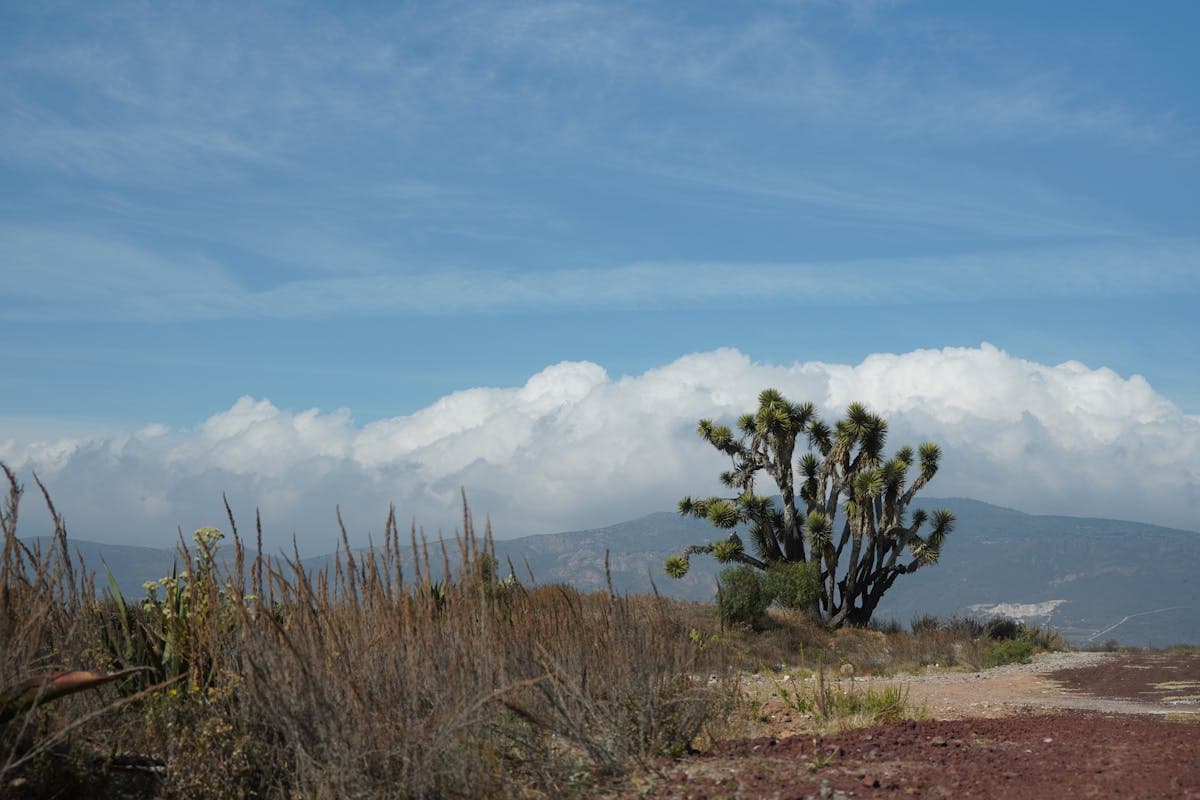
Your best friend asked you to officiate. The ceremony is at sunrise because the park permit requires it. You are standing on a boulder in the Hidden Valley area. The photos will live on your friend's wall for the next 40 years.
- Camel linen-cotton blend suit, unlined, patch pockets. Slightly cropped jacket length to photograph well from below (since the photographer will be shooting up at you on the rock). $169.
- Cream linen button-down shirt, one-piece collar. No tie. Two buttons undone. $39.
- Brown leather belt, brown suede chukka or Chelsea boot. Your own. Boots -- not loafers -- because you are walking on actual desert terrain.
- Wool felt hat (bring one). A tan or bone wool felt wide-brim hat with a leather band. Optional, but it reads correctly at Joshua Tree and saves your face from the sun. Skip the straw Panama here -- felt reads more considered in this context.
- Wedding band, leather-strap watch, nothing else. The landscape is the accessory.
Look 3: The Texas Hill Country Ranch Groomsman -- $208
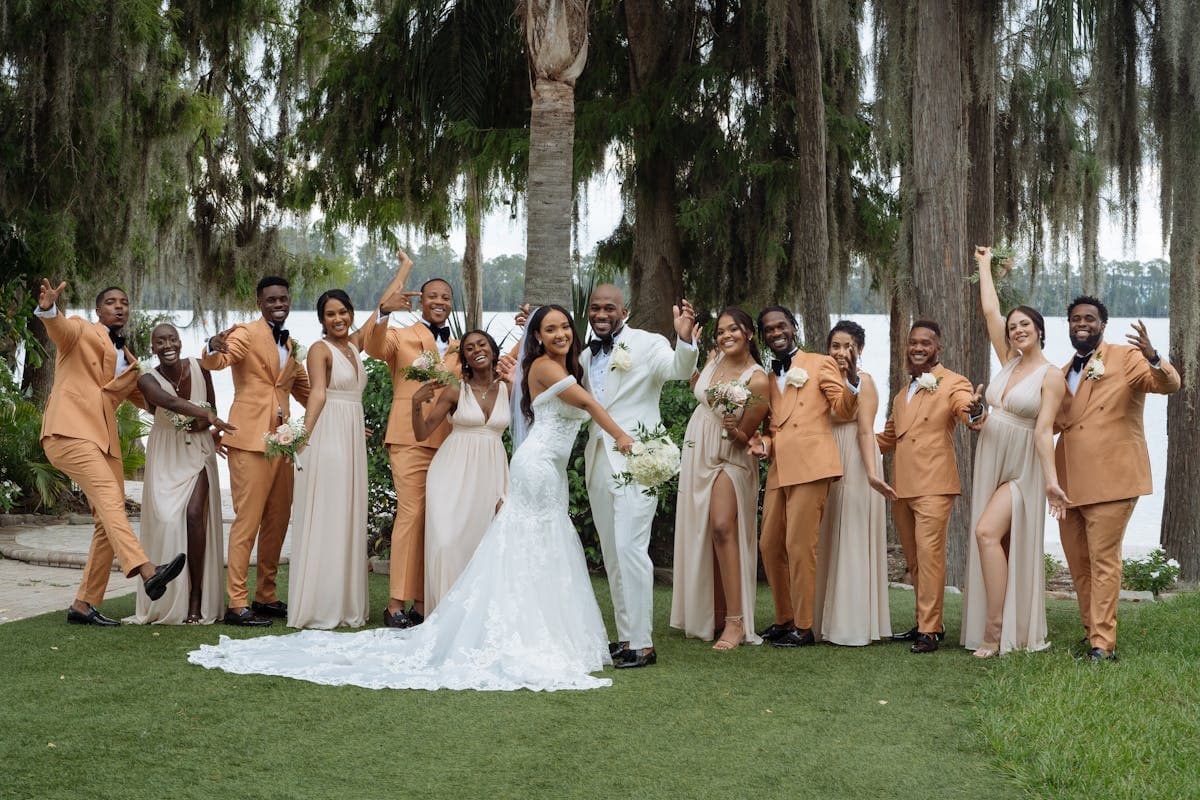
A Fredericksburg vineyard or a Dripping Springs ranch. Reception in a barn with string lights. Cowboy boots are standard. The bride has put the groomsmen in coordinated attire and sent you a color palette.
- Warm tan linen suit, unlined, natural shoulder, patch pockets. Pairs with the Western context without being too "costume." $169.
- White Western-cut shirt with pearl snaps. (If the bride has specified this -- and many Texas ranch weddings do -- she will send you a link to a $50-$80 shirt brand like Wrangler Retro or Tecovas. Skip our shirt in this case.)
- Or a cream linen shirt with a spread collar, open at the neck. $39.
- Bolo tie (optional). If the groom party is going bolo, a $80-$120 authentic turquoise-and-silver bolo is the move. Not ordered from us -- buy from a vetted source like Sky Stone Trading or a Santa Fe gallery.
- Cowboy boots. Your own. If you do not own boots and the wedding requires them, Tecovas or Lucchese are the two defensible purchases. Budget $300-$600.
- Why this works: The tan linen suit reads as "deliberately Western without being costume." You blend with the groom party without disappearing. Post-wedding, the same suit works for every summer wedding, every outdoor rehearsal dinner, and every rooftop event for the next five years.
Look 4: The Marfa Art-Scene Groom -- $254
El Cosmico, a private ranch outside town, or a courtyard ceremony at the Hotel Saint George. You want the outfit to land in the exact middle of Donald Judd minimalism and vintage Texas. This is the hardest desert wedding to dress for because the margin between "correct" and "too much" is thin.
- Off-white linen suit, unlined, patch pockets, soft roll lapel. Cream rather than stark white. $209.
- Dusty blue linen band-collar shirt. No tie ever. The band collar is the Marfa signal. $45.
- Silver bolo tie with a minimalist slide (bone, stone, or matte silver). Not turquoise, which reads too Santa Fe. Matte neutral slide reads Donald Judd. Budget $100-$180 from a New Mexico or West Texas gallery. Not included in our pricing.
- Plain brown leather belt, roper boots or minimal leather loafers. Your own.
- Vintage watch (or no watch). Nothing sporty. Nothing digital.
- The rule: If you are looking at your reflection and thinking "this is a lot," remove one item. Marfa rewards subtraction.
The Guest Mini-Section: What You Actually Need
If you are a guest, not the groom or a groomsman, the assignment is easier: match the aesthetic without competing with it. Here is the short version:
- Default guest outfit: Linen sport coat (tan, cream, or sage) + dress trousers or fitted chinos + linen shirt + loafers. $227-$387 total from us. Infinitely reusable.
- Do not out-match the groom party. If the groomsmen are in sage green, do not also wear sage green. If they are in cream, pick camel. Your job is to complement the palette, not join it.
- Bring layers. Desert temperatures swing 30+ degrees between afternoon ceremony and midnight reception. A linen sport coat over a shirt gives you both options.
- Boots vs. loafers: If you own cowboy boots and the wedding is Texas, Arizona, or New Mexico -- bring them. If you do not own boots, do not buy them for a single wedding. Tan suede loafers work at every one of the five desert wedding types.
- Read the invitation. "Black tie optional" in Palm Springs is different from "black tie optional" in Marfa. Err toward the aesthetic of the venue, not the formal phrase on the card.
The Cost Comparison: Why Ready-to-Wear Does Not Work for This
| Look | SuitSupply / Ralph Lauren / Brooks Brothers | Designer (Brunello Cucinelli, Zegna, The Row) | Nathan Tailors (Custom) |
|---|---|---|---|
| Palm Springs sage linen-silk suit + shirt | $798-$950 + $150 alterations | $4,800-$6,200 | $228 |
| Joshua Tree camel linen-cotton suit + shirt | $649-$798 + $150 alterations | $3,200-$4,500 | $208 |
| Texas ranch tan linen suit + shirt | $598-$798 + $150 alterations | $2,800-$3,800 | $208 |
| Marfa off-white linen suit + band-collar shirt | $798-$950 + $150 alterations | $3,800-$5,400 | $254 |
| Fit type | Off-the-rack, mannequin fit | Off-the-rack, Italian sizing | Made to your measurements |
| Patch pockets / natural shoulder / soft roll lapel | Rarely available off-the-rack | Yes, at a 15x markup | Standard, no upcharge |
A custom Palm Springs sage linen-silk suit from Nathan Tailors costs less than the tailoring bill alone on a Brunello Cucinelli. The fabric is real linen-silk from established mill suppliers -- we are not going to name-drop specific heritage mills, because for a Vietnam workshop those claims are usually marketing fiction. The construction details (patch pockets, natural shoulder, unlined, soft roll lapel) are standard for us, not upcharges. We are not pretending our cloth tier matches Brunello's -- it does not -- but the overhead gap (Tran Hung Dao Street vs Madison Avenue) is where most of the price gap lives.
Timeline: How to Order in Time for a 2026 Desert Wedding
Most destination desert weddings happen in October-November and March-May, when temperatures are manageable. If your wedding is in that window, here is the realistic timeline:
- 8+ weeks out: Ideal. Message us with the venue, the date, and the color palette. We send fabric swatches by DHL if you want them in hand, which adds 5-7 days.
- 5-6 weeks out: Comfortable. Standard production (3-4 working days) plus 6-8 days DHL Express gives you time for a fit check and minor adjustments.
- 3-4 weeks out: Doable. Skip the physical swatches, pick from high-resolution photos, rush production if needed.
- Under 3 weeks: Message us first. We will tell you honestly whether we can make the deadline. We would rather you know now than chase your package at DHL the morning of the ceremony.
The Supply Chain Economics (Short Version)
Every article I write ends with some version of this section because it is the actual answer to "how are your prices real." Here it is for desert wedding suits specifically:
- Fabric. Real linen and linen blends from established mill suppliers. We are not name-dropping specific heritage mills -- for a Vietnam workshop that game is usually marketing fiction. We buy direct from our supplier network. No US distributor markup.
- Labor. Our tailors in Hoi An have 10-25 years of experience. Hoi An has been a textile center for 400 years -- this is not improvised. Our tailors are paid well by local standards; the cost-of-living differential does the rest.
- Volume. Because our prices are low, we see more customers. Because we see more customers, our tailors cut more linen suits in a month than a good local US tailor cuts in a year. That pattern recognition -- knowing how a specific linen-silk blend behaves on a 42R with narrow shoulders -- is the single biggest determinant of fit quality. Experience compounds.
- No storefront tax. No Madison Avenue rent, no sponsorship of polo tournaments, no glossy catalog. Just a workshop, WhatsApp, DHL, and 520+ five-star reviews.
The Footwear Question: Boots, Loafers, or Something Else
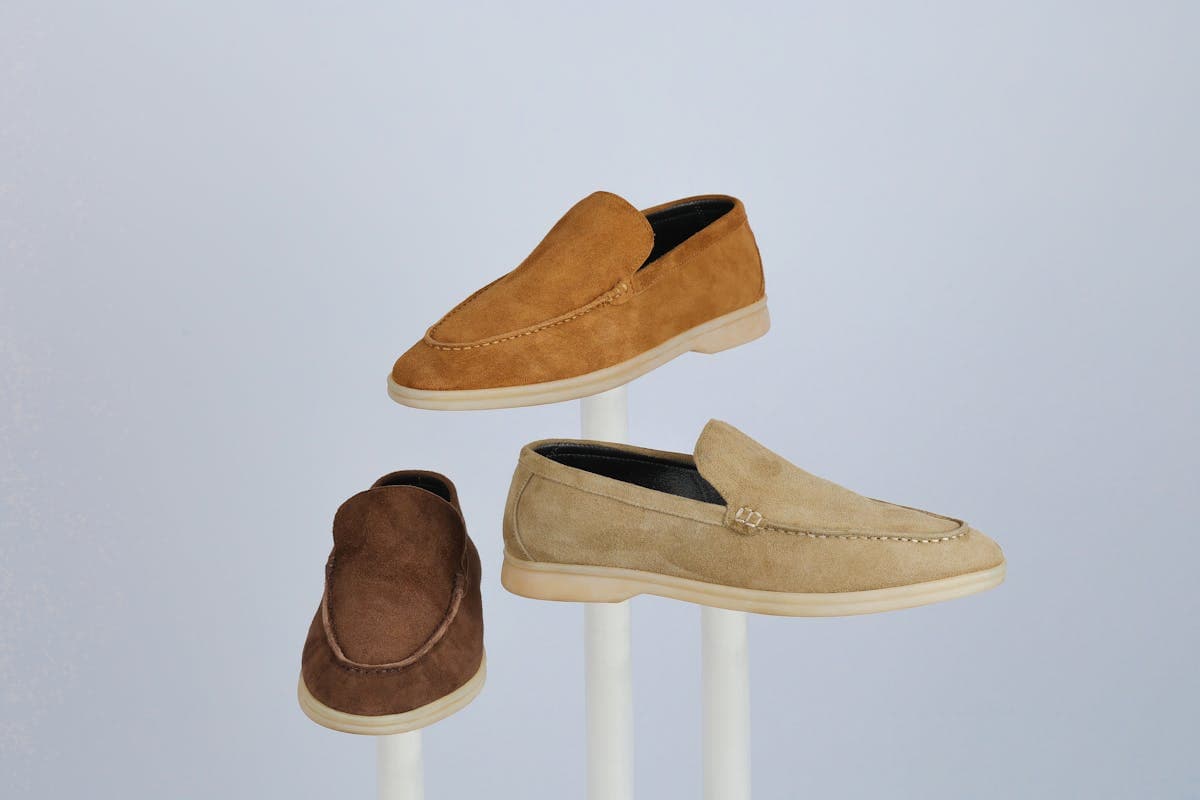
Footwear decides more than you think. The wrong shoe kills a great desert-wedding outfit faster than anything else on the list. The right shoe lets a cheap outfit look considered. Here is the honest breakdown by venue:
- Palm Springs modernist wedding: Tan or cognac suede loafers. Penny, tassel, or bit. Brown leather if suede is not available. Avoid black. Avoid anything with heavy rubber soles. Hard leather soles read too formal against a pool deck -- Blake-stitched or crepe-bottom loafers are the sweet spot. Budget $150-$400 if buying new (Meermin, Allen Edmonds, Myrqvist are the value picks; Edward Green and John Lobb are the luxury picks).
- Joshua Tree or any national park ceremony: Chukka boots or Chelsea boots in brown suede. You are walking on actual desert terrain with sand, small rocks, and uneven footing. Loafers will not survive. Hiking boots read as costume. Suede chukkas -- specifically the Clarks Desert Boot and its descendants -- were literally invented for this. $140-$260.
- Sedona resort wedding: Brown leather derbies or monk straps. Slightly more formal than Palm Springs because the crowd skews more traditional. A plain-toe blucher in cognac is the most versatile choice. Skip wingtips -- too much visual detail against the red rock backdrop.
- Marfa art-scene wedding: Roper boots (short, unadorned leather pull-on boots) or minimalist loafers. No visible brand logos. No Tecovas boots with heavy embroidery -- too Texas-tourist. The Marfa signal is "I own this boot because I needed a boot, not because I am dressing Western."
- Texas / Arizona / New Mexico ranch wedding: Actual cowboy boots, and they need to fit you already. If you do not own boots and the wedding requires them, Tecovas The Cartwright ($235) or Lucchese Hi-Line ($400-$800) are the defensible entry points. Do not order novelty boots from Amazon. The groom and his family will know.
One universal rule: your shoes must be broken in before the wedding. Desert venues mean walking -- across sand, across rocks, across an outdoor ceremony site that is often 50+ yards from parking. A brand-new pair of loafers is a blister waiting to happen. Wear them for at least two weekends before the event.
What the Groom's Father and the Officiant Should Wear
A section nobody writes because it feels niche, but I get this question constantly from clients. Roles dictate subtle dress code differences:
- The groom's father: Should coordinate with the groom party but pull one notch more formal. If the groom is in sage linen, the father of the groom is in camel or cream linen with a silk tie (where the groom goes no-tie). If the groom is in a shirt-and-trousers only, the father wears a sport coat too. The goal is "more formal than the groomsmen, less formal than the groom." Budget $189-$259 for a full custom setup from us.
- The officiant (non-religious, friend doing the ceremony): Match the wedding aesthetic closely but stay neutral in color. Off-white, cream, or pale gray linen reads well on camera because it contrasts with the couple without competing. A pocket square is a nice touch. Avoid patterns -- you are framed with the couple for the entire ceremony and a busy jacket pulls focus from them.
- The officiant (religious, in vestments): Most religious officiants wear their own vestments over whatever they choose underneath. No style advice needed -- their tradition handles it.
- Ring bearer (adult): If the ring bearer is an adult groomsman, dress code is identical to the rest of the groom party. If the ring bearer is a child, the family handles that and you are not involved.
Four Things That Will Ruin a Desert Wedding Outfit
The failure modes are consistent. I have seen all four repeatedly.
- Full polyester lining. A fully lined jacket in 95-degree desert heat is a physical discomfort and a visual one -- you will sweat through the lining and the stain will show on the outside of the jacket by reception. This is not hypothetical. I have received photos from customers at Palm Springs weddings in August who regretted their SuitSupply fully-lined purchase within 45 minutes of the ceremony.
- Black or dark charcoal. Reads as funeral in photographs taken at 5pm in bright desert sun. The camera compresses the brightness of the background against the darkness of a black suit and you end up looking like a shadow in everyone's group photos for the rest of their lives.
- Shoes that do not match the terrain. Patent leather oxfords at a Joshua Tree ceremony. White sneakers at a Palm Springs pool deck wedding. Flip-flops at a Marfa ranch. Match the shoe to the ground the ceremony happens on.
- Trying to be "the most Western" guest. The guest who shows up at a Texas ranch wedding in a full head-to-toe Western costume -- boots, hat, bolo, buckle, Western-cut jacket, string tie -- reads as a tourist no matter how expensive each piece is. Pick one or two Western elements and let the rest of the outfit be restrained. Subtraction is the move.
A Note on the Coachella Effect
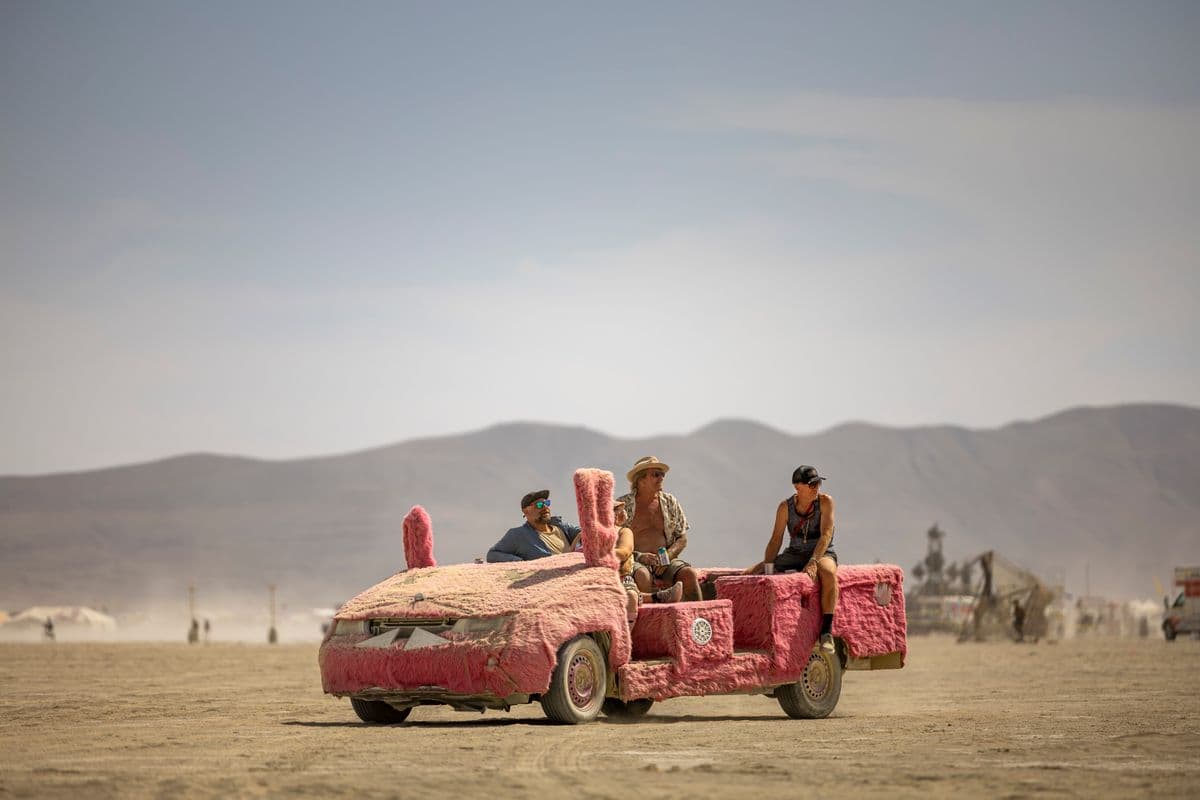
I started this piece talking about Coachella because the convergence is real. The men photographing well at the festival right now -- linen-on-linen, earth tones, unstructured tailoring, the occasional carefully-chosen Western element -- are working from the same aesthetic vocabulary that Palm Springs wedding photographers are building Instagram portfolios around. What reads as "festival cool" in April reads as "considered destination-wedding guest" in October. Same language. Slightly different dialect.
Which means: if you buy a sage green linen suit for a July desert wedding, you will also wear it to Coachella next year, to a rooftop dinner in August, to a garden party in September, and to every outdoor event in your rotation for the next five summers. The cost-per-wear math on a good desert wedding suit is better than almost any other purchase in a man's wardrobe because the aesthetic keeps paying off.
That is why I wanted to write this now, in the middle of Coachella Weekend 2, while the visual vocabulary is in everyone's feed. The moment is available. The wedding season is here. And the math -- for once -- actually works in your favor.
FAQ: Desert Wedding Suits in 2026
Is linen really okay for a wedding, or will I look too casual?
Linen is the correct fabric for an outdoor wedding in a warm climate. "Too casual" is a fit problem, not a fabric problem. A well-fitted linen suit with proper construction (natural shoulder, patch pockets, soft roll lapel) photographs as sophisticated and intentional. A poorly fitted linen suit photographs as slept-in. The difference is whether the suit was made for your body.
Can I wear the same suit to Coachella and to a friend's Palm Springs wedding?
Yes, with one adjustment. At Coachella, you would wear it open -- linen trousers and a linen shirt with the jacket slung over your shoulder, sneakers, sunglasses, relaxed posture. At the wedding, you wear it buttoned, with loafers, a tucked shirt, and a pocket square. Same suit, two different registers. This is exactly the cost-per-wear logic the piece is built around.
What is the average temperature at these desert weddings?
Palm Springs in October-November averages 75-85 degrees Fahrenheit daytime, cool nights. Joshua Tree swings wildly -- sunrise ceremonies are often 55-65, afternoons hit 90. Sedona stays milder, 70-80 in peak wedding season. Marfa is hot -- plan for 85-95 in the wedding months. Texas Hill Country ranges 75-90 in spring and fall. All of these justify linen or a linen blend.
Can I really get a custom wedding suit in 3 weeks?
Yes. Standard production is 3-4 working days. DHL Express to the US is 6-8 days. Total door-to-door on express is about 2 weeks from the day you place the order, and around 3 weeks is typical with standard shipping. For anything tighter, message us on WhatsApp first -- we will tell you honestly whether we can make the date before you commit.
What if I need to do a fitting?
We build generous seam allowance into every garment, and each piece ships with a swatch of the same fabric, so a local tailor in your city can adjust the fit if needed. The overwhelming majority of orders fit right from the measurements alone. If something is off, send us photos and we will help you find the right fix.
Can you make matching suits for the whole groom party?
Yes -- this is actually a core part of what we do. For groomsman sets of 4+, we coordinate color, fabric, and fit across all suits, and we can ship individually to each groomsman's address worldwide. Message us on WhatsApp with the count, the sizes, and the color palette.
Headed to a desert wedding this year? Message us on WhatsApp with the venue, the date, and the aesthetic (send us the invitation photo if you have it). We will recommend the right fabric, the right color, and the right construction for your specific desert -- and have the suit at your door in 3 weeks. Custom linen suits from $169. Full guest kits from $208. Over 420 five-star reviews. See our full pricing menu, follow our measurement guide, or read more on destination wedding planning, linen suits for Summer 2026, and what to wear to summer weddings in 2026.